A generalized function, also called a "distribution" or "ideal function," is the class of all regular sequences of particularly well-behaved functions equivalent to a given regular sequence. As its name implies, a generalized function is a generalization of the concept of a function. For example, in physics, a baseball being hit by a bat encounters a force from the bat, as a function of time. Since the transfer of momentum from the bat is modeled as taking place at an instant, the force is not actually a function. Instead, it is a multiple of the delta function. The set of distributions contains functions (locally integrable) and Radon measures. Note that the term "distribution" is closely related to statistical distributions.
Generalized functions are defined as continuous linear functionals over a space of infinitely differentiable functions such
that all continuous functions have derivatives which are themselves generalized functions.
The most commonly encountered generalized function is the delta
function. Vladimirov (1971) contains a nice treatment of distributions from a
physicist's point of view, while the multivolume work by Gel'fand and Shilov (1964abcde)
is a classic and rigorous treatment of the field. A result of Schwarz shows that
distributions can't be consistently defined over the complex numbers  .
.
While it is possible to add distributions, it is not possible to multiply distributions when they have coinciding singular support. Despite this, it is possible to take
the derivative of a distribution, to get another distribution.
Consequently, they may satisfy a linear partial
differential equation, in which case the distribution is called a weak solution.
For example, given any locally integrable function  it makes sense to ask for solutions
  of Poisson's equation
 |
(1) |
by only requiring the equation to hold in the sense of distributions, that is, both sides are the same distribution. The definitions of the derivatives of a distribution
 are given by
Distributions also differ from functions because they are covariant, that is, they push forward. Given a smooth function  , a distribution
 on
on  pushes forward to a distribution on
  . In contrast, a real function
  on
on  pulls back to a function on
  , namely
  .
.
Distributions are, by definition, the dual to the smooth functions of compact support, with a particular
topology. For example, the delta
function  is the linear functional
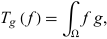
  . The distribution corresponding to a function
 is
is
 |
(4) |
and the distribution corresponding to a measure  is
is
 |
(5) |
The pushforward map of a distribution  along
along  is defined by
 |
(6) |
and the derivative of  is defined by
  where
where  is the formal adjoint of
  . For example, the first derivative of the delta
function is given by
. For example, the first derivative of the delta
function is given by
![d/(dx)[delta(f)]=-(df)/(dx)|_(x=0).](https://txtdot.deep-swarm.xyz/proxy/img?url=https%3A%2F%2Fmathworld.wolfram.com%2Fimages%2Fequations%2FGeneralizedFunction%2FNumberedEquation5.svg) |
(7) |
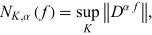
As is the case for any function space, the topology determines which linear functionals are continuous, that is, are in the dual vector space. The topology is defined by the family of seminorms,
 |
(8) |
where sup denotes the supremum. It agrees with the C-infty topology on compact subsets. In this
topology, a sequence converges,  , iff there is a compact set
 such that all
  are supported in
  and every derivative
  converges uniformly to
  in
in  . Therefore, the constant function 1 is a distribution, because
if
. Therefore, the constant function 1 is a distribution, because
if  then
then
 |
(9) |
See also
Convolution, Delta Function, Delta Sequence, Fourier Series, Functional, Linear Functional
Related Wolfram sites
http://functions.wolfram.com/GeneralizedFunctions/
This entry contributed by Todd Rowland
Explore with Wolfram|Alpha
References
Brychkov, Yu. A. and Prudnikov, A. P. Integral Transforms of Generalized Functions. New York: Gordon and Breach, 1989.Gel'fand, I. M. and Shilov, G. E. Generalized Functions, Vol. 1: Properties and Operations. New York: Academic Press, 1964a.Gel'fand, I. M. and Shilov, G. E. Generalized Functions, Vol. 2: Spaces of Fundamental and Generalized Functions. New York: Academic Press, 1964b.Gel'fand, I. M. and Shilov, G. E. Generalized Functions, Vol. 3: Theory of Differential Equations. New York: Academic Press, 1964c.Gel'fand, I. M. and Shilov, G. E. Generalized Functions, Vol. 4: Applications of Harmonic Analysis. New York: Academic Press, 1964d.Gel'fand, I. M. and Shilov, G. E. Generalized Functions, Vol. 5: Integral Geometry and Representation Theory. New York: Academic Press, 1964e.Kanwal, R. P. Generalized Functions: Theory and Technique, 2nd ed. Boston, MA: Birkhäuser, 1998.Vladimirov, V. S. Equations of Mathematical Physics. New York: Dekker, 1971.
Referenced on Wolfram|Alpha
Cite this as:
Rowland, Todd. "Generalized Function." From MathWorld--A Wolfram Resource, created by Eric W. Weisstein. https://mathworld.wolfram.com/GeneralizedFunction.html