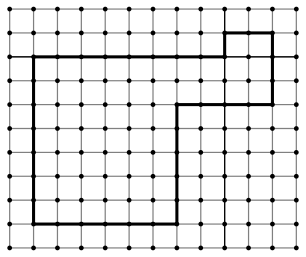
A plane path on a set of equally spaced lattice points, starting at the origin, where the first step
is one unit to the north or south, the second step is two units to the east or west,
the third is three units to the north or south, etc., and continuing until the origin is again reached. No crossing or backtracking is allowed.
The simplest golygon is (0, 0), (0, 1), (2, 1), (2,  ), (
), ( ,
,
 ), (
), ( ,
,  ),
(
),
( ,
,  ), (
), ( ,
0), (0, 0).
,
0), (0, 0).
A golygon can be formed if there exists an even integer  such that
(Vardi 1991). Gardner proved that all golygons are of the form  .
The number of golygons of length
.
The number of golygons of length  (even), with each initial direction
counted separately, is the product of the coefficient
of
(even), with each initial direction
counted separately, is the product of the coefficient
of  in
in
 |
(3) |
with the coefficient of  in
in
 |
(4) |
The number of golygons  of length
  for the first few
  is therefore 4, 112, 8432, 909288, ... (OEIS A006718),
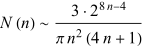
and is asymptotic to
is therefore 4, 112, 8432, 909288, ... (OEIS A006718),
and is asymptotic to
 |
(5) |
(Sallows et al. 1991, Vardi 1991).
See also
Canonical Polygon, Lattice Path, Lattice Polygon
Explore with Wolfram|Alpha
References
Dudeney, A. K. "An Odd Journey Along Even Roads Leads to Home in Golygon City." Sci. Amer. 263, 118-121, July 1990.Sallows, L. C. F. "New Pathways in Serial Isogons." Math. Intell. 14, 55-67, 1992.Sallows, L.; Gardner, M.; Guy, R. K.; and Knuth, D. "Serial Isogons of 90 Degrees." Math Mag. 64, 315-324, 1991.Sloane, N. J. A. Sequence A006718/M3707 in "The On-Line Encyclopedia of Integer Sequences."Smith, H. J. "Golygons." http://www.geocities.com/hjsmithh/Golygons.html.Vardi, I. "American Science." §5.3 in Computational Recreations in Mathematica. Redwood City, CA: Addison-Wesley, pp. 90-96, 1991.
Referenced on Wolfram|Alpha
Cite this as:
Weisstein, Eric W. "Golygon." From MathWorld--A Wolfram Resource. https://mathworld.wolfram.com/Golygon.html