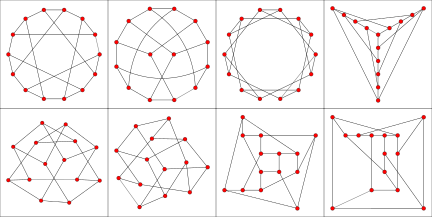
The Heawood graph is a cubic graph on 14 vertices and 21 edges which is the unique (3,6)-cage graph.
It is also a Moore graph. It has graph
diameter 3, graph radius 3, and girth
6. It is cubic symmetric, nonplanar,
Hamiltonian, and can be represented in LCF
notation as ![[5,-5]^7](https://txtdot.deep-swarm.xyz/proxy/img?url=https%3A%2F%2Fmathworld.wolfram.com%2Fimages%2Fequations%2FHeawoodGraph%2FInline1.svg) .
The Heawood graph is illustrated above in a number of embeddings.
.
The Heawood graph is illustrated above in a number of embeddings.
The Heawood graph is isomorphic to the generalized hexagon  ,
Knödel graph
,
Knödel graph  , and honeycomb
toroidal graph
, and honeycomb
toroidal graph  .
The line graph is the generalized
hexagon
.
The line graph is the generalized
hexagon  .
.
It has chromatic number 2 and chromatic polynomial

Its graph spectrum is  .
.
It is 4-transitive, but not 5-transitive (Harary 1994, p. 173).
The Heawood graph is one of eight cubic graphs on 14 nodes with smallest possible graph crossing
number of 3 (another being the generalized
Petersen graph  ),
making it a smallest cubic crossing
number graph (Pegg and Exoo 2009, Clancy et al. 2019).
),
making it a smallest cubic crossing
number graph (Pegg and Exoo 2009, Clancy et al. 2019).
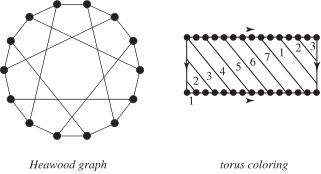
The Heawood graph corresponds to the seven-color torus map on 14 nodes illustrated above. The Heawood graph is the point/line Levi graph on the Fano plane (Royle).

Chvátal (1972) conjectured that point-line incidence graphs of finite projective planes, the smallest example of which is the Heawood graph, were not unit-distance embeddable. The first explicit embedding refuting this conjecture was found by Gerbracht (2008), and exactly 11 such embeddings (illustrated above) were published by Gerbracht (2009) following a general outline first suggested by Harris (2007).

An apparent unit-distance embedding based on a central hexagon has also been constructed by E. Gerbracht (pers. comm., Jan. 2010).

Another unit-distance embedding has apparently been found by Horvat (2009), illustrated above.
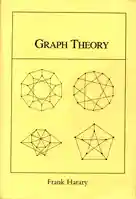
The Heawood graph is the second of four graphs depicted on the cover of Harary (1994).
It is implemented in the Wolfram Language as GraphData["HeawoodGraph"].
See also
Cage Graph, Fano Plane, Foster Graph, Heawood Four-Color Graph, Honeycomb Toroidal Graph, Moore Graph, Smallest Cubic Crossing Number Graph, Szilassi Polyhedron, Torus Coloring
Explore with Wolfram|Alpha
References
Bondy, J. A. and Murty, U. S. R. Graph Theory with Applications. New York: North Holland, pp. 236 and 244,
1976.Brouwer, A. E. "Heawood Graph." http://www.win.tue.nl/~aeb/drg/graphs/Heawood.html.Brouwer,
A. E.; Cohen, A. M.; and Neumaier, A. Distance
Regular Graphs. New York: Springer-Verlag, pp. 209 and 221, 1989.Brouwer,
A. E. and Haemers, W. H. "The Gewirtz Graph: An Exercise in the Theory
of Graph Spectra." European J. Combin. 14, 397-407, 1993.Chvátal,
V. Problem 21 in Chvátal, V.; Klarner, D. E.; and Knuth, D. E. "Selected
Combinatorial Research Problems." Tech. Report STAN-CS-72-292, Computer Science
Department, School of Humanities and Sciences. Stanford, CA: Stanford University,
pp. 11-13, 1972.Clancy, K.; Haythorpe, M.; Newcombe, A.; and Pegg,
E. Jr. "There Are No Cubic Graphs on 26 Vertices with Crossing Number 10
or 11." Preprint. 2019.Coxeter, H. S. M. "Self-Dual
Configurations and Regular Graphs." Bull. Amer. Math. Soc. 56,
413-455, 1950.DistanceRegular.org. "Heawood Graph  Incidence Graph of
 Incidence Graph of Hadamard (7,3,1)-Design." https://www.math.mun.ca/distanceregular/graphs//heawood.html.Exoo,
G. "Rectilinear Drawings of Famous Graphs: The Heawood Graph." http://isu.indstate.edu/ge/COMBIN/RECTILINEAR/heawood.gif.Gerbracht,
E. H.-A. "On the Unit Distance Embeddability of Connected Cubic Symmetric
Graphs." Kolloquium über Kombinatorik. Magdeburg, Germany. Nov. 15,
2008.Gerbracht, E. H.-A. "Eleven Unit Distance Embeddings
of the Heawood Graph." Dec. 30, 2009. http://arxiv.org/abs/0912.5395.Gethner,
E. and Springer, W. M. II. "How False Is Kempe's Proof of the Four-Color
Theorem?" Congr. Numer. 164, 159-175, 2003.Harary,
F. Graph
Theory. Reading, MA: Addison-Wesley, p. 173, 1994.Harris,
M. A. "Toward a Unit Distance Embedding for the Heawood Graph." Nov. 7,
2007. http://arxiv.org/abs/math/0711.1157.Heawood,
P. J. "Map-Colour Theorem." Quart. J. Math. Oxford Ser. 24,
332-338, 1890.Horvat, B. "Predstavitve grafov z enotsko razdaljo"
("Representations of Unit-Distance Graphs"). Ph.D. thesis, Faculty of Computer
and Information Science. Ljubljana, Slovenia: University of Ljubljana, June 2009.
http://eprints.fri.uni-lj.si/858/.Pegg,
E. Jr. and Exoo, G. "Crossing Number Graphs." Mathematica J. 11,
161-170, 2009. https://www.mathematica-journal.com/data/uploads/2009/11/CrossingNumberGraphs.pdf.Pisanski,
T. and Randić, M. "Bridges between Geometry and Graph Theory." In
Geometry
at Work: A Collection of Papers Showing Applications of Geometry (Ed. C. A. Gorini).
Washington, DC: Math. Assoc. Amer., pp. 174-194, 2000.Read, R. C.
and Wilson, R. J. An
Atlas of Graphs. Oxford, England: Oxford University Press, p. 271, 1998.Royle,
G. "Cubic Cages." http://school.maths.uwa.edu.au/~gordon/remote/cages/.Royle,
G. "F014A." http://www.csse.uwa.edu.au/~gordon/foster/F014A.html.Skiena,
S. Implementing
Discrete Mathematics: Combinatorics and Graph Theory with Mathematica. Reading,
MA: Addison-Wesley, p. 192, 1990.Wolfram, S. A
New Kind of Science. Champaign, IL: Wolfram Media, p. 1032,
2002.Wong, P. K. "Cages--A Survey." J. Graph Th. 6,
1-22, 1982.
Incidence Graph of Hadamard (7,3,1)-Design." https://www.math.mun.ca/distanceregular/graphs//heawood.html.Exoo,
G. "Rectilinear Drawings of Famous Graphs: The Heawood Graph." http://isu.indstate.edu/ge/COMBIN/RECTILINEAR/heawood.gif.Gerbracht,
E. H.-A. "On the Unit Distance Embeddability of Connected Cubic Symmetric
Graphs." Kolloquium über Kombinatorik. Magdeburg, Germany. Nov. 15,
2008.Gerbracht, E. H.-A. "Eleven Unit Distance Embeddings
of the Heawood Graph." Dec. 30, 2009. http://arxiv.org/abs/0912.5395.Gethner,
E. and Springer, W. M. II. "How False Is Kempe's Proof of the Four-Color
Theorem?" Congr. Numer. 164, 159-175, 2003.Harary,
F. Graph
Theory. Reading, MA: Addison-Wesley, p. 173, 1994.Harris,
M. A. "Toward a Unit Distance Embedding for the Heawood Graph." Nov. 7,
2007. http://arxiv.org/abs/math/0711.1157.Heawood,
P. J. "Map-Colour Theorem." Quart. J. Math. Oxford Ser. 24,
332-338, 1890.Horvat, B. "Predstavitve grafov z enotsko razdaljo"
("Representations of Unit-Distance Graphs"). Ph.D. thesis, Faculty of Computer
and Information Science. Ljubljana, Slovenia: University of Ljubljana, June 2009.
http://eprints.fri.uni-lj.si/858/.Pegg,
E. Jr. and Exoo, G. "Crossing Number Graphs." Mathematica J. 11,
161-170, 2009. https://www.mathematica-journal.com/data/uploads/2009/11/CrossingNumberGraphs.pdf.Pisanski,
T. and Randić, M. "Bridges between Geometry and Graph Theory." In
Geometry
at Work: A Collection of Papers Showing Applications of Geometry (Ed. C. A. Gorini).
Washington, DC: Math. Assoc. Amer., pp. 174-194, 2000.Read, R. C.
and Wilson, R. J. An
Atlas of Graphs. Oxford, England: Oxford University Press, p. 271, 1998.Royle,
G. "Cubic Cages." http://school.maths.uwa.edu.au/~gordon/remote/cages/.Royle,
G. "F014A." http://www.csse.uwa.edu.au/~gordon/foster/F014A.html.Skiena,
S. Implementing
Discrete Mathematics: Combinatorics and Graph Theory with Mathematica. Reading,
MA: Addison-Wesley, p. 192, 1990.Wolfram, S. A
New Kind of Science. Champaign, IL: Wolfram Media, p. 1032,
2002.Wong, P. K. "Cages--A Survey." J. Graph Th. 6,
1-22, 1982.

Referenced on Wolfram|Alpha
Cite this as:
Weisstein, Eric W. "Heawood Graph." From MathWorld--A Wolfram Resource. https://mathworld.wolfram.com/HeawoodGraph.html