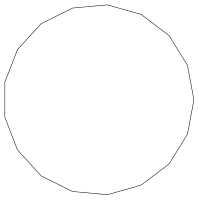
The regular polygon of 17 sides is called the heptadecagon, or sometimes the heptakaidecagon. Gauss proved in 1796 (when he was
19 years old) that the heptadecagon is constructible
with a compass and straightedge.
Gauss's proof appears in his monumental work Disquisitiones Arithmeticae.
The proof relies on the property of irreducible polynomial
equations that roots composed of a finite number of square
root extractions only exist when the order of the equation is a product of
the form 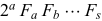 ,
where the
,
where the  are distinct primes of
the form
are distinct primes of
the form
 |
(1) |
known as Fermat primes. Constructions for the regular triangle ( ), square (
 ), pentagon (
 ), hexagon (
 ), etc., had been given by Euclid, but constructions based
on the Fermat primes
), etc., had been given by Euclid, but constructions based
on the Fermat primes  were unknown to the ancients. The first explicit construction
of a heptadecagon was given by Erchinger in about 1800.
were unknown to the ancients. The first explicit construction
of a heptadecagon was given by Erchinger in about 1800.
The trigonometric functions  and
and  are both algebraic
numbers of degree 8 given respectively by
are both algebraic
numbers of degree 8 given respectively by
The heptadecagon with unit edge lengths has inradius and circumradius given by
both of which can be expressed in terms of finite root extractions. They can also be expressed as the largest roots of the algebraic equations
 |
(6) |
 |
(7) |
The area of the regular heptadecagon is given by
 |
(8) |
where  can be expressed as the largest root of
 |
(9) |
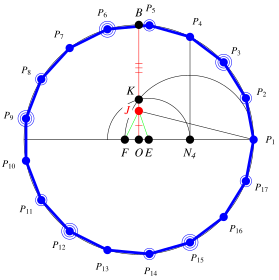
The following elegant construction for the heptadecagon (Yates 1949, Coxeter 1969, Stewart 1977, Wells 1991) was first given by Richmond (1893).
1. Given an arbitrary point  , draw a circle centered on
  and a diameter
drawn through
and a diameter
drawn through  .
.
2. Call the right end of the diameter dividing the circle into a semicircle  .
.
3. Construct the diameter perpendicular to the original diameter by finding the perpendicular
bisector  .
.
4. Construct  a quarter of the way up
  .
.
5. Join  and find
  so that
  is a quarter of
  .
.
6. Find  so that
  is
is  .
.
7. Construct the semicircle with diameter  .
.
8. This semicircle cuts  at
at  .
.
9. Draw a semicircle with center  and radius
  .
.
10. This cuts the line segment  at
at  .
.
11. Construct a line perpendicular to  through
  .
.
12. This line meets the original semicircle at  .
.
13. You now have points  and
and  of a heptadecagon.
14. Use  and
and  to get the remaining 15 points of the heptadecagon around the original circle
by constructing
to get the remaining 15 points of the heptadecagon around the original circle
by constructing  ,
,
 ,
,  ,
,  ,
,  ,
,  [filled circles],
  ,
,  ,
,  ,
,  ,
,  ,
,  [single-ringed filled circles],
  ,
,  ,
,  ,
,  , and
, and  [double-ringed filled circles].
15. Connect the adjacent points  for
for  to 17, forming the heptadecagon.
This construction, when suitably streamlined, has simplicity 53. The construction of Smith (1920) has a greater simplicity
of 58. Another construction due to Tietze (1965) and reproduced in Hall (1970) has
a simplicity of 50. However, neither Tietze (1965)
nor Hall (1970) provides a proof that this construction is correct. Both Richmond's
and Tietze's constructions require extensive calculations to prove their validity.
DeTemple (1991) gives an elegant construction involving the Carlyle
circles which has geometrography symbol  and simplicity
45. The construction problem has now been automated to some extent (Bishop 1978).
and simplicity
45. The construction problem has now been automated to some extent (Bishop 1978).
See also
257-gon, 65537-gon, Compass, Constructible Polygon, Fermat Number, Fermat Prime, Regular Polygon, Straightedge, Trigonometry Angles, Trigonometry Angles--pi/17
Explore with Wolfram|Alpha
References
Archibald, R. C. "The History of the Construction of the Regular Polygon of Seventeen Sides." Bull. Amer. Math. Soc. 22,
239-246, 1916.Archibald, R. C. "Gauss and the Regular Polygon
of Seventeen Sides." Amer. Math. Monthly 27, 323-326, 1920.Ball,
W. W. R. and Coxeter, H. S. M. Mathematical
Recreations and Essays, 13th ed. New York: Dover, pp. 95-96, 1987.Bishop,
W. "How to Construct a Regular Polygon." Amer. Math. Monthly 85,
186-188, 1978.Bold, B. Famous
Problems of Geometry and How to Solve Them. New York: Dover, pp. 63-69,
1982.Conway, J. H. and Guy, R. K. The
Book of Numbers. New York: Springer-Verlag, pp. 201 and 229-230, 1996.Coxeter,
H. S. M. Introduction
to Geometry, 2nd ed. New York: Wiley, pp. 26-28, 1969.DeTemple,
D. W. "Carlyle Circles and the Lemoine Simplicity of Polygonal Constructions."
Amer. Math. Monthly 98, 97-108, 1991.Dickson, L. E.
"Construction of the Regular Polygon of 17 Sides." §8.20 in Monographs
on Topics of Modern Mathematics Relevant to the Elementary Field (Ed. J. W. A.
Young). New York: Dover, pp. 372-373, 1955.Dixon, R. "Gauss
Extends Euclid." §1.4 in Mathographics.
New York: Dover, pp. 52-54, 1991.Dummit, D. S. and Foote,
R. M. Abstract
Algebra, 2nd ed. Englewood Cliffs, NJ: Prentice-Hall, 1998.Gauss,
C. F. §365 and 366 in Disquisitiones
Arithmeticae. Leipzig, Germany: Fleischer, 1801. Reprinted in New Haven,
CT: Yale University Press, 1965.Hall, T. Carl
Friedrich Gauss: A Biography. Cambridge, MA: MIT Press, 1970.Hardy,
G. H. and Wright, E. M. "Construction of the Regular Polygon of 17
Sides." §5.8 in An
Introduction to the Theory of Numbers, 5th ed. Oxford, England: Clarendon
Press, pp. 57-62, 1979.Klein, F. Famous
Problems of Elementary Geometry and Other Monographs. New York: Chelsea,
1956.Ore, Ø. Number
Theory and Its History. New York: Dover, 1988.Rademacher, H.
Lectures
on Elementary Number Theory. New York: Blaisdell, 1964.Richmond,
H. W. "A Construction for a Regular Polygon of Seventeen Sides." Quart.
J. Pure Appl. Math. 26, 206-207, 1893.Smith, L. L. "A
Construction of the Regular Polygon of Seventeen Sides." Amer. Math. Monthly 27,
322-323, 1920.Stewart, I. "Gauss." Sci. Amer. 237,
122-131, 1977.Tietze, H. Famous
Problems of Mathematics: Solved and Unsolved Mathematics Problems from Antiquity
to Modern Times. New York: Graylock Press, 1965.Trott, M. " à la Gauss."
Mathematica Educ. Res. 4, 31-36, 1995.Trott, M. "
à la Gauss."
Mathematica Educ. Res. 4, 31-36, 1995.Trott, M. " à la Gauss."
§1.10.2 in The
Mathematica GuideBook for Symbolics. New York: Springer-Verlag, pp. 312-321,
2006. http://www.mathematicaguidebooks.org/.Vélez,
P. and Luis, O. "A Chord Approach for an Alternative Ruler and Compasses Construction
of the 17-Side Regular Polygon." Geom. Dedicata 52, 209-213, 1994.
à la Gauss."
§1.10.2 in The
Mathematica GuideBook for Symbolics. New York: Springer-Verlag, pp. 312-321,
2006. http://www.mathematicaguidebooks.org/.Vélez,
P. and Luis, O. "A Chord Approach for an Alternative Ruler and Compasses Construction
of the 17-Side Regular Polygon." Geom. Dedicata 52, 209-213, 1994. Wang, P. "The Regular
Heptadecagon." http://www.ugcs.caltech.edu/~peterw/studies/17gon/Wells,
D. The
Penguin Dictionary of Curious and Interesting Geometry. New York: Penguin,
pp. 212-213, 1991.Yates, R. C. Geometrical
Tools: A Mathematical Sketch and Model Book. St. Louis, MO: Educational
Publishers, 1949.
Wang, P. "The Regular
Heptadecagon." http://www.ugcs.caltech.edu/~peterw/studies/17gon/Wells,
D. The
Penguin Dictionary of Curious and Interesting Geometry. New York: Penguin,
pp. 212-213, 1991.Yates, R. C. Geometrical
Tools: A Mathematical Sketch and Model Book. St. Louis, MO: Educational
Publishers, 1949.
Referenced on Wolfram|Alpha
Cite this as:
Weisstein, Eric W. "Heptadecagon." From MathWorld--A Wolfram Resource. https://mathworld.wolfram.com/Heptadecagon.html