An integrating factor is a function by which an ordinary differential equation can be multiplied in order to make it integrable. For example, a linear first-order ordinary differential equation of type
 |
(1) |
where  and
and  are given continuous functions, can be made
integrable by letting
are given continuous functions, can be made
integrable by letting  be a function such that
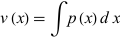 |
(2) |
and
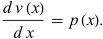 |
(3) |
Then  would be the integrating factor such that multiplying by
  gives the expression
using the product rule. Integrating both sides with respect to  then gives the solution
 |
(6) |
See also
First-Order Ordinary Differential Equation, Ordinary Differential Equation
This entry contributed by Joakim Munkhammar
Explore with Wolfram|Alpha
References
Adams, R. A. Calculus: A Complete Course, 4th ed. Reading, MA: Addison Wesley, 1999.Morse, P. M. and Feshbach, H. Methods of Theoretical Physics, Part I. New York: McGraw-Hill, pp. 526-529, 1953.
Referenced on Wolfram|Alpha
Cite this as:
Munkhammar, Joakim. "Integrating Factor." From MathWorld--A Wolfram Resource, created by Eric W. Weisstein. https://mathworld.wolfram.com/IntegratingFactor.html