Lorentzian Function
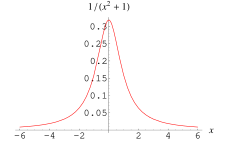
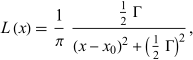
The Lorentzian function is the singly peaked function given by
 |
(1) |
where  is the center and
  is a parameter specifying the width. The Lorentzian function is normalized so that
 |
(2) |
It has a maximum at  ,
where
,
where
![L^'(x)=-(16(x-x_0)Gamma)/(pi[4(x-x_0)^2+Gamma^2]^2)=0.](https://txtdot.deep-swarm.xyz/proxy/img?url=https%3A%2F%2Fmathworld.wolfram.com%2Fimages%2Fequations%2FLorentzianFunction%2FNumberedEquation3.svg) |
(3) |
Its value at the maximum is
 |
(4) |
It is equal to half its maximum at
 |
(5) |
and so has full width at half maximum  . The function has inflection points
at
. The function has inflection points
at
![L^('')(x)=16Gamma(12(x-x_0)^2-Gamma^2)/(pi[4(x-x_0)^2+Gamma^2]^3)=0,](https://txtdot.deep-swarm.xyz/proxy/img?url=https%3A%2F%2Fmathworld.wolfram.com%2Fimages%2Fequations%2FLorentzianFunction%2FNumberedEquation6.svg) |
(6) |
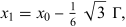
giving
 |
(7) |
where
 |
(8) |
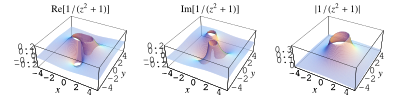
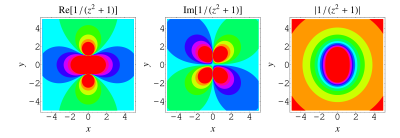
The Lorentzian function extended into the complex plane is illustrated above.
The Lorentzian function gives the shape of certain types of spectral lines and is the distribution function in the Cauchy distribution. The Lorentzian function has Fourier transform
=e^(-2piikx_0-Gammapi|k|).](https://txtdot.deep-swarm.xyz/proxy/img?url=https%3A%2F%2Fmathworld.wolfram.com%2Fimages%2Fequations%2FLorentzianFunction%2FNumberedEquation9.svg) |
(9) |
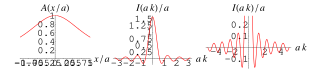
The Lorentzian function can also be used as an apodization function, although its instrument function is complicated to express analytically.