The trace of an  square matrix
  is defined to be
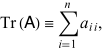 |
(1) |
i.e., the sum of the diagonal elements. The matrix trace is implemented in the Wolfram Language as Tr[list]. In group theory, traces are known as "group characters."
For square matrices  and
and  ,
it is true that
,
it is true that
(Lang 1987, p. 40), where  denotes the transpose. The
trace is also invariant under a similarity
transformation
denotes the transpose. The
trace is also invariant under a similarity
transformation
 |
(5) |
(Lang 1987, p. 64). Since
 |
(6) |
(where Einstein summation is used here to sum over repeated indices), it follows that
where  is the Kronecker delta.
The trace of a product of two square matrices is independent of the order of the multiplication since
(again using Einstein summation). Therefore, the trace of the commutator of  and
and  is given by
![Tr([A,B])=Tr(AB)-Tr(BA)=0.](https://txtdot.deep-swarm.xyz/proxy/img?url=https%3A%2F%2Fmathworld.wolfram.com%2Fimages%2Fequations%2FMatrixTrace%2FNumberedEquation4.svg) |
(17) |
The trace of a product of three or more square matrices, on the other hand, is invariant only under cyclic permutations of the order of multiplication of the matrices, by a similar argument.
The product of a symmetric and an antisymmetric matrix has zero trace,
 |
(18) |
The value of the trace for a  nonsingular matrix can be found using the fact that
the matrix can always be transformed to a coordinate system where the z-axis
lies along the axis of rotation. In the new coordinate system (which is assumed to
also have been appropriately rescaled), the matrix is
nonsingular matrix can be found using the fact that
the matrix can always be transformed to a coordinate system where the z-axis
lies along the axis of rotation. In the new coordinate system (which is assumed to
also have been appropriately rescaled), the matrix is
![A^'=[cosphi sinphi 0; -sinphi cosphi 0; 0 0 1],](https://txtdot.deep-swarm.xyz/proxy/img?url=https%3A%2F%2Fmathworld.wolfram.com%2Fimages%2Fequations%2FMatrixTrace%2FNumberedEquation6.svg) |
(19) |
so the trace is
 |
(20) |
where  is interpreted as Einstein summation notation.
See also
Group Character, Matrix, Square Matrix, Tensor Contraction, Tensor Trace
Explore with Wolfram|Alpha
References
Lang, S. Linear Algebra, 3rd ed. New York: Springer-Verlag, pp. 40 and 64, 1987.Munkres, J. R. Elements of Algebraic Topology. New York: Perseus Books Pub.,p. 122, 1993.
Referenced on Wolfram|Alpha
Cite this as:
Weisstein, Eric W. "Matrix Trace." From MathWorld--A Wolfram Resource. https://mathworld.wolfram.com/MatrixTrace.html