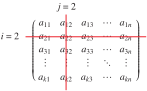
A minor  is the reduced determinant
of a determinant expansion that
is formed by omitting the
is the reduced determinant
of a determinant expansion that
is formed by omitting the  th
row and
th
row and  th column of a matrix
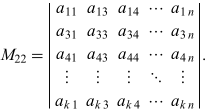
  . So, for example, the minor
  of the above matrix is given by
The  th minor can be computed in the Wolfram Language using
  Minor[m_List?MatrixQ, {i_Integer, j_Integer}] :=
    Det[Drop[Transpose[Drop[Transpose[m], {j}]],
      {i}]]
The Wolfram Language's built-in Minors[m]
command instead gives the minors of a matrix  obtained by deleting the
  st row and
  st column of
  , while Minors[m,
k] gives the
, while Minors[m,
k] gives the  th
minors of
th
minors of  . The Minor code above therefore
corresponds to
. The Minor code above therefore
corresponds to  th
entry of
th
entry of
  MinorMatrix[m_List?MatrixQ] := Map[Reverse,
    Minors[m], {0, 1}]
i.e., the definition Minors[m,  i, j
i, j ] is equivalent to MinorMatrix[m][[i,
j]].
] is equivalent to MinorMatrix[m][[i,
j]].
See also
Cofactor, Determinant, Determinant Expansion by Minors
Explore with Wolfram|Alpha
References
Arfken, G. Mathematical Methods for Physicists, 3rd ed. Orlando, FL: Academic Press, pp. 169-170,
1985. Lichtblau, D. "Symbolic FAQ." http://library.wolfram.com/infocenter/Conferences/325.Muir,
T. "Minors and Expansion." Ch. 4 in A
Treatise on the Theory of Determinants. New York: Dover, pp. 53-137,
1960.Skiena, S. Implementing
Discrete Mathematics: Combinatorics and Graph Theory with Mathematica. Reading,
MA: Addison-Wesley, p. 235, 1990.
Lichtblau, D. "Symbolic FAQ." http://library.wolfram.com/infocenter/Conferences/325.Muir,
T. "Minors and Expansion." Ch. 4 in A
Treatise on the Theory of Determinants. New York: Dover, pp. 53-137,
1960.Skiena, S. Implementing
Discrete Mathematics: Combinatorics and Graph Theory with Mathematica. Reading,
MA: Addison-Wesley, p. 235, 1990.
Referenced on Wolfram|Alpha
Cite this as:
Weisstein, Eric W. "Minor." From MathWorld--A Wolfram Resource. https://mathworld.wolfram.com/Minor.html