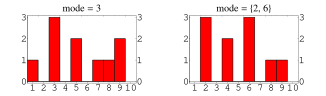
The mode of a set of observations is the most commonly occurring value. For example, for a data set (3, 7, 3, 9, 9, 3, 5, 1, 8, 5) (left histogram), the unique mode is 3. Similarly, for a data set (2, 4, 9, 6, 4, 6, 6, 2, 8, 2) (right histogram), there are two modes: 2 and 6. A distribution with a single mode is said to be unimodal. A distribution with more than one mode is said to be bimodal, trimodal, etc., or in general, multimodal. The mode of a set of data is implemented in the Wolfram Language as Commonest[data].
An interesting empirical relationship between the sample mean, statistical median, and mode which appears to hold for unimodal curves of moderate asymmetry is given by

(Kenney and Keeping 1962, p. 53), which is the basis for the definition of the Pearson mode skewness.
See also
Mean, Order Statistic, Pearson Mode Skewness, Statistical Median Explore this topic in the MathWorld classroom
Explore with Wolfram|Alpha
References
Kenney, J. F. and Keeping, E. S. "The Mode," "Relation Between Mean, Median, and Mode," and "Relative Merits of Mean, Median, and Mode." §4.7-4.9 in Mathematics of Statistics, Pt. 1, 3rd ed. Princeton, NJ: Van Nostrand, pp. 50-54, 1962.Zwillinger, D. (Ed.). CRC Standard Mathematical Tables and Formulae. Boca Raton, FL: CRC Press, p. 602, 1995.
Referenced on Wolfram|Alpha
Cite this as:
Weisstein, Eric W. "Mode." From MathWorld--A Wolfram Resource. https://mathworld.wolfram.com/Mode.html