Starting with the circle  tangent to the three semicircles forming the arbelos,
construct a chain of tangent circles
tangent to the three semicircles forming the arbelos,
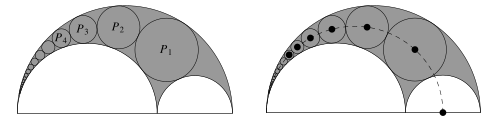
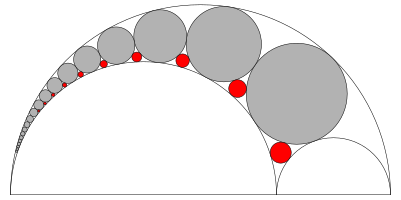
construct a chain of tangent circles  , all tangent to one of the two small interior circles and
to the large exterior one. This chain is called the Pappus chain (left figure).
, all tangent to one of the two small interior circles and
to the large exterior one. This chain is called the Pappus chain (left figure).
In a Pappus chain, the distance from the center of the first inscribed circle  to the bottom line is twice the circle's radius, from the second circle
  is four times the radius,
and for the
is four times the radius,
and for the  th
circle
th
circle  is
is  times the radius. Furthermore,
the centers of the circles
times the radius. Furthermore,
the centers of the circles  lie on an ellipse (right figure).
If  , then the center and radius of
the
, then the center and radius of
the  th circle
  in the Pappus chain are
This general result simplifies to 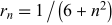 for
for  (Gardner 1979). Further special cases when
 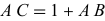 are considered by Gaba (1940).
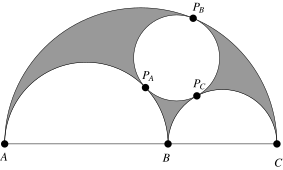
The positions of the points of tangency for the first circle are
The diameter of the  th circle
  is given by (
 )th the perpendicular distance
to the base of the semicircle. This result was known
to Pappus, who referred to it as an ancient theorem (Hood 1961, Cadwell 1966, Gardner
1979, Bankoff 1981). Note that this is also valid for the chain of tangent circles
starting with
)th the perpendicular distance
to the base of the semicircle. This result was known
to Pappus, who referred to it as an ancient theorem (Hood 1961, Cadwell 1966, Gardner
1979, Bankoff 1981). Note that this is also valid for the chain of tangent circles
starting with  and tangent to the two interior semicircles of the arbelos.
The simplest proof is via inversive geometry.
and tangent to the two interior semicircles of the arbelos.
The simplest proof is via inversive geometry.
Eliminating  from the equations for
  and
and  , the center
  of the circle
  , gives
 |
(10) |
Completing the square gives
![4r[x-1/4(1+r)]^2+(1+r^2)y^2=1/4r(1+r)^2,](https://txtdot.deep-swarm.xyz/proxy/img?url=https%3A%2F%2Fmathworld.wolfram.com%2Fimages%2Fequations%2FPappusChain%2FNumberedEquation2.svg) |
(11) |
which can be rearranged as
![[(x-1/4(1+r))/(1/4(1+r))]^2+(y/(1/2sqrt(r)))^2=1,](https://txtdot.deep-swarm.xyz/proxy/img?url=https%3A%2F%2Fmathworld.wolfram.com%2Fimages%2Fequations%2FPappusChain%2FNumberedEquation3.svg) |
(12) |
which is simply the equation of an ellipse having center  and semimajor and semiminor axes
  and
and  respectively. Since
 |
(13) |
 and 1/2, so the ellipse
has foci at the centers of the semicircles bounding the chain.
and 1/2, so the ellipse
has foci at the centers of the semicircles bounding the chain.
The circles  tangent to the first arbelos semicircle and adjacent Pappus circles
  and
and  have positions and sizes
A special case of this problem with  (giving equal circles forming the arbelos) was considered
in a Japanese temple tablet (Sangaku problem)
from 1788 in the Tokyo prefecture (Rothman 1998). In this case, the solution simplifies
to
(giving equal circles forming the arbelos) was considered
in a Japanese temple tablet (Sangaku problem)
from 1788 in the Tokyo prefecture (Rothman 1998). In this case, the solution simplifies
to
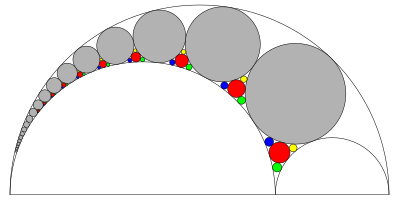
Furthermore, the positions and radii of the three tangent circles surrounding this circle can also be found analytically, and are given by
If  divides
  in the golden ratio
  , then the circles in the chain satisfy
a number of other special properties (Bankoff 1955).
, then the circles in the chain satisfy
a number of other special properties (Bankoff 1955).
In each arbelos, there are two Pappus chains  and
and  , with
  . For fixed
  , the line connecting the centers of
  and
and  passes through the external similitude center
  of the two smaller semicircles of the arbelos. The line connecting
the point of tangency of
of the two smaller semicircles of the arbelos. The line connecting
the point of tangency of  and
and  and the point of tangency of
  and
and  passes through
  as well. Also the line connecting the point of tangency of
 and the large exterior semicircle
(the smaller interior semicircle) and the point of tangency of
and the large exterior semicircle
(the smaller interior semicircle) and the point of tangency of  and the large exterior semicircle (the smaller interior
semicircle) passes through
and the large exterior semicircle (the smaller interior
semicircle) passes through  . This can be proven with circle inversion. In particular,
since
. This can be proven with circle inversion. In particular,
since  ,
the common tangent of
,
the common tangent of  and the large exterior semicircle passes through
  .
.
See also
Arbelos, Coxeter's Loxodromic Sequence of Tangent Circles, Pappus's Centroid Theorem, Pappus's Harmonic Theorem, Pappus's Hexagon Theorem, Six Circles Theorem, Soddy Circles, Steiner Chain
Portions of this entry contributed by Floor van Lamoen
Explore with Wolfram|Alpha
References
Bankoff, L. "The Golden Arbelos." Scripta Math. 21, 70-76, 1955.Bankoff, L. "Are the Twin Circles of Archimedes Really Twins?" Math. Mag. 47, 214-218, 1974.Bankoff, L. "How Did Pappus Do It?" In The Mathematical Gardner (Ed. D. Klarner). Boston, MA: Prindle, Weber, and Schmidt, pp. 112-118, 1981.Cadwell, J. H. Topics in Recreational Mathematics. Cambridge, England: Cambridge University Press, 1966.Casey, J. A Sequel to the First Six Books of the Elements of Euclid, Containing an Easy Introduction to Modern Geometry with Numerous Examples, 5th ed., rev. enl. Dublin: Hodges, Figgis, & Co., p. 103, 1888.Gaba, M. G. "On a Generalization of the Arbelos." Amer. Math. Monthly 47, 19-24, 1940.Gardner, M. "Mathematical Games: The Diverse Pleasures of Circles that Are Tangent to One Another." Sci. Amer. 240, 18-28, Jan. 1979.Hood, R. T. "A Chain of Circles." Math. Teacher 54, 134-137, 1961.Johnson, R. A. Modern Geometry: An Elementary Treatise on the Geometry of the Triangle and the Circle. Boston, MA: Houghton Mifflin, p. 117, 1929.Rothman, T. "Japanese Temple Geometry." Sci. Amer. 278, 85-91, May 1998.Steiner, J. Jacob Steiner's gesammelte Werke, Band I. Bronx, NY: Chelsea, p. 47, 1971.
Referenced on Wolfram|Alpha
Cite this as:
van Lamoen, Floor and Weisstein, Eric W. "Pappus Chain." From MathWorld--A Wolfram Resource. https://mathworld.wolfram.com/PappusChain.html