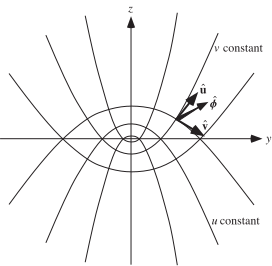
A system of curvilinear coordinates in which two sets of coordinate surfaces are obtained by revolving the parabolas of
parabolic cylindrical coordinates
about the x-axis, which is then relabeled the z-axis. There are several notational conventions.
Whereas  is used in this work, Arfken (1970) uses
  .
.
The equations for the parabolic coordinates are
where  ,
,
 ,
and
,
and  .
To solve for
.
To solve for  ,
,
 ,
and
,
and  ,
examine
,
examine
so
 |
(7) |
and
 |
(8) |
 |
(9) |
We therefore have
The scale factors are
The line element is
 |
(16) |
and the volume element is
 |
(17) |
The Laplacian is
The Helmholtz differential equation is separable in parabolic coordinates.
See also
Confocal Paraboloidal Coordinates, Helmholtz Differential Equation--Parabolic Coordinates, Parabolic Cylindrical Coordinates
Explore with Wolfram|Alpha
References
Arfken, G. "Parabolic Coordinates ( ,
,  ,
,  )." §2.12 in Mathematical
Methods for Physicists, 2nd ed. Orlando, FL: Academic Press, pp. 109-112,
1970.Moon, P. and Spencer, D. E. "Parabolic Coordinates
)." §2.12 in Mathematical
Methods for Physicists, 2nd ed. Orlando, FL: Academic Press, pp. 109-112,
1970.Moon, P. and Spencer, D. E. "Parabolic Coordinates  ." Table 1.08 in Field
Theory Handbook, Including Coordinate Systems, Differential Equations, and Their
Solutions, 2nd ed. New York: Springer-Verlag, pp. 34-36, 1988.Morse,
P. M. and Feshbach, H. Methods
of Theoretical Physics, Part I. New York: McGraw-Hill, p. 660, 1953.
." Table 1.08 in Field
Theory Handbook, Including Coordinate Systems, Differential Equations, and Their
Solutions, 2nd ed. New York: Springer-Verlag, pp. 34-36, 1988.Morse,
P. M. and Feshbach, H. Methods
of Theoretical Physics, Part I. New York: McGraw-Hill, p. 660, 1953.
Referenced on Wolfram|Alpha
Cite this as:
Weisstein, Eric W. "Parabolic Coordinates." From MathWorld--A Wolfram Resource. https://mathworld.wolfram.com/ParabolicCoordinates.html