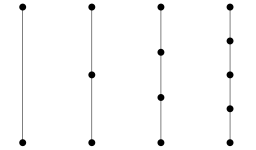
The path graph  is a tree with two nodes of vertex
degree 1, and the other
is a tree with two nodes of vertex
degree 1, and the other  nodes of vertex degree 2. A path graph is therefore
a graph that can be drawn so that all of its vertices and edges lie on a single straight
line (Gross and Yellen 2006, p. 18).
nodes of vertex degree 2. A path graph is therefore
a graph that can be drawn so that all of its vertices and edges lie on a single straight
line (Gross and Yellen 2006, p. 18).
The path graph of length  is implemented in the Wolfram Language
as PathGraph[Range[n]],
and precomputed properties of path graphs are available as GraphData[
is implemented in the Wolfram Language
as PathGraph[Range[n]],
and precomputed properties of path graphs are available as GraphData[ "Path", n
 ]. (Note that the Wolfram
Language believes cycle graphs to be path graph, a convention that seems neither
standard nor useful.)
]. (Note that the Wolfram
Language believes cycle graphs to be path graph, a convention that seems neither
standard nor useful.)
The path graph  is known as the singleton graph and is equivalent
to the complete graph
is known as the singleton graph and is equivalent
to the complete graph  and the star graph
  .
.  is isomorphic to the complete bipartite graph
  and
and  to
to  .
.
Path graphs  are graceful.
The path graph  has chromatic polynomial, independence
polynomial, matching polynomial, and reliability polynomial given by
has chromatic polynomial, independence
polynomial, matching polynomial, and reliability polynomial given by
where  . These have recurrence equations
The line graph of  is isomorphic to
  .
.
 is the Cayley
graph of the permutations
is the Cayley
graph of the permutations 
 2,
1
2,
1
 and
and 
 1, 3, 2
 .
.
See also
Cycle Graph, Graceful Graph, Hamiltonian Path, Path, Path Complement Graph, Tree, Triangular Snake Graph
Explore with Wolfram|Alpha
References
Gross, J. T. and Yellen, J. Graph Theory and Its Applications, 2nd ed. Boca Raton, FL: CRC Press, 2006.
Referenced on Wolfram|Alpha
Cite this as:
Weisstein, Eric W. "Path Graph." From MathWorld--A Wolfram Resource. https://mathworld.wolfram.com/PathGraph.html