Let  be a permutation. Then
  is a permutation ascent if
  . For example, the permutation
  is composed of three ascents, namely
  ,
,  , and
, and  .
.
The number of permutations of length  having
  ascents is given by the Eulerian
number
ascents is given by the Eulerian
number  .
.
The total number of ascents in all permutations of order  is
is

giving the first few terms for  , 2, ... as 0, 1, 6, 36, 240, 1800, 15120, ... (OEIS A001286).
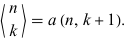
There is an intimate connection between permutation ascents and permutation runs, with the number of ascents of length  in the permutations
  being equal to the number of permutation
runs
being equal to the number of permutation
runs  of length
  (Skiena 1990, p. 31), or
See also
Eulerian Number, Permutation, Permutation Run
Explore with Wolfram|Alpha
References
Bona, M. Combinatorics of Permutations. Boca Raton, FL: Chapman & Hall/CRC, 2004.Graham, R. L.; Knuth, D. E.; and Patashnik, O. Concrete Mathematics: A Foundation for Computer Science, 2nd ed. Reading, MA: Addison-Wesley, 1994.Knuth, D. E. The Art of Computer Programming, Vol. 3: Sorting and Searching, 2nd ed. Reading, MA: Addison-Wesley, 1998.Mannila, H. "Measures of Presortedness and Optimal Sorting Algorithms." IEE Trans. Comput. 34, 318-325, 1985.Skiena, S. "Runs and Eulerian Numbers." §1.3.4 in Implementing Discrete Mathematics: Combinatorics and Graph Theory with Mathematica. Reading, MA: Addison-Wesley, pp. 30-31, 1990.Sloane, N. J. A. Sequence A001286/M4225 in "The On-Line Encyclopedia of Integer Sequences."
Referenced on Wolfram|Alpha
Cite this as:
Weisstein, Eric W. "Permutation Ascent." From MathWorld--A Wolfram Resource. https://mathworld.wolfram.com/PermutationAscent.html