A permutation cycle is a subset of a permutation whose elements trade places with one another. Permutations cycles are called "orbits"
by Comtet (1974, p. 256). For example, in the permutation
group  ,
(143) is a 3-cycle and (2) is a 1-cycle. Here, the notation (143) means that starting
from the original ordering
,
(143) is a 3-cycle and (2) is a 1-cycle. Here, the notation (143) means that starting
from the original ordering  , the first element is replaced by the fourth, the
fourth by the third, and the third by the first, i.e.,
, the first element is replaced by the fourth, the
fourth by the third, and the third by the first, i.e., 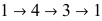 .
.
There is a great deal of freedom in picking the representation of a cyclic decomposition since (1) the cycles are disjoint and can therefore be specified in any order, and
(2) any rotation of a given cycle specifies the same cycle (Skiena 1990, p. 20).
Therefore, (431)(2), (314)(2), (143)(2), (2)(431), (2)(314), and (2)(143) all describe
the same permutation. The following table gives the set of representations for each
element of the symmetric group on three elements,
 , sorted in lowest canonical order
(first by cycle length, and then by lowest initial order of elements).
, sorted in lowest canonical order
(first by cycle length, and then by lowest initial order of elements).
The cyclic decomposition of a permutation can be computed in the Wolfram Language with
the function PermutationCycles[p]
and the permutation corresponding to a cyclic decomposition
can be computed with PermutationList[c].
Here, the individual cycles are represented using the function Cycles.
In previous versions, the cyclic decomposition could be computed less efficiently
using ToCycles[p]
in the Wolfram Language package Permutations`
and the permutation corresponding to a cyclic decomposition
could be computed using FromCycles[ c1, ..., cn
 ] in the Wolfram
Language package Permutations` . According to Vardi (1991), the Wolfram
Language code for ToCycles is one of the most obscure ever written.
] in the Wolfram
Language package Permutations` . According to Vardi (1991), the Wolfram
Language code for ToCycles is one of the most obscure ever written.
Every permutation group on  symbols can be uniquely expressed as a product of disjoint
cycles (Skiena 1990, p. 20). A cycle decomposition of a permutation
can be viewed as a class of a permutation
group.
symbols can be uniquely expressed as a product of disjoint
cycles (Skiena 1990, p. 20). A cycle decomposition of a permutation
can be viewed as a class of a permutation
group.
The number  of
of  -cycles
in a permutation group of order
-cycles
in a permutation group of order  is given by
 |
(1) |
where  are the Stirling numbers of the first
kind. More generally, let
are the Stirling numbers of the first
kind. More generally, let  be the number of permutations of
  having exactly
  cycles all of which are of length
  .
.  are sometimes called the associated Stirling
numbers of the first kind (Comtet 1974, p. 256). The quantities
are sometimes called the associated Stirling
numbers of the first kind (Comtet 1974, p. 256). The quantities  appear in a closed-form expression for the coefficients
of in Stirling's series (Comtet 1974, p. 257
and 267). The following table gives the triangles for
appear in a closed-form expression for the coefficients
of in Stirling's series (Comtet 1974, p. 257
and 267). The following table gives the triangles for  .
.
 | Sloane |  |
| 1 | A008275 | 1; 1, 1; 2, 3, 1; 6, 11, 6, 1; 24, 50, 35, 10, 1; ... |
| 2 | A008306 | 1; 2; 6, 3; 24, 20; 120, 130, 15; 720, 924, 210; ... |
| 3 | A050211 | 2; 6; 24; 120, 40; 720, 420; 5040, 3948; 40320, ... |
| 4 | A050212 | 6; 24; 120; 720; 5040, 1260; 40320, 18144; ... |
| 5 | A050213 | 24; 120; 720; 5040; 40320; 362880, 72576; ... |
The functions  are given by the recurrence relation
 |
(2) |
where  is the falling factorial, combined with the
initial conditions
is the falling factorial, combined with the
initial conditions
(Riordan 1958, p. 85; Comtet 1974, p. 257).
See also
Golomb-Dickman Constant, Permutation, Permutation Group, Stirling Number of the First Kind, Stirling's Series, Subset
Explore with Wolfram|Alpha
References
Biggs, N. Discrete Mathematics, rev. ed. Oxford, England: Clarendon Press, 1993.Comtet, L. Advanced Combinatorics: The Art of Finite and Infinite Expansions, rev. enl. ed. Dordrecht, Netherlands: Reidel, p. 257, 1974.Graham, R. L.; Knuth, D. E.; and Patashnik, O. Concrete Mathematics: A Foundation for Computer Science, 2nd ed. Reading, MA: Addison-Wesley, 1994.Knuth, D. E. The Art of Computer Programming, Vol. 1: Fundamental Algorithms, 3rd ed. Reading, MA: Addison-Wesley, 1997.Riordan, J. Combinatorial Identities. New York: Wiley, 1958.Skiena, S. "The Cycle Structure of Permutations." §1.2.4 in Implementing Discrete Mathematics: Combinatorics and Graph Theory with Mathematica. Reading, MA: Addison-Wesley, pp. 20-24, 1990.Sloane, N. J. A. Sequences A008275, A008306, A050211, A050212, A050213 in "The On-Line Encyclopedia of Integer Sequences."Stanton, D. and White, D. Constructive Combinatorics. New York: Springer-Verlag, 1986.Vardi, I. Computational Recreations in Mathematica. Redwood City, CA: Addison-Wesley, p. 223, 1991.
Referenced on Wolfram|Alpha
Cite this as:
Weisstein, Eric W. "Permutation Cycle." From MathWorld--A Wolfram Resource. https://mathworld.wolfram.com/PermutationCycle.html