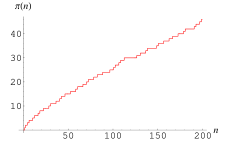
The prime counting function is the function  giving the number of primes
less than or equal to a given number
giving the number of primes
less than or equal to a given number  (Shanks 1993, p. 15). For example, there are no primes
 ,
so
,
so  .
There is a single prime (2)
.
There is a single prime (2)  , so
, so  . There are two primes (2 and 3)
  , so
, so  . And so on.
The notation  for the prime counting function is slightly unfortunate because it has nothing whatsoever
to do with the constant
for the prime counting function is slightly unfortunate because it has nothing whatsoever
to do with the constant 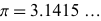 . This notation was introduced by number theorist
Edmund Landau in 1909 and has now become standard. In the words of Derbyshire (2004,
p. 38), "I am sorry about this; it is not my fault. You'll just have to
put up with it."
. This notation was introduced by number theorist
Edmund Landau in 1909 and has now become standard. In the words of Derbyshire (2004,
p. 38), "I am sorry about this; it is not my fault. You'll just have to
put up with it."
Letting  denote the
  th
prime,
th
prime, is a right inverse of
  since
since
 |
(1) |
for all positive integers. Also,
 |
(2) |
iff  is a prime number.
The first few values of  for
for  , 2, ... are 0, 1, 2, 2, 3, 3, 4, 4, 4, 4, 5, 5, 6, 6, 6,
... (OEIS A000720). The Wolfram
Language command giving the prime counting function for a number
, 2, ... are 0, 1, 2, 2, 3, 3, 4, 4, 4, 4, 5, 5, 6, 6, 6,
... (OEIS A000720). The Wolfram
Language command giving the prime counting function for a number  is PrimePi[x],
which works up to a maximum value of
is PrimePi[x],
which works up to a maximum value of  .
.
The notation  is used to denote the modular prime
counting function, i.e., the number of primes of the form
is used to denote the modular prime
counting function, i.e., the number of primes of the form  less than or equal to
  (Shanks 1993, pp. 21-22).
The following table gives the values of  for powers of 10 (OEIS A006880),
extending other printed tabulations (e.g., Hardy and Wright 1979, p. 4; Shanks
1993, pp. 242-243; Ribenboim 1996, p. 237; Derbyshire 2004, p. 35).
Note that
for powers of 10 (OEIS A006880),
extending other printed tabulations (e.g., Hardy and Wright 1979, p. 4; Shanks
1993, pp. 242-243; Ribenboim 1996, p. 237; Derbyshire 2004, p. 35).
Note that  was incorrectly computed as
  by Meissel (1885), which is off by 56 (Havil 2003,
p. 171), a result quoted by Hardy and Wright (1979) and Hardy (1999) and sometimes
(erroneously) known as Bertelsen's number. The
value for
by Meissel (1885), which is off by 56 (Havil 2003,
p. 171), a result quoted by Hardy and Wright (1979) and Hardy (1999) and sometimes
(erroneously) known as Bertelsen's number. The
value for  comes from Deleglise and Rivat (1996), and
  was reported by X. Gourdon on Oct. 27,
2000. Oliveira e Silva and X. Gourdon independently computed values for
was reported by X. Gourdon on Oct. 27,
2000. Oliveira e Silva and X. Gourdon independently computed values for  and
and  ,
but an error was found in the computations of Gourdon. The value given for
,
but an error was found in the computations of Gourdon. The value given for  was computed by Tomás Oliveira e Silva, who
verified this result using set sets of hardware and program parameters (pers. comm.,
Apr. 7, 2008). (Values of
was computed by Tomás Oliveira e Silva, who
verified this result using set sets of hardware and program parameters (pers. comm.,
Apr. 7, 2008). (Values of  computed independently by Oliveira e Silva and X. Gourdon
already agree for all powers of 10 up to
computed independently by Oliveira e Silva and X. Gourdon
already agree for all powers of 10 up to  .)
.)  was computed by Büthe (2014),
  by Staple in 2014 (Staple 2015), and
  by D. Baugh and K. Walisch (2015) using
the primecount fast prime counting function implementation (Walisch).
by D. Baugh and K. Walisch (2015) using
the primecount fast prime counting function implementation (Walisch).
One of the most fundamental and important results in number theory is the asymptotic form of  as
as  becomes large. This is given by the prime
number theorem, which states that
becomes large. This is given by the prime
number theorem, which states that
 |
(3) |
where  is the logarithmic integral and
  is asymptotic notation.
This relation was first postulated by Gauss in 1792 (when he was 15 years old), although
not revealed until an 1849 letter to Johann Encke and not published until 1863 (Gauss
1863; Havil 2003, pp. 176-177).
is asymptotic notation.
This relation was first postulated by Gauss in 1792 (when he was 15 years old), although
not revealed until an 1849 letter to Johann Encke and not published until 1863 (Gauss
1863; Havil 2003, pp. 176-177).
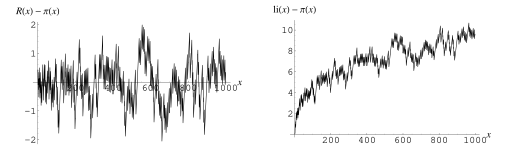
The following table compares the prime counting function  , Riemann
prime counting function
, Riemann
prime counting function  , and logarithmic integral
  for powers of ten, i.e.,
  . The corresponding differences are plotted above for
small
. The corresponding differences are plotted above for
small  .
Note that the values given by Hardy (1999, p. 26) for
.
Note that the values given by Hardy (1999, p. 26) for  are incorrect. In the following table,
 ![[x]](https://txtdot.deep-swarm.xyz/proxy/img?url=https%3A%2F%2Fmathworld.wolfram.com%2Fimages%2Fequations%2FPrimeCountingFunction%2FInline75.svg) denotes the nearest
integer function. A similar table comparing
denotes the nearest
integer function. A similar table comparing  and
and  is given by Borwein and Bailey (2003, p. 65).
The prime counting function can be expressed by Legendre's formula, Lehmer's formula, Mapes'
method, or Meissel's formula. A brief history
of attempts to calculate  is given by Berndt (1994). The following table is taken
from Riesel (1994), where
is given by Berndt (1994). The following table is taken
from Riesel (1994), where  is asymptotic notation.
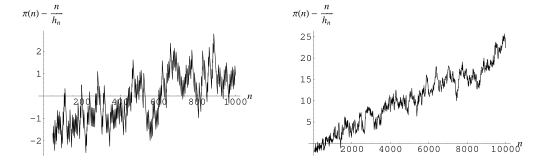
An approximate formula due to Locker-Ernst (Locker-Ernst 1959; Panaitopol 1999; Havil 2003, pp. 179-180), illustrated above, is given by
 |
(4) |
where  is related to the harmonic number
  by
by  . This formula is within
  of the actual value for
 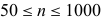 . The values for which
  are 1, 109, 113, 114, 199, 200, 201, ... (OEIS
A051046). Panaitopol (1999) shows that this
quantity is positive for all
are 1, 109, 113, 114, 199, 200, 201, ... (OEIS
A051046). Panaitopol (1999) shows that this
quantity is positive for all  .
.
An upper bound for  is given by
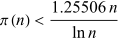 |
(5) |
for  ,
and a lower bound by
,
and a lower bound by
 |
(6) |
for  (Rosser and Schoenfeld 1962).
Hardy and Wright (1979, p. 414) give the formula
![pi(n)=-1+sum_(j=3)^n[(j-2)!-j|_((j-2)!)/j_|]](https://txtdot.deep-swarm.xyz/proxy/img?url=https%3A%2F%2Fmathworld.wolfram.com%2Fimages%2Fequations%2FPrimeCountingFunction%2FNumberedEquation7.svg) |
(7) |
for  ,
where
,
where  is the floor function.
A modified version of the prime counting function is given by
 |
(8) |
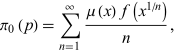 |
(9) |
where  is the Möbius function and
  is the Riemann
prime counting function.
is the Riemann
prime counting function.
Ramanujan also showed that
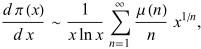 |
(10) |
where  is the Möbius function (Berndt 1994, p. 117;
Havil 2003, p. 199).
is the Möbius function (Berndt 1994, p. 117;
Havil 2003, p. 199).
The smallest  such that
  for
for  ,
3, ... are 2, 27, 96, 330, 1008, ... (OEIS A038625),
and the corresponding
,
3, ... are 2, 27, 96, 330, 1008, ... (OEIS A038625),
and the corresponding  are 1, 9, 24, 66, 168, 437, ... (OEIS A038626).
The number of solutions of
are 1, 9, 24, 66, 168, 437, ... (OEIS A038626).
The number of solutions of  for
for  , 3, ... are 4, 3, 3, 6, 7, 6, ... (OEIS A038627).
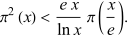
Ramanujan showed that for sufficiently large  ,
,
 |
(11) |
This holds for  ,
9, 10, 12, 14, 15, 16, 18, ... (OEIS A091886).
The largest known prime for which the inequality
fails is
,
9, 10, 12, 14, 15, 16, 18, ... (OEIS A091886).
The largest known prime for which the inequality
fails is  (Berndt 1994, pp. 112-113). The related inequality
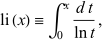
![[li(x)]^2<(ex)/(lnx)li(x/e)](https://txtdot.deep-swarm.xyz/proxy/img?url=https%3A%2F%2Fmathworld.wolfram.com%2Fimages%2Fequations%2FPrimeCountingFunction%2FNumberedEquation12.svg) |
(12) |
where
 |
(13) |
is true for  and no smaller number (Berndt 1994, p. 114).
See also
Bertelsen's Number, Chebyshev's Theorem, Equinumerous, Legendre's Constant, Legendre's Formula, Lehmer-Schur Method, Logarithmic Integral, Mapes' Method, Modular Prime Counting Function, Prime Arithmetic Progression, Prime-Counting Concatenation Constant, Prime Number, Prime Number Theorem, Riemann Prime Counting Function Explore this topic in the MathWorld classroom
Related Wolfram sites
http://functions.wolfram.com/NumberTheoryFunctions/PrimePi/
Explore with Wolfram|Alpha
References
Baugh, D. and Walisch, K. "New Confirmed pi(1027) Prime Counting Function Record." https://www.mersenneforum.org/showthread.php?t=20473.
Sep. 6, 2015.Beiler, A. H. Recreations
in the Theory of Numbers: The Queen of Mathematics Entertains. New York:
Dover, p. 218, 1966.Berndt, B. C. Ramanujan's
Notebooks, Part IV. New York: Springer-Verlag, pp. 134-135, 1994.Booker,
A. "The Nth Prime Page." http://primes.utm.edu/nthprime/.Borwein,
J. and Bailey, D. "Prime Numbers and the Zeta Function." Mathematics
by Experiment: Plausible Reasoning in the 21st Century. Wellesley, MA: A
K Peters, pp. 63-72, 2003.Brent, R. P. "Irregularities
in the Distribution of Primes and Twin Primes." Math. Comput. 29,
43-56, 1975.Büthe, J. "A Practical Analytic Method for Calculating
 II." 26 Oct 2014. http://arxiv.org/abs/1410.7008.Caldwell,
C. "How Many Primes Are There?" http://primes.utm.edu/howmany.shtml.Deleglise,
M. and Rivat, J. "Computing
II." 26 Oct 2014. http://arxiv.org/abs/1410.7008.Caldwell,
C. "How Many Primes Are There?" http://primes.utm.edu/howmany.shtml.Deleglise,
M. and Rivat, J. "Computing  : The Meissel, Lehmer, Lagarias, Miller, Odlyzko Method."
Math. Comput. 65, 235-245, 1996.Derbyshire, J. Prime
Obsession: Bernhard Riemann and the Greatest Unsolved Problem in Mathematics.
New York: Penguin, 2004.Finch, S. R. "Hardy-Littlewood Constants."
§2.1 in Mathematical
Constants. Cambridge, England: Cambridge University Press, pp. 84-94,
2003.Forbes, T. "Prime
: The Meissel, Lehmer, Lagarias, Miller, Odlyzko Method."
Math. Comput. 65, 235-245, 1996.Derbyshire, J. Prime
Obsession: Bernhard Riemann and the Greatest Unsolved Problem in Mathematics.
New York: Penguin, 2004.Finch, S. R. "Hardy-Littlewood Constants."
§2.1 in Mathematical
Constants. Cambridge, England: Cambridge University Press, pp. 84-94,
2003.Forbes, T. "Prime  -tuplets." http://anthony.d.forbes.googlepages.com/ktuplets.htm.Gauss,
C. F. Werke,
Band 10, Teil I. p. 10, 1863.Gourdon, X. "New Record
Computation for pi(x), x=10^21." 27 Oct 2000. http://listserv.nodak.edu/scripts/wa.exe?A2=ind0010&L=nmbrthry&P=2988.Guiasu,
S. "Is There Any Regularity in the Distribution of Prime Numbers at the Beginning
of the Sequence of Positive Integers?" Math. Mag. 68, 110-121,
1995.Hardy, G. H. Ramanujan:
Twelve Lectures on Subjects Suggested by His Life and Work, 3rd ed. New York:
Chelsea, 1999.Hardy, G. H. and Wright, E. M. An
Introduction to the Theory of Numbers, 5th ed. Oxford, England: Clarendon
Press, 1979.Havil, J. Gamma:
Exploring Euler's Constant. Princeton, NJ: Princeton University Press, pp. 164-188,
2003.Lagarias, J.; Miller, V. S.; and Odlyzko, A. "Computing
-tuplets." http://anthony.d.forbes.googlepages.com/ktuplets.htm.Gauss,
C. F. Werke,
Band 10, Teil I. p. 10, 1863.Gourdon, X. "New Record
Computation for pi(x), x=10^21." 27 Oct 2000. http://listserv.nodak.edu/scripts/wa.exe?A2=ind0010&L=nmbrthry&P=2988.Guiasu,
S. "Is There Any Regularity in the Distribution of Prime Numbers at the Beginning
of the Sequence of Positive Integers?" Math. Mag. 68, 110-121,
1995.Hardy, G. H. Ramanujan:
Twelve Lectures on Subjects Suggested by His Life and Work, 3rd ed. New York:
Chelsea, 1999.Hardy, G. H. and Wright, E. M. An
Introduction to the Theory of Numbers, 5th ed. Oxford, England: Clarendon
Press, 1979.Havil, J. Gamma:
Exploring Euler's Constant. Princeton, NJ: Princeton University Press, pp. 164-188,
2003.Lagarias, J.; Miller, V. S.; and Odlyzko, A. "Computing
 :
The Meissel-Lehmer Method." Math. Comput. 44, 537-560, 1985.Lagarias,
J. and Odlyzko, A. "Computing
:
The Meissel-Lehmer Method." Math. Comput. 44, 537-560, 1985.Lagarias,
J. and Odlyzko, A. "Computing  : An Analytic Method." J. Algorithms 8,
173-191, 1987.Locker-Ernst, L. "Bemerkung über die Verteilung
der Primzahlen." Elemente Math. (Basel) 14, 1-5, 1959.Mapes,
D. C. "Fast Method for Computing the Number of Primes Less than a Given
Limit." Math. Comput. 17, 179-185, 1963.Meissel,
E. D. F. "Über die Bestimmung der Primzahlmenge innerhalb gegebener
Grenzen." Math. Ann. 2, 636-642, 1870.Meissel, E. D. F.
"Berechnung der Menge von Primzahlen, welche innerhalb der ersten Milliarde
naturlicher Zahlen vorkommen." Math. Ann. 25, 251-257, 1885.Nagell,
T. "The Function
: An Analytic Method." J. Algorithms 8,
173-191, 1987.Locker-Ernst, L. "Bemerkung über die Verteilung
der Primzahlen." Elemente Math. (Basel) 14, 1-5, 1959.Mapes,
D. C. "Fast Method for Computing the Number of Primes Less than a Given
Limit." Math. Comput. 17, 179-185, 1963.Meissel,
E. D. F. "Über die Bestimmung der Primzahlmenge innerhalb gegebener
Grenzen." Math. Ann. 2, 636-642, 1870.Meissel, E. D. F.
"Berechnung der Menge von Primzahlen, welche innerhalb der ersten Milliarde
naturlicher Zahlen vorkommen." Math. Ann. 25, 251-257, 1885.Nagell,
T. "The Function  ." §16 in Introduction
to Number Theory. New York: Wiley, pp. 54-57, 1951.Panaitopol,
L. "Several Approximations of
." §16 in Introduction
to Number Theory. New York: Wiley, pp. 54-57, 1951.Panaitopol,
L. "Several Approximations of  ." Math. Ineq. Appl. 2, 317-324, 1999.Platt,
D. "Computing
." Math. Ineq. Appl. 2, 317-324, 1999.Platt,
D. "Computing  Analytically." To appear in Math. Comput.Ribenboim,
P. The
New Book of Prime Number Records, 3rd ed. New York: Springer-Verlag, 1996.Riesel,
H. "The Number of Primes Below
Analytically." To appear in Math. Comput.Ribenboim,
P. The
New Book of Prime Number Records, 3rd ed. New York: Springer-Verlag, 1996.Riesel,
H. "The Number of Primes Below  ." Prime
Numbers and Computer Methods for Factorization, 2nd ed. Boston, MA: Birkhäuser,
pp. 10-12, 1994.Rosser, J. B. and Schoenfeld, L. "Approximate
Formulas for Some Functions of Prime Numbers." Illinois J. Math. 6,
64-97, 1962.Séroul, R. "The Function pi(
." Prime
Numbers and Computer Methods for Factorization, 2nd ed. Boston, MA: Birkhäuser,
pp. 10-12, 1994.Rosser, J. B. and Schoenfeld, L. "Approximate
Formulas for Some Functions of Prime Numbers." Illinois J. Math. 6,
64-97, 1962.Séroul, R. "The Function pi( )." §8.7 in Programming
for Mathematicians. Berlin: Springer-Verlag, pp. 175-181, 2000.Shallit,
J. http://www.math.uwaterloo.ca/~shallit/bib/pi.bib.Shanks,
D. Solved
and Unsolved Problems in Number Theory, 4th ed. New York: Chelsea, 1993.Sloane,
N. J. A. Sequences A000720/M0256,
A006880/M3608, A038625,
A038626, A038627,
A052434, A052435,
A057752, A057794,
and A091886 in "The On-Line Encyclopedia
of Integer Sequences."Staple, D. B. "The Combinatorial
Algorithm for Computing
)." §8.7 in Programming
for Mathematicians. Berlin: Springer-Verlag, pp. 175-181, 2000.Shallit,
J. http://www.math.uwaterloo.ca/~shallit/bib/pi.bib.Shanks,
D. Solved
and Unsolved Problems in Number Theory, 4th ed. New York: Chelsea, 1993.Sloane,
N. J. A. Sequences A000720/M0256,
A006880/M3608, A038625,
A038626, A038627,
A052434, A052435,
A057752, A057794,
and A091886 in "The On-Line Encyclopedia
of Integer Sequences."Staple, D. B. "The Combinatorial
Algorithm for Computing  ." https://arxiv.org/abs/1503.01839.
28 May 2015.Vardi, I. Computational
Recreations in Mathematica. Reading, MA: Addison-Wesley, pp. 74-76,
1991.Walisch, K. "Fast Prime Counting Function Implementations."
https://github.com/kimwalisch/primecount.Wolf,
M. "Unexpected Regularities in the Distribution of Prime Numbers." http://www.ift.uni.wroc.pl/~mwolf/.
." https://arxiv.org/abs/1503.01839.
28 May 2015.Vardi, I. Computational
Recreations in Mathematica. Reading, MA: Addison-Wesley, pp. 74-76,
1991.Walisch, K. "Fast Prime Counting Function Implementations."
https://github.com/kimwalisch/primecount.Wolf,
M. "Unexpected Regularities in the Distribution of Prime Numbers." http://www.ift.uni.wroc.pl/~mwolf/.
Referenced on Wolfram|Alpha
Cite this as:
Weisstein, Eric W. "Prime Counting Function." From MathWorld--A Wolfram Resource. https://mathworld.wolfram.com/PrimeCountingFunction.html