The principal branch of an analytic multivalued function, also called a principal sheet, is a single-valued "slice"
(i.e., branch) of the function chosen that is for convenience
in referring to a specific canonical value (a so-called principal
value) of the function for each complex  .
.
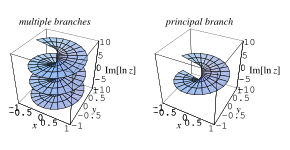
For example, the principal branch of the natural logarithm, sometimes denoted  , is the one for which
  , and hence is equal to the value
  for all
  (Knopp 1996, p. 111). The value of a function on
its principal branch is known as its principal value.
All values of
(Knopp 1996, p. 111). The value of a function on
its principal branch is known as its principal value.
All values of  then consist of

with  ,
..., with the principal branch corresponding to
,
..., with the principal branch corresponding to  . Since
  has only a single branch point,
all branches can be plotted to give the entire Riemann
surface.
has only a single branch point,
all branches can be plotted to give the entire Riemann
surface.
See also
Branch, Branch Cut, Branch Point, Lambert W-Function, Multivalued Function, Principal Value
Explore with Wolfram|Alpha
References
Knopp, K. Theory of Functions Parts I and II, Two Volumes Bound as One. New York: Dover, Part I, p. 111, 1996.
Referenced on Wolfram|Alpha
Cite this as:
Weisstein, Eric W. "Principal Branch." From MathWorld--A Wolfram Resource. https://mathworld.wolfram.com/PrincipalBranch.html