In this work, the name Pythagoras's constant will be given to the square root of 2,
 |
(1) |
(OEIS A002193), which the Pythagoreans proved to be irrational.
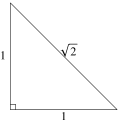
In particular,  is the length of the hypotenuse of an isosceles
right triangle with legs of length one, and the statement that it is irrational
means that it cannot be expressed as a ratio
is the length of the hypotenuse of an isosceles
right triangle with legs of length one, and the statement that it is irrational
means that it cannot be expressed as a ratio  of integers
  and
and  . Legend has it that the Pythagorean philosopher Hippasus used
geometric methods to demonstrate the irrationality of
. Legend has it that the Pythagorean philosopher Hippasus used
geometric methods to demonstrate the irrationality of  while at sea and, upon notifying his comrades of his
great discovery, was immediately thrown overboard by the fanatic Pythagoreans. A
slight generalization is sometimes known as Pythagoras's
theorem.
while at sea and, upon notifying his comrades of his
great discovery, was immediately thrown overboard by the fanatic Pythagoreans. A
slight generalization is sometimes known as Pythagoras's
theorem.
Theodorus subsequently proved that the square roots of the numbers from 3 to 17 (excluding 4, 9,and 16) are also irrational (Wells 1986, p. 34).
It is not known if Pythagoras's constant is normal to any base (Stoneham 1970, Bailey and Crandall 2003).
The continued fraction for  is periodic, as are all quadratic surds,
![sqrt(2)=[1,2,2,2,...]=[1,2^_]](https://txtdot.deep-swarm.xyz/proxy/img?url=https%3A%2F%2Fmathworld.wolfram.com%2Fimages%2Fequations%2FPythagorassConstant%2FNumberedEquation2.svg) |
(2) |
(OEIS A040000).
 has the Engel expansion 1, 3, 5, 5, 16, 18, 78,
102, 120, ... (OEIS A028254).
has the Engel expansion 1, 3, 5, 5, 16, 18, 78,
102, 120, ... (OEIS A028254).
It is apparently not known if any BBP-type formula exists for  ,
but
,
but  has the formulas
(E. W. Weisstein, Aug. 30, 2008).
The binary representation for  is given by
 |
(9) |
(OEIS A004539; Graham and Polack 1970; Bailey et al. 2003).
Using the Bhaskara-Brouncker square root algorithm for the case  ,
this gives the convergents to
,
this gives the convergents to  as 1, 3/2, 7/5, 17/12, 41/29, 99/70, ... (OEIS A001333
and A000129; Wells 1986, p. 34; Flannery
and Flannery 2000, p. 132; Derbyshire 2004, p. 16). The numerators are
given by the solutions to the linear recurrence
equation
as 1, 3/2, 7/5, 17/12, 41/29, 99/70, ... (OEIS A001333
and A000129; Wells 1986, p. 34; Flannery
and Flannery 2000, p. 132; Derbyshire 2004, p. 16). The numerators are
given by the solutions to the linear recurrence
equation
 |
(10) |
given by
![a(n)=1/2[(1-sqrt(2))^n+(1+sqrt(2))^n],](https://txtdot.deep-swarm.xyz/proxy/img?url=https%3A%2F%2Fmathworld.wolfram.com%2Fimages%2Fequations%2FPythagorassConstant%2FNumberedEquation5.svg) |
(11) |
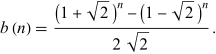
and the denominators are the Pell numbers, i.e., solutions to the same recurrence equation with  and
and  , which has solution
 |
(12) |
Every other value of  , i.e., 1, 7, 41, 239, ... (OEIS A002315)
produces the NSW numbers.
, i.e., 1, 7, 41, 239, ... (OEIS A002315)
produces the NSW numbers.
Ribenboim (1996, p. 369) considers prime values of  such that
  is prime, although he mistakenly refers to these as values
of
is prime, although he mistakenly refers to these as values
of  that yield prime NSW numbers. The first few such
  are 3, 5, 7, 19, 29, 47, 59, 163, 257, 421, 937, 947, 1493,
1901, ... (OEIS A005850).
are 3, 5, 7, 19, 29, 47, 59, 163, 257, 421, 937, 947, 1493,
1901, ... (OEIS A005850).
For  ,
the Newton's iteration square
root algorithm gives the convergents 1, 3/2, 17/12, 577/408, 665857/470832, ...
(OEIS A001601 and A051009).
,
the Newton's iteration square
root algorithm gives the convergents 1, 3/2, 17/12, 577/408, 665857/470832, ...
(OEIS A001601 and A051009).
The Babylonians gave the impressive approximation
 |
(13) |
(OEIS A070197; Wells 1986, p. 35; Guy 1990; Conway and Guy 1996, pp. 181-182; Flannery 2006, pp. 32-33).
See also
2, Delian Constant, Gelfond-Schneider Constant, Irrational Number, Isosceles Right Triangle, NSW Number, Octagon, Pythagoras's Constant Digits, Pythagoras's Theorem, Square, Square Root, Square Root Algorithms, Theodorus's Constant
Explore with Wolfram|Alpha
References
Bailey, D. H.; Borwein, J.; Crandall, R. E.; and Pomerance, C. "On the Binary Expansions of Algebraic Numbers." J. Théor.
Nombres Bordeaux 16, 487-518, 2004.Bailey, D. H. and
Crandall, R. E. "Random Generators and Normal Numbers." Exper.
Math. 11, 527-546, 2002.Conway, J. H. and Guy, R. K.
The
Book of Numbers. New York: Springer-Verlag, p. 25 and 181-182, 1996.Derbyshire,
J. Prime
Obsession: Bernhard Riemann and the Greatest Unsolved Problem in Mathematics.
New York: Penguin, 2004.Finch, S. R. "Pythagoras' Constant."
§1.1 in Mathematical
Constants. Cambridge, England: Cambridge University Press, pp. 1-5,
2003.Flannery, D. The
Square Root of 2: A Dialogue Concerning a Number and a Sequence. New York:
Copernicus, 2006.Flannery, S. and Flannery, D. In
Code: A Mathematical Journey. London: Profile Books, pp. 130-132, 2000.Good,
I. J. and Gover, T. N. "The Generalized Serial Test and the Binary
Expansion of  ."
J. Roy. Statist. Soc. Ser. A 130, 102-107, 1967.Good,
I. J. and Gover, T. N. "Corrigendum." J. Roy. Statist. Soc.
Ser. A 131, 434, 1968.Gourdon, X. and Sebah, P. "Pythagore's
Constant:
."
J. Roy. Statist. Soc. Ser. A 130, 102-107, 1967.Good,
I. J. and Gover, T. N. "Corrigendum." J. Roy. Statist. Soc.
Ser. A 131, 434, 1968.Gourdon, X. and Sebah, P. "Pythagore's
Constant:  ."
http://numbers.computation.free.fr/Constants/Sqrt2/sqrt2.html.Graham,
R. L. and Pollak, H. O. "Note on a Nonlinear Recurrence Related to
."
http://numbers.computation.free.fr/Constants/Sqrt2/sqrt2.html.Graham,
R. L. and Pollak, H. O. "Note on a Nonlinear Recurrence Related to
 ."
Math. Mag. 43, 143-145, 1970.Guy, R. K. "Review:
The Mathematics of Plato's Academy." Amer. Math. Monthly 97, 440-443,
1990.Jones, M. F. "22900D [sic] Approximations to the Square
Roots of the Primes Less Than 100." Math. Comput. 22, 234-235,
1968.Nagell, T. Introduction
to Number Theory. New York: Wiley, p. 34, 1951.Ribenboim,
P. The
New Book of Prime Number Records. New York: Springer-Verlag, 1996.Shanks,
D. Solved
and Unsolved Problems in Number Theory, 4th ed. New York: Chelsea, p. 126,
1993.Sloane, N. J. A. Sequences A000129/M1314,
A001333/M2665, A001601/M3042,
A002193/M3195, A004539,
A005850/M2426, A028254,
A040000, A051009,
and A070197 in "The On-Line Encyclopedia
of Integer Sequences."Stoneham, R. "A General Arithmetic Construction
of Transcendental Non-Liouville Normal Numbers from Rational Functions." Acta
Arith. 16, 239-253, 1970.Uhler, H. S. "Many-Figures
Approximations to
."
Math. Mag. 43, 143-145, 1970.Guy, R. K. "Review:
The Mathematics of Plato's Academy." Amer. Math. Monthly 97, 440-443,
1990.Jones, M. F. "22900D [sic] Approximations to the Square
Roots of the Primes Less Than 100." Math. Comput. 22, 234-235,
1968.Nagell, T. Introduction
to Number Theory. New York: Wiley, p. 34, 1951.Ribenboim,
P. The
New Book of Prime Number Records. New York: Springer-Verlag, 1996.Shanks,
D. Solved
and Unsolved Problems in Number Theory, 4th ed. New York: Chelsea, p. 126,
1993.Sloane, N. J. A. Sequences A000129/M1314,
A001333/M2665, A001601/M3042,
A002193/M3195, A004539,
A005850/M2426, A028254,
A040000, A051009,
and A070197 in "The On-Line Encyclopedia
of Integer Sequences."Stoneham, R. "A General Arithmetic Construction
of Transcendental Non-Liouville Normal Numbers from Rational Functions." Acta
Arith. 16, 239-253, 1970.Uhler, H. S. "Many-Figures
Approximations to  ,
and Distribution of Digits in
,
and Distribution of Digits in  and
and  ." Proc. Nat. Acad. Sci. U.S.A. 37,
63-67, 1951.Wells, D. The
Penguin Dictionary of Curious and Interesting Numbers. Middlesex, England:
Penguin Books, pp. 34-35, 1986.
." Proc. Nat. Acad. Sci. U.S.A. 37,
63-67, 1951.Wells, D. The
Penguin Dictionary of Curious and Interesting Numbers. Middlesex, England:
Penguin Books, pp. 34-35, 1986.
Referenced on Wolfram|Alpha
Cite this as:
Weisstein, Eric W. "Pythagoras's Constant." From MathWorld--A Wolfram Resource. https://mathworld.wolfram.com/PythagorassConstant.html