A right triangle is triangle with an angle of  (
( radians). The sides
  ,
,  ,
and
,
and  of such a triangle satisfy the Pythagorean
theorem
of such a triangle satisfy the Pythagorean
theorem
 |
(1) |
where the largest side is conventionally denoted  and is called the hypotenuse.
The other two sides of lengths
and is called the hypotenuse.
The other two sides of lengths  and
and  are called legs, or sometimes catheti.
The favorite A-level math exam question of the protagonist Christopher in the novel The
Curious Incident of the Dog in the Night-Time asks for proof that a triangle
with sides of the form  ,
,
 , and
, and  where
where  is a right triangle, and that the converse does not hold
(Haddon 2003, pp. 214 and 223-226).
is a right triangle, and that the converse does not hold
(Haddon 2003, pp. 214 and 223-226).

The side lengths  of a right triangle form a so-called Pythagorean
triple. A triangle that is not a right triangle
is sometimes called an oblique triangle. Special
cases of the right triangle include the isosceles
right triangle (middle figure) and 30-60-90
triangle (right figure).
of a right triangle form a so-called Pythagorean
triple. A triangle that is not a right triangle
is sometimes called an oblique triangle. Special
cases of the right triangle include the isosceles
right triangle (middle figure) and 30-60-90
triangle (right figure).
For any three similar shapes of area  on the sides of a right triangle,
 |
(2) |
which is equivalent to the Pythagorean theorem.

For a right triangle with sides  ,
,  ,
and hypotenuse
,
and hypotenuse  , the area is simply
 |
(3) |
The inradius can be found by equating the area of the triangle  with the sum of the areas of the three triangles
  ,
,  , and
, and  having the inradii as altitudes, giving
 |
(4) |
Solving for  then gives
 |
(5) |
This can also be written in the equivalent forms
The hypotenuse of a right triangle is a diameter of the triangle's circumcircle, so the circumradius is given by
 |
(8) |
A primitive right triangle is a right triangle having integer sides  ,
,  ,
and
,
and  such that
  ,
where
,
where  is the greatest common divisor. The set
of values
is the greatest common divisor. The set
of values  is then known as a primitive Pythagorean
triple.
is then known as a primitive Pythagorean
triple.
For a right triangle with integer side lengths, any primitive Pythagorean triple can be written
Using these, equation (6) becomes
which is an integer whenever  and
and  are integers (Ogilvy and Anderson 1988, p. 68).
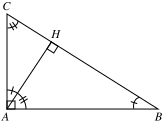
Given a right triangle  ,
draw the altitude
,
draw the altitude  from the right angle
  . Then the triangles
  and
and  are similar.

In a right triangle, the midpoint of the hypotenuse is equidistant from the three polygon vertices
(Dunham 1990). This can be proved as follows. Given  , let
, let  be the midpoint of
  (so that
  ). Draw
  , then since
  is similar to
  , it follows that
  . Since both
  and
and  are right triangles and the corresponding legs are
equal, the hypotenuses are also equal, so we have
are right triangles and the corresponding legs are
equal, the hypotenuses are also equal, so we have
 and the theorem is proved.
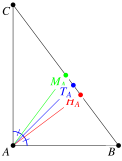
In addition, the triangle median  and altitude
  of a triangle
  are reflections about the angle
bisector
are reflections about the angle
bisector  of
of  iff
iff  is a right triangle (G. McRae, pers. comm., May
1, 2006).
is a right triangle (G. McRae, pers. comm., May
1, 2006).
Fermat showed how to construct an arbitrary number of equiareal nonprimitive right triangles. An analysis of Pythagorean triples
demonstrates that the right triangle generated by a triple  has common area
 |
(14) |
(Beiler 1966, pp. 126-127). The only extremum of this function occurs at  .
Since
.
Since  for
for  ,
the smallest area shared by three nonprimitive right
triangles is given by
,
the smallest area shared by three nonprimitive right
triangles is given by  ,
which results in an area of 840 and corresponds to the triplets (24, 70, 74), (40,
42, 58), and (15, 112, 113) (Beiler 1966, p. 126). One can also find quartets
of right triangles with the same area. The quartet
having the smallest known area is (111, 6160, 6161), (231, 2960, 2969), (518, 1320,
1418), (280, 2442, 2458), with area
,
which results in an area of 840 and corresponds to the triplets (24, 70, 74), (40,
42, 58), and (15, 112, 113) (Beiler 1966, p. 126). One can also find quartets
of right triangles with the same area. The quartet
having the smallest known area is (111, 6160, 6161), (231, 2960, 2969), (518, 1320,
1418), (280, 2442, 2458), with area  (Beiler 1966, p. 127). Guy (1994) gives additional
information.
(Beiler 1966, p. 127). Guy (1994) gives additional
information.
It is also possible to find sets of three and four right triangles having the same perimeter (Beiler 1966, pp. 131-132).
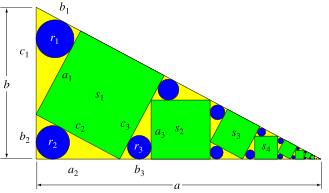
In a given right triangle, an infinite sequence of squares that alternately lie on the hypotenuse and longest leg can be constructed,
as illustrated above. These create a sequence of increasingly smaller similar right
triangles. Let the original triangle have legs of lengths  and
and  and hypotenuse of length
  . Also define
Then the sides of the  square are of length
 |
(17) |
Number the upper left triangle as 1, and then the remainder by following the "strip" of triangles at adjoining vertices. Then the side lengths of these triangles are
The inradii of the corresponding triangles can be found from
 |
(21) |
giving
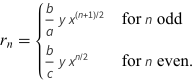 |
(22) |
A Sangaku problem from 1913 in the Miyagi Prefecture asks for the relationships between the first, third, and fifth inradii (Rothman 1998). This can be solved using elementary trigonometry as well as the explicit equations given above, and has solution
 |
(23) |
See also
30-60-90 Triangle, Acute Triangle, Archimedes' Midpoint Theorem, Brocard Midpoint, Cathetus, Circle-Point Midpoint Theorem, Dom, Euler-Gergonne-Soddy Triangle, Fermat's Right Triangle Theorem, Hypotenuse, Isosceles Right Triangle, Isosceles Triangle, Leg, Malfatti's Problem, Oblique Triangle, Obtuse Triangle, Primitive Right Triangle, Pythagorean Triangle, Pythagorean Triple, Quadrilateral, RAT-Free Set, Right Angle, Triangle, Trigonometry Explore this topic in the MathWorld classroom
Explore with Wolfram|Alpha
References
Beiler, A. H. "The Eternal Triangle." Ch. 14 in Recreations in the Theory of Numbers: The Queen of Mathematics Entertains. New York: Dover, 1966.Beyer, W. H. (Ed.). CRC Standard Mathematical Tables, 28th ed. Boca Raton, FL: CRC Press, p. 121, 1987.Dunham, W. Journey through Genius: The Great Theorems of Mathematics. New York: Wiley, pp. 120-121, 1990.Gardner, M. The Sixth Book of Mathematical Games from Scientific American. Chicago, IL: University of Chicago Press, pp. 160-161, 1984.Guy, R. K. "Triangles with Integer Sides, Medians, and Area." §D21 in Unsolved Problems in Number Theory, 2nd ed. New York: Springer-Verlag, pp. 188-190, 1994.Haddon, M. The Curious Incident of the Dog in the Night-Time. New York: Vintage, 2003.Kern, W. F. and Bland, J. R. Solid Mensuration with Proofs, 2nd ed. New York: Wiley, p. 2, 1948.Ogilvy, C. S. and Anderson, J. T. Excursions in Number Theory. New York: Dover, p. 68, 1988.Rothman, T. "Japanese Temple Geometry." Sci. Amer. 278, 85-91, May 1998.Sierpiński, W. Pythagorean Triangles. New York: Academic Press, 1962.Whitlock, W. P. Jr. "Rational Right Triangles with Equal Areas." Scripta Math. 9, 155-161, 1943a.Whitlock, W. P. Jr. "Rational Right Triangles with Equal Areas." Scripta Math. 9, 265-268, 1943b.
Referenced on Wolfram|Alpha
Cite this as:
Weisstein, Eric W. "Right Triangle." From MathWorld--A Wolfram Resource. https://mathworld.wolfram.com/RightTriangle.html