When a number is expressed in scientific notation, the number of significant digits (or significant figures) is the number of digits
needed to express the number to within the uncertainty of calculation. For example,
if a quantity is known to be 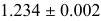 , four figures would be significant
The number of significant figures of a multiplication or division of two or more quantities is equal to the
smallest number of significant figures for the quantities involved. For addition
or subtraction, the number of significant figures
is determined with the smallest significant figure of all the quantities involved.
For example, the sum  is 115.7574, but should be written 115.8 (with rounding), since the quantity 5.2
is significant only to
is 115.7574, but should be written 115.8 (with rounding), since the quantity 5.2
is significant only to  .
.
See also
Accuracy, Fractional Part, Integer Part, Least Significant Bit, Nearest Integer Function, Precision, Rounding, Significance Arithmetic, Truncate
Explore with Wolfram|Alpha
References
Kenney, J. F. and Keeping, E. S. "Significant Figures." §1.5 in Mathematics of Statistics, Pt. 1, 3rd ed. Princeton, NJ: Van Nostrand, pp. 8-9, 1962.Mulliss, C. "Significant Figures and Rounding Rules." http://www.angelfire.com/oh/cmulliss/.
Referenced on Wolfram|Alpha
Cite this as:
Weisstein, Eric W. "Significant Digits." From MathWorld--A Wolfram Resource. https://mathworld.wolfram.com/SignificantDigits.html