|
|
|
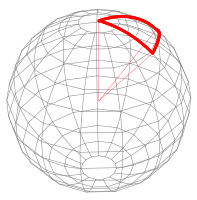

A spherical triangle is a figure formed on the surface of a sphere by three great circular arcs intersecting pairwise in three vertices.
The spherical triangle is the spherical analog of the planar triangle,
and is sometimes called an Euler triangle (Harris
and Stocker 1998). Let a spherical triangle have angles  ,
,  , and
, and  (measured in radians at the vertices along the surface of
the sphere) and let the sphere on which the spherical triangle sits have radius
(measured in radians at the vertices along the surface of
the sphere) and let the sphere on which the spherical triangle sits have radius  . Then the surface
area
. Then the surface
area  of the spherical triangle is
![Delta=R^2[(A+B+C)-pi]=R^2E,](https://txtdot.deep-swarm.xyz/proxy/img?url=https%3A%2F%2Fmathworld.wolfram.com%2Fimages%2Fequations%2FSphericalTriangle%2FNumberedEquation1.svg)
where  is called the spherical excess, with
  in the degenerate case of a planar triangle.
The sum of the angles of a spherical triangle is between  and
and  radians (
 and
and  ; Zwillinger 1995, p. 469). The amount by which
it exceeds
; Zwillinger 1995, p. 469). The amount by which
it exceeds  is called the spherical excess and is denoted
 or
or  ,
the latter of which can cause confusion since it also can refer to the surface
area of a spherical triangle. The difference between
,
the latter of which can cause confusion since it also can refer to the surface
area of a spherical triangle. The difference between  radians (
 ) and the sum of the side arc lengths
  ,
,  , and
, and  is called the spherical defect
and is denoted
is called the spherical defect
and is denoted  or
or  .
.
On any sphere, if three connecting arcs are drawn, two triangles are created. If each triangle takes up one hemisphere, then they are equal in size, but in general
there will be one larger and one smaller. Any spherical triangle can therefore be
considered both an inner and outer triangle, with the inner triangle usually being
assumed. The sum of the angles of an outer spherical triangle is between  and
and  radians.
The study of angles and distances of figures on a sphere is known as spherical trigonometry.
See also
Circular Triangle, Colunar Triangle, Geodesic Dome, Geodesic Triangle, Girard's Spherical Excess Formula, L'Huilier's Theorem, Napier's Analogies, Polar Triangle, Spherical Defect, Spherical Excess, Spherical Polygon, Spherical Trigonometry
Explore with Wolfram|Alpha
References
Abramowitz, M. and Stegun, I. A. (Eds.). Handbook of Mathematical Functions with Formulas, Graphs, and Mathematical Tables, 9th printing. New York: Dover, p. 79, 1972.Beyer, W. H. CRC Standard Mathematical Tables, 28th ed. Boca Raton, FL: CRC Press, pp. 131 and 147-150, 1987.Gellert, W.; Gottwald, S.; Hellwich, M.; Kästner, H.; and Künstner, H. (Eds.). "The Spherical Triangle." §12.2 in VNR Concise Encyclopedia of Mathematics, 2nd ed. New York: Van Nostrand Reinhold, pp. 262-272, 1989.Green, R. M. Textbook on Spherical Astronomy, 6th ed. Cambridge, England: Cambridge University Press, 1985.Harris, J. W. and Stocker, H. "General Spherical Triangle." §4.9.1 in Handbook of Mathematics and Computational Science. New York: Springer-Verlag, pp. 108-109, 1998.Hartle, J. B. Gravity: An Introduction to Einstein's General Relativity. San Francisco: Addison-Wesley, p. 18, 2003.Smart, W. M. Text-Book on Spherical Astronomy, 6th ed. Cambridge, England: Cambridge University Press, 1960.Zwillinger, D. (Ed.). "Spherical Geometry and Trigonometry." §6.4 in CRC Standard Mathematical Tables and Formulae. Boca Raton, FL: CRC Press, pp. 468-471, 1995.
Referenced on Wolfram|Alpha
Cite this as:
Weisstein, Eric W. "Spherical Triangle." From MathWorld--A Wolfram Resource. https://mathworld.wolfram.com/SphericalTriangle.html