|
|
|

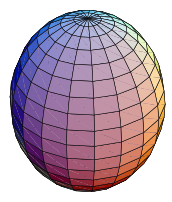
A spheroid is an ellipsoid having two axes of equal length, making it a surface of revolution.
By convention, the two distinct axis lengths are denoted  and
and  ,
and the spheroid is oriented so that its axis of rotational symmetric is along the
,
and the spheroid is oriented so that its axis of rotational symmetric is along the
 -axis, giving it the parametric representation
with  , and
, and ![v in [0,pi]](https://txtdot.deep-swarm.xyz/proxy/img?url=https%3A%2F%2Fmathworld.wolfram.com%2Fimages%2Fequations%2FSpheroid%2FInline14.svg) .
.
The Cartesian equation of the spheroid is
 |
(4) |
If  , the spheroid is called oblate
(left figure). If
, the spheroid is called oblate
(left figure). If  ,
the spheroid is prolate (right figure). If
,
the spheroid is prolate (right figure). If  , the spheroid degenerates to a sphere.
In the above parametrization, the coefficients of the first fundamental form are
and of the second fundamental form are
The Gaussian curvature is given by
![K(u,v)=(4c^2)/([a^2+c^2+(a^2-c^2)cos(2v)]^2),](https://txtdot.deep-swarm.xyz/proxy/img?url=https%3A%2F%2Fmathworld.wolfram.com%2Fimages%2Fequations%2FSpheroid%2FNumberedEquation2.svg) |
(11) |
the implicit Gaussian curvature by
![K(x,y,z)=(c^6)/([c^4+(a^2-c^2)z^2]^2),](https://txtdot.deep-swarm.xyz/proxy/img?url=https%3A%2F%2Fmathworld.wolfram.com%2Fimages%2Fequations%2FSpheroid%2FNumberedEquation3.svg) |
(12) |
and the mean curvature by
![H(u,v)=(c[3a^2+c^2+(a^2-c^2)cos(2v)])/(sqrt(2)a[a^2+c^2+(a^2-c^2)cos(2v)]^(3/2)).](https://txtdot.deep-swarm.xyz/proxy/img?url=https%3A%2F%2Fmathworld.wolfram.com%2Fimages%2Fequations%2FSpheroid%2FNumberedEquation4.svg) |
(13) |
The surface area of a spheroid can be variously written as
where
and 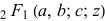 is a hypergeometric
function.
is a hypergeometric
function.
The volume of a spheroid can be computed from the formula for a general ellipsoid with  ,
,
(Beyer 1987, p. 131).
The moment of inertia tensor of a spheroid with  -axis along the axis of symmetry is given by
![I=[1/5M(a^2+c^2) 0 0; 0 1/5M(a^2+c^2) 0; 0 0 2/5Ma^2].](https://txtdot.deep-swarm.xyz/proxy/img?url=https%3A%2F%2Fmathworld.wolfram.com%2Fimages%2Fequations%2FSpheroid%2FNumberedEquation5.svg) |
(22) |
See also
Darwin-de Sitter Spheroid, Ellipsoid, Latitude, Longitude, North Pole, Oblate Spheroid, Prolate Spheroid, South Pole, Sphere
Explore with Wolfram|Alpha
References
Beyer, W. H. CRC Standard Mathematical Tables, 28th ed. Boca Raton, FL: CRC Press, 1987.
Referenced on Wolfram|Alpha
Cite this as:
Weisstein, Eric W. "Spheroid." From MathWorld--A Wolfram Resource. https://mathworld.wolfram.com/Spheroid.html