A recursive function devised by I. Takeuchi in 1978 (Knuth 1998). For integers  ,
,  ,
and
,
and  , it is defined by
 |
(1) |
This can be described more simply by
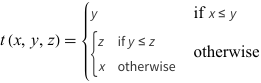 |
(2) |
Let  be the number of times "otherwise"
is called in the above function. Then
be the number of times "otherwise"
is called in the above function. Then  for
for  is given by
(Vardi 1991).
The Takeuchi numbers are defined by  .
.
The TAK function is also connected with the ballot problem (Vardi 1991).
See also
Ackermann Function, Ballot Problem, Recursive Function, Takeuchi Number, Takeuchi-Prellberg Constant
Explore with Wolfram|Alpha
References
Finch, S. R. Mathematical Constants. Cambridge, England: Cambridge University Press, p. 321, 2003.Gabriel, R. P. Performance and Implementation of Lisp Systems. Cambridge, MA: MIT Press, 1985.Knuth, D. E. "Textbook Examples of Recursion." Artificial Intelligence and Mathematical Theory of Computation, Papers in Honor of John McCarthy (Ed. V. Lifschitz). Boston, MA: Academic Press, pp. 207-229, 1990.Knuth, D. E. The Art of Computer Programming, Vol. 2: Seminumerical Algorithms, 3rd ed. Reading, MA: Addison-Wesley, 1998.Knuth, D. E. The Art of Computer Programming, Vol. 3: Sorting and Searching, 2nd ed. Reading, MA: Addison-Wesley, 1998.Vardi, I. "The Running Time of TAK." Ch. 9 in Computational Recreations in Mathematica. Redwood City, CA: Addison-Wesley, pp. 179-199, 1991.
Referenced on Wolfram|Alpha
Cite this as:
Weisstein, Eric W. "TAK Function." From MathWorld--A Wolfram Resource. https://mathworld.wolfram.com/TAKFunction.html