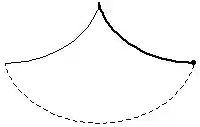
The problem of finding the curve down which a bead placed anywhere will fall to the bottom in the same amount of time. The solution is a cycloid, a fact first discovered and published by Huygens in Horologium oscillatorium (1673). This property was also alluded to in the following passage from Moby Dick: "[The try-pot] is also a place for profound mathematical meditation. It was in the left-hand try-pot of the Pequod, with the soapstone diligently circling round me, that I was first indirectly struck by the remarkable fact, that in geometry all bodies gliding along a cycloid, my soapstone, for example, will descend from any point in precisely the same time" (Melville 1851).
Huygens also constructed the first pendulum clock with a device to ensure that the pendulum was isochronous by forcing the pendulum to swing in an arc of a cycloid. This is accomplished by placing two evolutes of inverted cycloid arcs on each side of the pendulum's point of suspension against which the pendulum is constrained to move (Wells 1991, p. 47; Gray 1997, p. 123). Unfortunately, friction along the arcs causes a greater error than that corrected by the cycloidal path (Gardner 1984).
The parametric equations of the cycloid are
To see that the cycloid satisfies the tautochrone property, consider the derivatives
and
Now
 |
(7) |
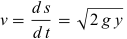 |
(8) |
so the time required to travel from the top of the cycloid to the bottom is
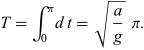 |
(13) |
However, from an intermediate point  ,
,
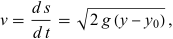 |
(14) |
so
To integrate, rearrange this equation using the half-angle formulas
with the latter rewritten in the form
 |
(19) |
to obtain
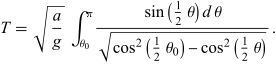 |
(20) |
Now transform variables to
so
and the amount of time is the same from any point.
See also
Brachistochrone Problem, Cycloid
Explore with Wolfram|Alpha
References
Gardner, M. The Sixth Book of Mathematical Games from Scientific American. Chicago, IL: University
of Chicago Press, pp. 129-130, 1984.Gray, A. Modern
Differential Geometry of Curves and Surfaces with Mathematica, 2nd ed. Boca
Raton, FL: CRC Press, 1997.Lagrange, J. L. "Sue les courbes
tautochrones." Mém. de l'Acad. Roy. des Sci. et Belles-Lettres de
Berlin 21, 1765. Reprinted in Oeuvres de Lagrange, tome 2, section
deuxième: Mémoires extraits des recueils de l'Academie royale des sciences
et Belles-Lettres de Berlin. Paris: Gauthier-Villars, pp. 317-332, 1868.Melville,
H. "The Tryworks." Ch. 96 in Moby
Dick. New York: Bantam, 1981. Originally published in 1851. Muterspaugh, J.; Driver,
T.; and Dick, J. E. "The Cycloid and Tautochronism." http://php.indiana.edu/~jedick/project/intro.htmlMuterspaugh, J.; Driver,
T.; and Dick, J. E. "P221 Tautochrone Problem." http://php.indiana.edu/~jedick/project/project.htmlPhillips,
J. P. "Brachistochrone, Tautochrone, Cycloid--Apple of Discord." Math.
Teacher 60, 506-508, 1967.Wagon, S. Mathematica
in Action. New York: W. H. Freeman, pp. 54-60 and 384-385, 1991.Wells,
D. The
Penguin Dictionary of Curious and Interesting Geometry. London: Penguin,
pp. 46-47, 1991.
Muterspaugh, J.; Driver,
T.; and Dick, J. E. "The Cycloid and Tautochronism." http://php.indiana.edu/~jedick/project/intro.htmlMuterspaugh, J.; Driver,
T.; and Dick, J. E. "P221 Tautochrone Problem." http://php.indiana.edu/~jedick/project/project.htmlPhillips,
J. P. "Brachistochrone, Tautochrone, Cycloid--Apple of Discord." Math.
Teacher 60, 506-508, 1967.Wagon, S. Mathematica
in Action. New York: W. H. Freeman, pp. 54-60 and 384-385, 1991.Wells,
D. The
Penguin Dictionary of Curious and Interesting Geometry. London: Penguin,
pp. 46-47, 1991.
Referenced on Wolfram|Alpha
Cite this as:
Weisstein, Eric W. "Tautochrone Problem." From MathWorld--A Wolfram Resource. https://mathworld.wolfram.com/TautochroneProblem.html