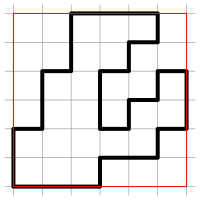
A lattice polygon formed by a three-choice walk. The anisotropic perimeter and area generating function

where  is the number of polygons with
  horizonal bonds,
  vertical bonds, and area
  , is not yet known in closed form, but it can be evaluated
in polynomial time (Conway et al. 1997, Bousquet-Mélou 1999). The perimeter-generating
function
, is not yet known in closed form, but it can be evaluated
in polynomial time (Conway et al. 1997, Bousquet-Mélou 1999). The perimeter-generating
function  has a logarithmic singularity and so is not algebraic, but is known to be D-finite
(Conway et al. 1997, Bousquet-Mélou 1999).
has a logarithmic singularity and so is not algebraic, but is known to be D-finite
(Conway et al. 1997, Bousquet-Mélou 1999).
The anisotropic area and perimeter generating function  satisfies an inversion relation of
the form
satisfies an inversion relation of
the form

(Bousquet-Mélou et al. 1999).
Explore with Wolfram|Alpha
References
Bousquet-Mélou, M.; Guttmann, A. J.; Orrick, W. P.; and Rechnitzer, A. "Inversion Relations, Reciprocity and Polyominoes." 23 Aug 1999. http://arxiv.org/abs/math.CO/9908123.Conway, A.; Cuttmann, A. J.; and Delest, M. "On the Number of Three-Choice Polygons." Math. Comput. Model. 26, 51-58, 1997.
Referenced on Wolfram|Alpha
Cite this as:
Weisstein, Eric W. "Three-Choice Polygon." From MathWorld--A Wolfram Resource. https://mathworld.wolfram.com/Three-ChoicePolygon.html