Let  and
and  be vectors. Then the triangle inequality is given by
 |
(1) |
Equivalently, for complex numbers  and
and  ,
,
 |
(2) |
Geometrically, the right-hand part of the triangle inequality states that the sum of the lengths of any two sides of a triangle is greater
than the length of the remaining side. So in addition to the side lengths of a triangle needing to be positive ( ,
,  ,
,  ), they must additionally satisfy
  ,
,  ,
,  .
.
A generalization is
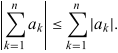 |
(3) |
See also
Metric Space, Ono Inequality, p-adic Number, Strong Triangle Inequality, Triangle, Triangle Inequalities, Triangular Inequalities Explore this topic in the MathWorld classroom
Explore with Wolfram|Alpha
References
Abramowitz, M. and Stegun, I. A. (Eds.). Handbook of Mathematical Functions with Formulas, Graphs, and Mathematical Tables, 9th printing. New York: Dover, p. 11, 1972.Apostol, T. M. Calculus, 2nd ed., Vol. 1: One-Variable Calculus, with an Introduction to Linear Algebra. Waltham, MA: Blaisdell, p. 42, 1967.Krantz, S. G. Handbook of Complex Variables. Boston, MA: Birkhäuser, p. 12, 1999.
Referenced on Wolfram|Alpha
Cite this as:
Weisstein, Eric W. "Triangle Inequality." From MathWorld--A Wolfram Resource. https://mathworld.wolfram.com/TriangleInequality.html