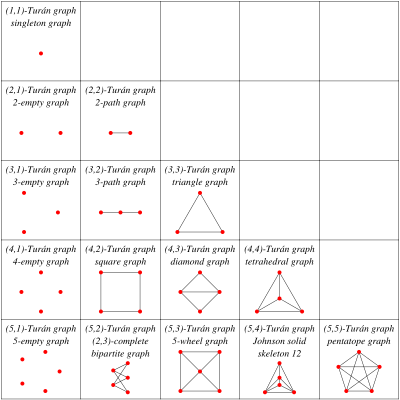
A Turán graph, sometimes called a maximally saturated graph (Zykov 1952, Chao and Novacky 1982), with positive integer parameters  and
and  is a type of extremal graph on
  vertices originally considered by Turán (1941). There
are unfortunately two different conventions for the index
vertices originally considered by Turán (1941). There
are unfortunately two different conventions for the index  .
.
In the more standard terminology (and that adopted here), the  -Turán graph, sometimes also called a K-graph and
variously denoted
-Turán graph, sometimes also called a K-graph and
variously denoted  ,
,
 (Gross and Yellen 2006, p. 476),
 (Chao and Novacky 1982), or
  (Pach and Agarwal 1995, p. 120),
is the extremal graph on
(Pach and Agarwal 1995, p. 120),
is the extremal graph on  graph vertices that contains
no
graph vertices that contains
no  -clique
for
-clique
for  (Chao and Novacky 1982;
Diestel 1997, p. 149; Bollobás 1998, p. 108). In other words, the
Turán graph has the maximum possible number of graph
edges of any
(Chao and Novacky 1982;
Diestel 1997, p. 149; Bollobás 1998, p. 108). In other words, the
Turán graph has the maximum possible number of graph
edges of any  -vertex
graph not containing a complete graph
-vertex
graph not containing a complete graph  . The Turán graph is also the complete
  -partite graph on
  vertices whose partite sets are as nearly equal in cardinality
as possible (Gross and Yellen 2006, p. 476).
vertices whose partite sets are as nearly equal in cardinality
as possible (Gross and Yellen 2006, p. 476).
Unfortunately, some authors, including Skiena (1990, pp. 143-144), Aigner (1995), and Pemmaraju and Skiena (2003, pp. 247-248), use the convention that the  -Turán graph contains no
  -clique (instead
of
-clique (instead
of  -clique),
meaning that the
-clique),
meaning that the  -Turán
graph of these authors is the
-Turán
graph of these authors is the  -Turán graph as defined above.
The Turán graph on  vertices that does not contain the complete graph
  can be generated in the Wolfram
Language using TuranGraph[n,
k] and precomputed properties are available using GraphData[
can be generated in the Wolfram
Language using TuranGraph[n,
k] and precomputed properties are available using GraphData[ "Turan",
  n, k
n, k
 ].
].
Turán graphs may be obtained by dividing a set of graph vertices  into
into  pairwise disjoint subsets with graph
vertices of degree
pairwise disjoint subsets with graph
vertices of degree  ,
...,
,
...,  , satisfying
 |
(1) |
and with two graph vertices joined iff they lie in distinct graph vertex sets. Such graphs
are sometimes denoted  .
.
They can be directly constructed by numbering the vertices 0, 1, ...,  and connecting vertices by an edge iff
when the vertices are incongruent modulo
and connecting vertices by an edge iff
when the vertices are incongruent modulo  (König 1936, Chao and Novacky 1982).
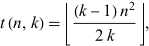
Turán's theorem gives the number of edges  for the
  -Turán graph as
 |
(2) |
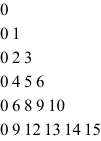
where  denotes the floor function. This gives the triangle
 |
(3) |
(OEIS A193331).
Turán graphs are chromatically unique (Chao and Novacky 1982). A Turán graph  is always strongly
regular if
is always strongly
regular if  (but may be regular even if
  ).
).
The chromatic number of  is
is  (Chao and Novacky 1982).
Special cases of Turán graphs are summarized in the following table.
The Turán graph ![T(n,[n/3])](https://txtdot.deep-swarm.xyz/proxy/img?url=https%3A%2F%2Fmathworld.wolfram.com%2Fimages%2Fequations%2FTuranGraph%2FInline55.svg) has
has  maximal cliques where
  and
and  , the largest number possible among all
  -vertex graphs (Moon and Moser 1965).
See also
Bipartite Graph, Clique, Complete Bipartite Graph, Complete Graph, Complete k-Partite Graph, k-Partite Graph, Extremal Graph, Extremal Graph Theory, Turán's Theorem
Explore with Wolfram|Alpha
References
Aigner, M. "Turán's Graph Theorem." Amer. Math. Monthly 102, 808-816, 1995.Bollobás, B. Extremal Graph Theory. New York: Academic Press, 1978.Bollobás, B. Modern Graph Theory. New York: Springer-Verlag, 1998.Chao, C. Y. and Novacky, G. A. Jr. "On Maximally Saturated Graphs." Disc. Math. 41, 139-143, 1982.Diestel, R. Graph Theory, 3rd ed. New York: Springer-Verlag, 1997.Gross, J. T. and Yellen, J. Graph Theory and Its Applications, 2nd ed. Boca Raton, FL: CRC Press, pp. 476-477, 2006.König, D. Theorie der endlichen under unendlichen Graphen. Leipzig, Germany: Akademic Verlag, 1936.Moon, J. W. and Moser, L. "On Cliques in Graphs." Israel J. Math. 3, 23-28, 1965.Pach, J. and Agarwal, P. K. Combinatorial Geometry. New York: Wiley, 1995.Pemmaraju, S. and Skiena, S. Computational Discrete Mathematics: Combinatorics and Graph Theory in Mathematica. Cambridge, England: Cambridge University Press, pp. 247-248, 2003.Skiena, S. Implementing Discrete Mathematics: Combinatorics and Graph Theory with Mathematica. Reading, MA: Addison-Wesley, pp. 143 and 218, 1990.Sloane, N. J. A. Sequence A193331 in "The On-Line Encyclopedia of Integer Sequences."Turán, P. "On an Extremal Problem in Graph Theory." Mat. Fiz. Lapok 48, 436-452, 1941.Turán, P. "On the Theorem of Graphs." Colloq. Math. 3, 19-30, 1954.Zykov, A. A. "On Some Properties of Linear Complexes." Mat. Sbornik N.S. 24, 163-188, 1949. Translation in Amer. Math. Soc. Transl., No. 79, 1-33, 1952.
Referenced on Wolfram|Alpha
Cite this as:
Weisstein, Eric W. "Turán Graph." From MathWorld--A Wolfram Resource. https://mathworld.wolfram.com/TuranGraph.html