Integrals over the unit square arising in geometric probability are
![int_0^1int_0^1sqrt(x^2+y^2)dxdy=1/3[sqrt(2)+sinh^(-1)(1)]
int_0^1int_0^1sqrt((x-1/2)^2+(y-1/2)^2)dxdy
=1/6[sqrt(2)+sinh^(-1)(1)],](https://txtdot.deep-swarm.xyz/proxy/img?url=https%3A%2F%2Fmathworld.wolfram.com%2Fimages%2Fequations%2FUnitSquareIntegral%2FNumberedEquation1.svg) |
(1) |
which give the average distances in square point picking from a point picked at random in a unit square to a corner and to the center, respectively.
Unit square integrals involving the absolute value are given by
for  and
and  ,
respectively.
,
respectively.
Another simple integral is given by
 |
(4) |
(Bailey et al. 2007, p. 67). Squaring the denominator gives
(OEIS A093754; M. Trott, pers. comm.), where  is Catalan's constant and
  is a generalized
hypergeometric function. A related integral is given by
is a generalized
hypergeometric function. A related integral is given by
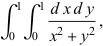 |
(10) |
which diverges in the Riemannian sense, as can quickly seen by transforming to polar coordinates. However, taking instead Hadamard integral to discard the divergent portion inside the unit circle gives
(OEIS A093753), where  is Catalan's constant.
A collection of beautiful integrals over the unit square are given by Guillera and Sondow (2005) that follow from the general integrals
for  ,
,
 if
if 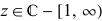 ,
and
,
and  if
if  ,
where
,
where  is the gamma function and
  is the Lerch transcendent.
In (15), to handle the case
is the Lerch transcendent.
In (15), to handle the case  , take the limit as
  , which gives (16).
Another result is
 |
(17) |
(Guillera and Sondow 2005), for  and where
  is the digamma function.
Guillera and Sondow (2005) also give
where the first holds for  , the second and third for
  ,
,  is the Riemann zeta
function,
is the Riemann zeta
function,  is the Dirichlet eta function, and
  is the Dirichlet
beta function. (19) was found by Hadjicostas (2002) for
is the Dirichlet
beta function. (19) was found by Hadjicostas (2002) for
 an integer. Formulas (18) and (19) are
special cases of (16) obtained by setting
an integer. Formulas (18) and (19) are
special cases of (16) obtained by setting  then taking
  and
and  , respectively.
The beautiful formulas
were given by Beukers (1979). These integrals are special cases of (19) obtained by taking  and 1, respectively. An analog involving Catalan's
constant
and 1, respectively. An analog involving Catalan's
constant  is given by
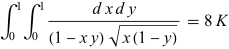 |
(23) |
(Zudilin 2003).
Other beautiful integrals related to Hadjicostas's formula are given by
(Sondow 2003, 2005; Borwein et al. 2004, p. 49), where  is the Euler-Mascheroni
constant.
is the Euler-Mascheroni
constant.
A collection of other special cases (Guillera and Sondow 2005) includes
where  is the Riemann zeta function,
  is Apéry's constant,
 is the golden ratio,
  is Somos's
quadratic recurrence constant, and
is Somos's
quadratic recurrence constant, and  is the Glaisher-Kinkelin
constant. Equation (57) appears in Sondow (2005), but is
a special case of the type considered by Guillera and Sondow (2005).
is the Glaisher-Kinkelin
constant. Equation (57) appears in Sondow (2005), but is
a special case of the type considered by Guillera and Sondow (2005).
Corresponding single integrals over ![[0,1]](https://txtdot.deep-swarm.xyz/proxy/img?url=https%3A%2F%2Fmathworld.wolfram.com%2Fimages%2Fequations%2FUnitSquareIntegral%2FInline196.svg) for most of these integrals can be found by making the
change of variables
for most of these integrals can be found by making the
change of variables  ,
,  . The Jacobian then gives
  , and the new limits of integration are
  ,
,  . Doing the integral with respect to
  then gives a 1-dimensional integral over
 ![[0,1]](https://txtdot.deep-swarm.xyz/proxy/img?url=https%3A%2F%2Fmathworld.wolfram.com%2Fimages%2Fequations%2FUnitSquareIntegral%2FInline203.svg) . For details, see the first part of the proof of Guillera-Sondow's
Theorem 3.1.
. For details, see the first part of the proof of Guillera-Sondow's
Theorem 3.1.
See also
Double Integral, Hadjicostas's Formula, Hypercube Line Picking, Square Point Picking, Unit Disk Integral, Unit Square
Explore with Wolfram|Alpha
References
Bailey, D. H.; Borwein, J. M.; Calkin, N. J.; Girgensohn, R.; Luke, D. R.; and Moll, V. H. Experimental
Mathematics in Action. Wellesley, MA: A K Peters, 2007.Beukers,
F. "A Note on the Irrationality of  and
and  ." Bull. London Math. Soc. 11, 268-272,
1979.Borwein, J.; Bailey, D.; and Girgensohn, R. Experimentation
in Mathematics: Computational Paths to Discovery. Wellesley, MA: A K Peters,
2004.Guillera, J. and Sondow, J. "Double Integrals and Infinite
Products for Some Classical Constants Via Analytic Continuations of Lerch's Transcendent."
16 June 2005. http://arxiv.org/abs/math.NT/0506319.Hadjicostas,
P. "Some Generalizations of Beukers' Integrals." Kyungpook Math. J. 42,
399-416, 2002.Sloane, N. J. A. Sequences A093753
and A093754 in "The On-Line Encyclopedia
of Integer Sequences."Sondow, J. "Criteria for Irrationality
of Euler's Constant." Proc. Amer. Math. Soc. 131, 3335-3344, 2003.
http://arxiv.org/abs/math.NT/0209070.Sondow,
J. "Double Integrals for Euler's Constant and
." Bull. London Math. Soc. 11, 268-272,
1979.Borwein, J.; Bailey, D.; and Girgensohn, R. Experimentation
in Mathematics: Computational Paths to Discovery. Wellesley, MA: A K Peters,
2004.Guillera, J. and Sondow, J. "Double Integrals and Infinite
Products for Some Classical Constants Via Analytic Continuations of Lerch's Transcendent."
16 June 2005. http://arxiv.org/abs/math.NT/0506319.Hadjicostas,
P. "Some Generalizations of Beukers' Integrals." Kyungpook Math. J. 42,
399-416, 2002.Sloane, N. J. A. Sequences A093753
and A093754 in "The On-Line Encyclopedia
of Integer Sequences."Sondow, J. "Criteria for Irrationality
of Euler's Constant." Proc. Amer. Math. Soc. 131, 3335-3344, 2003.
http://arxiv.org/abs/math.NT/0209070.Sondow,
J. "Double Integrals for Euler's Constant and  and an Analog of Hadjicostas's Formula." Amer.
Math. Monthly 112, 61-65, 2005.Zudilin, W. "An Apéry-Like
Difference Equation for Catalan's Constant." Electronic J. Combinatorics 10,
No. 1, R14, 1-10, 2003. http://www.combinatorics.org/Volume_10/Abstracts/v10i1r14.html.
and an Analog of Hadjicostas's Formula." Amer.
Math. Monthly 112, 61-65, 2005.Zudilin, W. "An Apéry-Like
Difference Equation for Catalan's Constant." Electronic J. Combinatorics 10,
No. 1, R14, 1-10, 2003. http://www.combinatorics.org/Volume_10/Abstracts/v10i1r14.html.
Referenced on Wolfram|Alpha
Cite this as:
Weisstein, Eric W. "Unit Square Integral." From MathWorld--A Wolfram Resource. https://mathworld.wolfram.com/UnitSquareIntegral.html