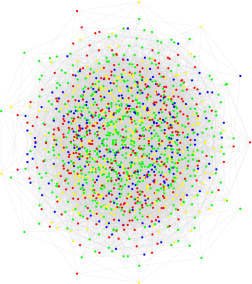
De Grey (2018) found the first examples of unit-distance graphs with chromatic number 5, thus demonstrating
that the solution to the Hadwiger-Nelson problem
(i.e., the chromatic number of the plane) is at least 5. While de Grey's original
graph contained  vertices, he was able to reduce this number (after a correction) to the 1581-vertex
graph illustrated above (de Grey 2018), referred to in this work as the de Grey graph.
vertices, he was able to reduce this number (after a correction) to the 1581-vertex
graph illustrated above (de Grey 2018), referred to in this work as the de Grey graph.
A few days after the original preprint was published, Mixon (2018) constructed a similar 1585-vertex graph, the removal of 8 vertices from which led to an even smaller 1577-vertex graph. This work terms these two graphs the Mixon graphs.
Smaller unit-distance graphs with chromatic number 5, here called the Heule graphs and Parts graphs, were computationally derived from the de Grey graph by Marijn Heule and Jaan Parts between 2018 and 2020. As of 2022, the smallest of these is the 509-vertex Parts graph (Parts 2020a).
The de Grey graph is implemented in the Wolfram Language as GraphData["DeGreyGraph"].
Additional graphs due to de Grey are 59- and 60-vertex graphs with chromatic number 6 that are unit-distance in 3 dimensions (but not 2) and a 126-vertex graph discussed by Parts (2020b).
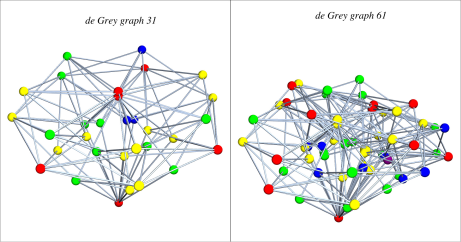
de Grey (2026) also constructed a 5-chromatic, triangle-free, unit-distance graph in three dimensions containing 61 vertices via spindling of a 31-vertex graph. These graphs are illustrated above. This 61-vertex graph graph is much smaller than the Voronov-Neopryatnaya-Dergachev graphs, which are two tetahedron-free graphs on 372 and 972 vertices which have unit-distance embeddings with all vertices on a sphere and having chromatic number 5. Exact coordinates for this graph were found by E. Weisstein (Dec. 19, 2025).
The de Grey graphs on 31, 60, 61, and 126 vertices are implemented in the Wolfram Language as GraphData["DeGreyGraph31"], GraphData["DeGreyGraph60"], GraphData["DeGreyGraph61"], and GraphData["DeGreyGraph126"], respectively.
See also
de Grey-Haugstrup Graphs, Golomb Graph, Hadwiger-Nelson Problem, Heule Graphs, Mixon Graphs, Moser Spindle, Parts Graphs, Unit-Distance Graph
Explore with Wolfram|Alpha
References
de Grey, A. D. N. J. "The Chromatic Number of the Plane Is at Least 5." Geombinatorics 28, No. 1,
18-31, 2018.de Grey, A. D. N. J. "A 5-Chromatic,
Triangle-Free Unit-Distance Graph in  With 61 Vertices." Geombinatorics 35,
2026.Heule, M. J. H. "Computing Small Unit-Distance Graphs
with Chromatic Number 5." Geombinatorics 28, 32-50, 2018.Lamb,
E. "Decades-Old Graph Problem Yields to Amateur Mathematician." Quanta
Mag. Apr. 17, 2018. https://www.quantamagazine.org/decades-old-graph-problem-yields-to-amateur-mathematician-20180417/.Mixon,
D. G. "The Chromatic Number of the Plane Is at Least 5."Apr. 10,
2018. https://dustingmixon.wordpress.com/2018/04/10/the-chromatic-number-of-the-plane-is-at-least-5/.Mixon,
D. G. "Polymath16, First Thread: Simplifying De Grey's Graph." 14
Apr 2018. https://dustingmixon.wordpress.com/2018/04/14/polymath16-first-thread-simplifying-de-greys-graph/.Parts,
J. "Graph Minimization, Focusing on the Example of 5-Chromatic Unit-Distance
Graphs in the Plane." Geombinatorics 29, No. 4, 137-166,
2020a.Parts, J. "A Small 6-Chromatic Two-Distance Graph in the
Plane." 23 Oct 2020b. https://arxiv.org/abs/2010.12656.PolyMath.
"Hadwiger-Nelson Problem." http://michaelnielsen.org/polymath1/index.php?title=Hadwiger-Nelson_problem.Soifer,
A. "Aubrey D. N. J. de Grey's Breakthrough" and "De
Grey's Construction." Ch. 51-52 in The
New Mathematical Coloring Book: Mathematics of Coloring and the Colorful Life of
Its Creators, 2nd ed. New York: Springer, pp. 657-674, 2024.
With 61 Vertices." Geombinatorics 35,
2026.Heule, M. J. H. "Computing Small Unit-Distance Graphs
with Chromatic Number 5." Geombinatorics 28, 32-50, 2018.Lamb,
E. "Decades-Old Graph Problem Yields to Amateur Mathematician." Quanta
Mag. Apr. 17, 2018. https://www.quantamagazine.org/decades-old-graph-problem-yields-to-amateur-mathematician-20180417/.Mixon,
D. G. "The Chromatic Number of the Plane Is at Least 5."Apr. 10,
2018. https://dustingmixon.wordpress.com/2018/04/10/the-chromatic-number-of-the-plane-is-at-least-5/.Mixon,
D. G. "Polymath16, First Thread: Simplifying De Grey's Graph." 14
Apr 2018. https://dustingmixon.wordpress.com/2018/04/14/polymath16-first-thread-simplifying-de-greys-graph/.Parts,
J. "Graph Minimization, Focusing on the Example of 5-Chromatic Unit-Distance
Graphs in the Plane." Geombinatorics 29, No. 4, 137-166,
2020a.Parts, J. "A Small 6-Chromatic Two-Distance Graph in the
Plane." 23 Oct 2020b. https://arxiv.org/abs/2010.12656.PolyMath.
"Hadwiger-Nelson Problem." http://michaelnielsen.org/polymath1/index.php?title=Hadwiger-Nelson_problem.Soifer,
A. "Aubrey D. N. J. de Grey's Breakthrough" and "De
Grey's Construction." Ch. 51-52 in The
New Mathematical Coloring Book: Mathematics of Coloring and the Colorful Life of
Its Creators, 2nd ed. New York: Springer, pp. 657-674, 2024.
Referenced on Wolfram|Alpha
Cite this as:
Weisstein, Eric W. "de Grey Graphs." From MathWorld--A Wolfram Resource. https://mathworld.wolfram.com/deGreyGraphs.html