Google OR-Tools: operations_research::CallMethod3< T, P, Q, R
Demon proxy to a method on the constraint with three arguments. More...
template<class T, class P, class Q, class R>
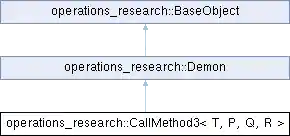
class operations_research::CallMethod3< T, P, Q, R >
Demon proxy to a method on the constraint with three arguments.
Definition at line 620 of file constraint_solveri.h.
#include <constraint_solveri.h>
Public Member Functions | |
| CallMethod3 (T *const ct, void(T::*method)(P, Q, R), const std::string &name, P param1, Q param2, R param3) | |
| ~CallMethod3 () override | |
| void | Run (Solver *const) override |
| This is the main callback of the demon. | |
| std::string | DebugString () const override |
| Public Member Functions inherited from operations_research::Demon | |
| Demon () | |
| Demon (const Demon &)=delete | |
| Demon & | operator= (const Demon &)=delete |
| ~Demon () override | |
| virtual Solver::DemonPriority | priority () const |
| std::string | DebugString () const override |
| void | inhibit (Solver *s) |
| void | desinhibit (Solver *s) |
| This method un-inhibits the demon that was previously inhibited. | |
| Public Member Functions inherited from operations_research::BaseObject | |
| BaseObject () | |
| BaseObject (const BaseObject &)=delete | |
| BaseObject & | operator= (const BaseObject &)=delete |
| virtual | ~BaseObject ()=default |
template<class T, class P, class Q, class R>
|
inline |
◆ ~CallMethod3()
template<class T, class P, class Q, class R>
◆ DebugString()
template<class T, class P, class Q, class R>
◆ Run()
template<class T, class P, class Q, class R>
The documentation for this class was generated from the following file:
- ortools/constraint_solver/constraint_solveri.h