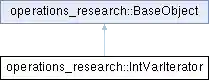
The class Iterator has two direct subclasses. HoleIterators iterates over all holes, that is value removed between the current min and max of the variable since the last time the variable was processed in the queue. DomainIterators iterates over all elements of the variable domain. Both iterators are not robust to domain changes. Hole iterators can also report values outside the current min and max of the variable. HoleIterators should only be called from a demon attached to the variable that has created this iterator. IntVar* current_var; std::unique_ptr<IntVarIterator> it(current_var->MakeHoleIterator(false)); for (const int64_t hole : InitAndGetValues(it)) { /// use the hole }
Definition at line 4275 of file constraint_solver.h.
#include <constraint_solver.h>
| operations_research::IntVarIterator::~IntVarIterator |
( |
| ) |
|
|
inlineoverride |
◆ DebugString()
| std::string operations_research::IntVarIterator::DebugString |
( |
| ) |
const |
|
inlineoverridevirtual |
◆ Init()
| virtual void operations_research::IntVarIterator::Init |
( |
| ) |
|
|
pure virtual |
This method must be called before each loop.
◆ Next()
| virtual void operations_research::IntVarIterator::Next |
( |
| ) |
|
|
pure virtual |
This method moves the iterator to the next value.
◆ Ok()
| virtual bool operations_research::IntVarIterator::Ok |
( |
| ) |
const |
|
pure virtual |
This method indicates if we can call Value() or not.
◆ Value()
| virtual int64_t operations_research::IntVarIterator::Value |
( |
| ) |
const |
|
pure virtual |
This method returns the current value of the iterator.
The documentation for this class was generated from the following file: