5.1. Iterator — Python - from None to AI
Iterate over a collection of objects
Usecase: Iterate over a group of users
Usecase: Iterate over browser history
The Iterator pattern is a design pattern that provides a way to access the elements of an aggregate object sequentially without exposing its underlying representation. In Python, this is typically implemented using the __iter__ and __next__ methods.
5.1.1. Problem
>>> class Group:
...     def __init__(self):
...         self.users = []
...
...     def add_user(self, user):
...         self.users.append(user)
...
...     def get_users(self):
...         return self.users
>>>
>>>
>>> admins = Group()
>>> admins.add_user('alice')
>>> admins.add_user('bob')
>>> admins.add_user('carol')
>>>
>>> for i in range(len(admins.get_users())):
...     print(admins.get_users()[i])
alice
bob
carol
5.1.2. Solution: Custom Iterator
>>> class Group:
...     def __init__(self):
...         self.users = []
...
...     def add_user(self, user):
...         self.users.append(user)
...
...     def __iter__(self):
...         self.current = 0
...         return self
...
...     def __next__(self):
...         if self.current >= len(self.users):
...             raise StopIteration
...         user = self.users[self.current]
...         self.current += 1
...         return user
>>>
>>>
>>> admins = Group()
>>> admins.add_user('alice')
>>> admins.add_user('bob')
>>> admins.add_user('carol')
>>>
>>> for user in admins:
...     print(user)
alice
bob
carol
5.1.3. Solution: Builtin Iterator
In Python you can access attributes directly
>>> class Group:
...     def __init__(self):
...         self.users = []
...
...     def add_user(self, user):
...         self.users.append(user)
>>>
>>>
>>> admins = Group()
>>> admins.add_user('alice')
>>> admins.add_user('bob')
>>> admins.add_user('carol')
>>>
>>> for user in admins.users:
...     print(user)
alice
bob
carol
5.1.4. Rationale
>>> class Group:
...     def __init__(self):
...         self.users = []
...
...     def add_user(self, user):
...         self.users.append(user)
...
...     def __iter__(self):
...         self.current = 0
...         return self
...
...     def __next__(self):
...         if self.current >= len(self.users):
...             raise StopIteration
...         user = self.users[self.current]
...         self.current += 1
...         return user
>>>
>>>
>>> admins = Group()
>>> admins.add_user('alice')
>>> admins.add_user('bob')
>>> admins.add_user('carol')
>>>
>>> hasattr(admins, '__iter__')
True
>>> hasattr(admins, '__next__')
True
>>>
>>> result = iter(admins)
>>> next(result)
'alice'
>>> next(result)
'bob'
>>> next(result)
'carol'
>>> next(result)
Traceback (most recent call last):
StopIteration
5.1.5. Internals
Iterable:
__iter__Iterator:
__iter__,__next__Generator:
__iter__,__next__,close,send,throw
>>> data = [1, 2, 3]
>>>
>>> for number in data:
...     print(number)
1
2
3
>>> data = [1, 2, 3]
>>> result = iter(data)
>>> try:
...     while True:
...         number = next(result)
...         print(number)
... except StopIteration:
...     pass
1
2
3
>>> data = [1, 2, 3]
>>> result = iter(data)
>>> try:
...     number = next(result)
...     print(number)
...
...     number = next(result)
...     print(number)
...
...     number = next(result)
...     print(number)
...
...     number = next(result)
...     print(number)
... except StopIteration:
...     pass
1
2
3
>>> data = [1, 2, 3]
>>> result = data.__iter__()
>>> try:
...     number = result.__next__()
...     print(number)
...
...     number = result.__next__()
...     print(number)
...
...     number = result.__next__()
...     print(number)
...
...     number = result.__next__()
...     print(number)
... except StopIteration:
...     pass
1
2
3
5.1.6. Builtins
Iterable:
__iter__Iterator:
__iter__,__next__Generator:
__iter__,__next__,close,send,throw
Iterable:
>>> data = range(0,3)
>>>
>>> data
range(0, 3)
>>>
>>> hasattr(data, '__iter__')
True
>>> hasattr(data, '__next__')
False
>>>
>>> result = iter(data)
>>> hasattr(result, '__iter__')
True
>>> hasattr(result, '__next__')
True
>>>
>>> next(result)
0
>>> next(result)
1
>>> next(result)
2
>>> next(result)
Traceback (most recent call last):
StopIteration
Iterator:
>>> data = [1, 2, 3]
>>> result = reversed(data)
>>>
>>> hasattr(result, '__iter__')
True
>>> hasattr(result, '__next__')
True
>>>
>>> next(result)
3
>>> next(result)
2
>>> next(result)
1
>>> next(result)
Traceback (most recent call last):
StopIteration
External Iterators:
>>> data = [1, 2, 3]
>>>
>>> iter(data)
<list_iterator object at 0x106475390>
>>>
>>> reversed(data)
<list_reverseiterator object at 0x106474b50>
5.1.7. Case Study
History (like browser history)
Problem:
class Group:
    def __init__(self):
        self.members = []

    def add_member(self, member):
        self.members.append(member)
        return self

    def get_members(self):
        return self.members


admins = Group()
admins.add_member('mwatney')
admins.add_member('mlewis')
admins.add_member('rmartinez')

for i in range(len(admins.get_members())):
    member = admins.get_members()[i]
    print(member)
# mwatney
# mlewis
# rmartinez
Solution:
class Group:
    def __init__(self):
        self.members = []

    def add_member(self, member):
        self.members.append(member)
        return self

    def __iter__(self):
        self._current = 0
        return self

    def __next__(self):
        if self._current >= len(self.members):
            raise StopIteration
        result = self.members[self._current]
        self._current += 1
        return result


admins = Group()
admins.add_member('mwatney')
admins.add_member('mlewis')
admins.add_member('rmartinez')

for member in admins:
    print(member)
# mwatney
# mlewis
# rmartinez
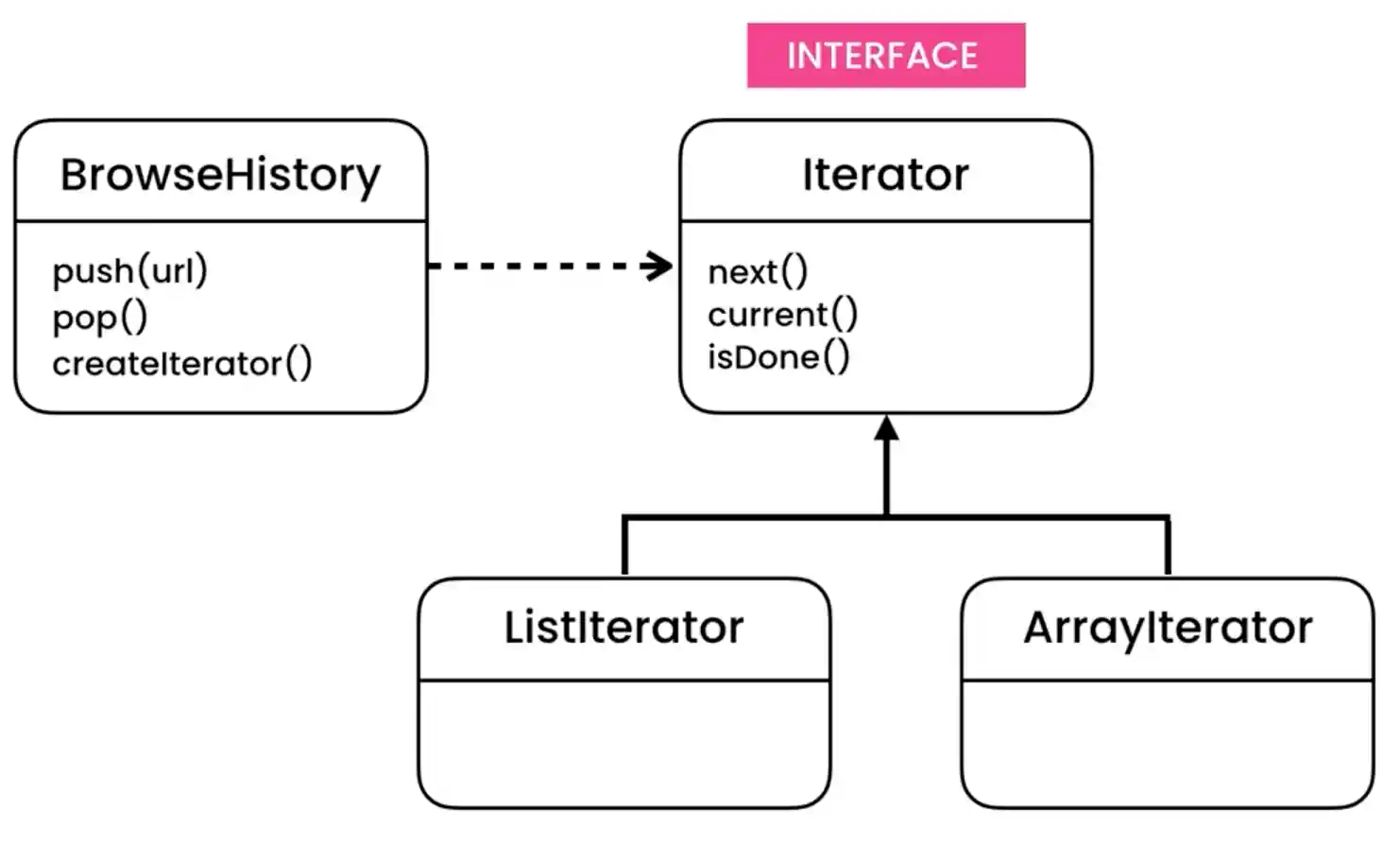
Diagram:
5.1.8. Use Case - 1
from typing import Self
from dataclasses import dataclass, field


@dataclass
class Browser:
    history: list[str] = field(default_factory=list)

    def open(self, url: str) -> None:
        self.history.append(url)
        # return urlopen(url).read()

    def __iter__(self) -> Self:
        self._current = 0
        return self

    def __next__(self) -> str:
        if self._current >= len(self.history):
            raise StopIteration
        result = self.history[self._current]
        self._current += 1
        return result


if __name__ == '__main__':
    browser = Browser()
    browser.open('https://python3.info')
    browser.open('https://numpy.astrotech.io')
    browser.open('https://pandas.astrotech.io')
    browser.open('https://design-patterns.astrotech.io')

    for url in browser:
        print(url)

# https://python3.info
# https://numpy.astrotech.io
# https://pandas.astrotech.io
# https://design-patterns.astrotech.io
5.1.9. Use Case - 2
from urllib.request import urlopen
from dataclasses import dataclass, field


@dataclass
class Browser:
    history: list[str] = field(default_factory=list)

    def open(self, url: str) -> None:
        self.history.append(url)
        # return urlopen(url).read()


if __name__ == '__main__':
    browser = Browser()
    browser.open('https://python3.info')
    browser.open('https://numpy.astrotech.io')
    browser.open('https://pandas.astrotech.io')
    browser.open('https://design-patterns.astrotech.io')

    for url in browser.history:
        print(url)

# https://python3.info
# https://numpy.astrotech.io
# https://pandas.astrotech.io
# https://design-patterns.astrotech.io
5.1.10. Use Case - 3
from dataclasses import dataclass, field


@dataclass
class BrowseHistory:
    urls: list[str] = field(default_factory=list)

    def push(self, url: str) -> None:
        self.urls.append(url)

    def pop(self) -> str:
        return self.urls.pop()

    def get_urls(self) -> list[str]:
        return self.urls


if __name__ == '__main__':
    history = BrowseHistory()
    history.push(url='https://a.example.com')
    history.push(url='https://b.example.com')
    history.push(url='https://c.example.com')

    for i in range(len(history.get_urls())):
        url = history.get_urls()[i]
        print(i)
from dataclasses import dataclass, field


class Iterator:
    def has_next(self) -> bool:
        raise NotImplementedError

    def current(self) -> str:
        raise NotImplementedError

    def next(self) -> None:
        raise NotImplementedError


@dataclass
class BrowseHistory:
    urls: list[str] = field(default_factory=list)

    def push(self, url: str) -> None:
        self.urls.append(url)

    def pop(self) -> str:
        return self.urls.pop()

    def get_urls(self) -> list[str]:
        return self.urls

    def create_iterator(self) -> Iterator:
        return self.ListIterator(self)

    @dataclass
    class ListIterator(Iterator):
        history: 'BrowseHistory'
        index: int = 0

        def has_next(self) -> bool:
            return self.index < len(history.urls)

        def current(self) -> str:
            return history.urls[self.index]

        def next(self) -> None:
            self.index += 1


if __name__ == '__main__':
    history = BrowseHistory()
    history.push(url='https://a.example.com')
    history.push(url='https://b.example.com')
    history.push(url='https://c.example.com')

    iterator = history.create_iterator()
    while iterator.has_next():
        url = iterator.current()
        print(url)
        iterator.next()

    # https://a.example.com
    # https://b.example.com
    # https://c.example.com
5.1.11. Use Case - 4
Overload
__iadd__operator
>>> class Group:
...     def __init__(self):
...         self.users = []
...
...     def __iadd__(self, user):
...         self.users.append(user)
...         return self
>>>
>>>
>>> admins = Group()
>>> admins += 'alice'
>>> admins += 'bob'
>>> admins += 'carol'
>>>
>>> for user in admins.users:
...     print(user)
alice
bob
carol
5.1.12. Assignments
# %% About
# - Name: DesignPatterns Behavioral Iterator
# - Difficulty: easy
# - Lines: 9
# - Minutes: 5

# %% License
# - Copyright 2025, Matt Harasymczuk <matt@python3.info>
# - This code can be used only for learning by humans
# - This code cannot be used for teaching others
# - This code cannot be used for teaching LLMs and AI algorithms
# - This code cannot be used in commercial or proprietary products
# - This code cannot be distributed in any form
# - This code cannot be changed in any form outside of training course
# - This code cannot have its license changed
# - If you use this code in your product, you must open-source it under GPLv2
# - Exception can be granted only by the author

# %% English
# 1. Implement Iterator pattern
# 2. Run doctests - all must succeed

# %% Polish
# 1. Zaimplementuj wzorzec Iterator
# 2. Uruchom doctesty - wszystkie muszą się powieść

# %% Doctests
"""
>>> import sys; sys.tracebacklimit = 0

>>> assert sys.version_info >= (3, 9), \
'Python has an is invalid version; expected: `3.9` or newer.'

>>> crew = Crew()
>>> crew += 'Alice'
>>> crew += 'Bob'
>>> crew += 'Carol'
>>>
>>> for member in crew:
...     print(member)
Alice
Bob
Carol
"""

# %% Run
# - PyCharm: right-click in the editor and `Run Doctest in ...`
# - PyCharm: keyboard shortcut `Control + Shift + F10`
# - Terminal: `python -m doctest -f -v myfile.py`

# %% Imports

# %% Types
from typing import Callable
Crew: type
__iadd__: Callable[[object, str], object]
__iter__: Callable[[object], object]
__next__: Callable[[object], str]

# %% Data

# %% Result
class Crew:
    def __init__(self):
        self.members = list()

    def __iadd__(self, other):
        self.members.append(other)
        return self
# %% About
# - Name: Protocol Iterator Implementation
# - Difficulty: easy
# - Lines: 9
# - Minutes: 3

# %% License
# - Copyright 2025, Matt Harasymczuk <matt@python3.info>
# - This code can be used only for learning by humans
# - This code cannot be used for teaching others
# - This code cannot be used for teaching LLMs and AI algorithms
# - This code cannot be used in commercial or proprietary products
# - This code cannot be distributed in any form
# - This code cannot be changed in any form outside of training course
# - This code cannot have its license changed
# - If you use this code in your product, you must open-source it under GPLv2
# - Exception can be granted only by the author

# %% English
# 1. Modify classes to implement iterator protocol
# 2. Iterator should return instances of `Group`
# 3. Run doctests - all must succeed

# %% Polish
# 1. Zmodyfikuj klasy aby zaimplementować protokół iterator
# 2. Iterator powinien zwracać instancje `Group`
# 3. Uruchom doctesty - wszystkie muszą się powieść

# %% Doctests
"""
>>> import sys; sys.tracebacklimit = 0

>>> assert sys.version_info >= (3, 9), \
'Python has an is invalid version; expected: `3.9` or newer.'

>>> from inspect import isclass, ismethod

>>> assert isclass(User), \
'Object `User` has an invalid type; expected: `class`.'


>>> mark = User('Mark', 'Watney')
>>> assert hasattr(mark, 'firstname'), \
'Object `mark` has an invalid attribute; expected: to have an attribute `firstname`.'

>>> assert hasattr(mark, 'lastname'), \
'Object `mark` has an invalid attribute; expected: to have an attribute `lastname`.'

>>> assert hasattr(mark, 'groups'), \
'Object `mark` has an invalid attribute; expected: to have an attribute `groups`.'

>>> assert hasattr(mark, '__iter__'), \
'Object `mark` has an invalid attribute; expected: to have an attribute `__iter__`.'

>>> assert hasattr(mark, '__next__'), \
'Object `mark` has an invalid attribute; expected: to have an attribute `__next__`.'

>>> assert ismethod(mark.__iter__)
>>> assert ismethod(mark.__next__)

>>> mark = User('Mark', 'Watney', groups=(
...     Group(gid=1, name='admins'),
...     Group(gid=2, name='staff'),
...     Group(gid=3, name='managers'),
... ))

>>> for mission in mark:
...     print(mission)
Group(gid=1, name='admins')
Group(gid=2, name='staff')
Group(gid=3, name='managers')
"""

# %% Run
# - PyCharm: right-click in the editor and `Run Doctest in ...`
# - PyCharm: keyboard shortcut `Control + Shift + F10`
# - Terminal: `python -m doctest -f -v myfile.py`

# %% Imports
from dataclasses import dataclass

# %% Types
from typing import Callable
User: type
__iter__: Callable[[object], object]
__next__: Callable[[object], object]

# %% Data
@dataclass
class Group:
    gid: int
    name: str

# %% Result
@dataclass
class User:
    firstname: str
    lastname: str
    groups: tuple = ()
# %% About
# - Name: Protocol Iterator Range
# - Difficulty: medium
# - Lines: 9
# - Minutes: 8

# %% License
# - Copyright 2025, Matt Harasymczuk <matt@python3.info>
# - This code can be used only for learning by humans
# - This code cannot be used for teaching others
# - This code cannot be used for teaching LLMs and AI algorithms
# - This code cannot be used in commercial or proprietary products
# - This code cannot be distributed in any form
# - This code cannot be changed in any form outside of training course
# - This code cannot have its license changed
# - If you use this code in your product, you must open-source it under GPLv2
# - Exception can be granted only by the author

# %% English
# 1. Modify class `Range` to write own implementation
#    of a built-in `range(start, stop, step)` function
# 2. Assume, that user will never give only one argument;
#    it will always be either two or three arguments
# 3. Use Iterator protocol
# 4. Run doctests - all must succeed

# %% Polish
# 1. Zmodyfikuj klasę `Range` aby napisać własną implementację
#    wbudowanej funkcji `range(start, stop, step)`
# 2. Przyjmij, że użytkownik nigdy nie poda tylko jednego argumentu;
#    zawsze będą to dwa lub trzy argumenty
# 3. Użyj protokołu Iterator
# 4. Uruchom doctesty - wszystkie muszą się powieść

# %% Doctests
"""
>>> import sys; sys.tracebacklimit = 0

>>> assert sys.version_info >= (3, 9), \
'Python has an is invalid version; expected: `3.9` or newer.'

>>> from inspect import isclass, ismethod

>>> assert isclass(Range), \
'Object `Range` has an invalid type; expected: `class`.'


>>> r = Range(0, 0, 0)
>>> assert hasattr(r, '__iter__'), \
'Object `r` has an invalid attribute; expected: to have an attribute `__iter__`.'

>>> assert hasattr(r, '__next__'), \
'Object `r` has an invalid attribute; expected: to have an attribute `__next__`.'

>>> assert ismethod(r.__iter__)
>>> assert ismethod(r.__next__)

>>> list(Range(0, 10, 2))
[0, 2, 4, 6, 8]

>>> list(Range(0, 5))
[0, 1, 2, 3, 4]
"""

# %% Run
# - PyCharm: right-click in the editor and `Run Doctest in ...`
# - PyCharm: keyboard shortcut `Control + Shift + F10`
# - Terminal: `python -m doctest -f -v myfile.py`

# %% Imports
from dataclasses import dataclass

# %% Types
from typing import Callable
Range: type
__iter__: Callable[[object], object]
__next__: Callable[[object], int]

# %% Data

# %% Result
@dataclass
class Range:
    start: int = 0
    stop: int = None
    step: int = 1