Convolutional Wasserstein Barycenter example — POT Python Optimal Transport 0.9.6 documentation
Note
Go to the end to download the full example code.
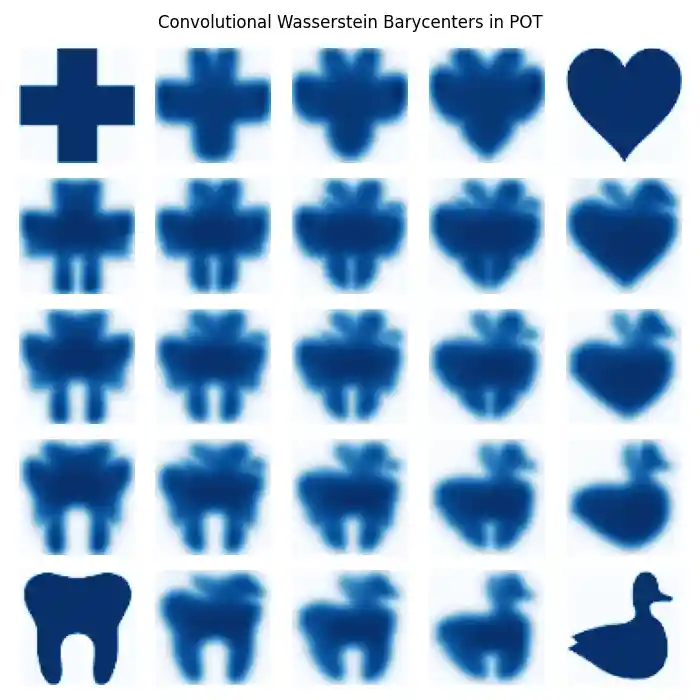
This example is designed to illustrate how the Convolutional Wasserstein Barycenter function of POT works.
# Author: Nicolas Courty <ncourty@irisa.fr>
#
# License: MIT License
import os
from pathlib import Path

import numpy as np
import matplotlib.pyplot as plt
import ot
Data preparation
The four distributions are constructed from 4 simple images
this_file = os.path.realpath("__file__")
data_path = os.path.join(Path(this_file).parent.parent.parent, "data")

f1 = 1 - plt.imread(os.path.join(data_path, "redcross.png"))[::2, ::2, 2]
f2 = 1 - plt.imread(os.path.join(data_path, "tooth.png"))[::2, ::2, 2]
f3 = 1 - plt.imread(os.path.join(data_path, "heart.png"))[::2, ::2, 2]
f4 = 1 - plt.imread(os.path.join(data_path, "duck.png"))[::2, ::2, 2]

f1 = f1 / np.sum(f1)
f2 = f2 / np.sum(f2)
f3 = f3 / np.sum(f3)
f4 = f4 / np.sum(f4)
A = np.array([f1, f2, f3, f4])

nb_images = 5

# those are the four corners coordinates that will be interpolated by bilinear
# interpolation
v1 = np.array((1, 0, 0, 0))
v2 = np.array((0, 1, 0, 0))
v3 = np.array((0, 0, 1, 0))
v4 = np.array((0, 0, 0, 1))
Barycenter computation and visualization
fig, axes = plt.subplots(nb_images, nb_images, figsize=(7, 7))
plt.suptitle("Convolutional Wasserstein Barycenters in POT")
cm = "Blues"
# regularization parameter
reg = 0.004
for i in range(nb_images):
    for j in range(nb_images):
        tx = float(i) / (nb_images - 1)
        ty = float(j) / (nb_images - 1)

        # weights are constructed by bilinear interpolation
        tmp1 = (1 - tx) * v1 + tx * v2
        tmp2 = (1 - tx) * v3 + tx * v4
        weights = (1 - ty) * tmp1 + ty * tmp2

        if i == 0 and j == 0:
            axes[i, j].imshow(f1, cmap=cm)
        elif i == 0 and j == (nb_images - 1):
            axes[i, j].imshow(f3, cmap=cm)
        elif i == (nb_images - 1) and j == 0:
            axes[i, j].imshow(f2, cmap=cm)
        elif i == (nb_images - 1) and j == (nb_images - 1):
            axes[i, j].imshow(f4, cmap=cm)
        else:
            # call to barycenter computation
            axes[i, j].imshow(
                ot.bregman.convolutional_barycenter2d(A, reg, weights), cmap=cm
            )
        axes[i, j].axis("off")
plt.tight_layout()
plt.show()
Total running time of the script: (0 minutes 20.537 seconds)