A programmer for fun, occasionally doing things that aren't useless
I’m Skye Owen-Lloyd-Walters, I’m one of those “programmer people” everyone likes to ask for printer advice. Sometimes I write code that does stuff, most of the time that code is purely for my own entertainment.
About me
I’m a software engineer I for the Metal as a Service team at Canonical. Prior to that, I studied Physics, Astronomy, and Cosmology and the University of Portsmouth where I graduated with First class Masters.
I love writing code with Python, and I reckon I’ve become fairly competent with it in the many years since 2011.
My primary interests are definitely spaceflight, astronomy, and programming. I wonder how many of those were obvious
Welcome to my personal website, I’ll steadily be adding anything of relevance here, collating all of my projects and occasionally dropping news and blog posts.
Do not attach a lot of weight to occasionally, I am... sporadic... with regular posts. Just look at my github commit history per repo.
news
| Apr 01, 2024 | This website gets a new look! |
|---|---|
| Sep 30, 2023 | I had the absolute pleasure of being invited as a panellist on the Brit astro Exoplanet webinar, where I presented my presentation: Computational Modelling of Transit Timing Variations. |
| May 01, 2023 | I’ve been promoted to Software Engineer I |
latest posts
selected publications
-

ExoClock Project IV: A homogeneous catalogue of 620 updated exoplanet ephemerides
arXiv, Nov 2025
The ExoClock project is an open platform aiming to monitor exoplanets by integrating observations from space and ground based telescopes. This study presents an updated catalogue of 620 exoplanet ephemerides, integrating 30000 measurements from ground-based telescopes (the ExoClock network), literature, and space telescopes (Kepler, K2 and TESS). The updated catalogue includes 277 planets from TESS which require special observing strategies due to their shallow transits or bright host stars. This study demonstrates that data from larger telescopes and the employment of new methodologies such as synchronous observations with small telescopes, are capable of monitoring special cases of planets. The new ephemerides show that 45% of the planets required an update while the results show an improvement of one order of magnitude in prediction uncertainty. The collective analysis also enabled the identification of new planets showing TTVs, highlighting the importance of extensive observing coverage. Developed in the context of the ESA’s Ariel space mission, with the goal of delivering a catalogue with reliable ephemerides to increase the mission efficiency, ExoClock’s scope and service have grown well beyond the remit of Ariel. The ExoClock project has been operating in the framework of open science, and all tools and products are accessible to everyone within academia and beyond, to support efficient scheduling of future exoplanet observations, especially from larger telescopes where the pressure for time allocation efficiency is higher (Ariel, JWST, VLT, ELT, Subaru etc). The inclusion of diverse audiences in the process and the collaborative mode not only foster democratisation of science but also enhance the quality of the results.
-
Determining The Parameters of Exoplanetary Candidates From Transit Timing Variations
J. Lloyd-Walters , S. Futcher , D. Thomas , and 1 more author
May 2022
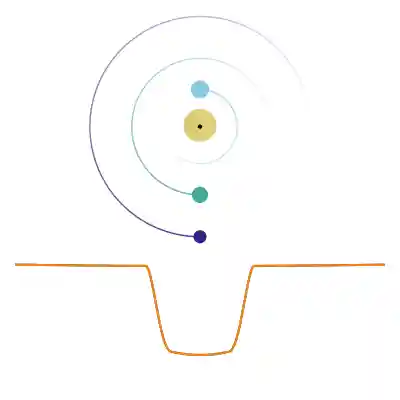
Transit Timing Variation (TTV) provides a powerful tool to probe the dynamical configuration of exoplanetary systems from historical transit data (Holman & Murray 2005; Agol et al. 2004). TTV analysis has allowed both verification of planetary parameters (Wang et al. 2017) and the discovery of new planetary bodies (Ballard et al. 2011) from transit observation alone. As part of this work, additional transit light curves have been collected with the 24" Ritchey-Chrétien telescope at Clanfield observatory and combined with the ExoClock database (Kokori et al. 2021, 2022), Exoplanet transit database (Poddaný et al. 2010), and TESS light curves (Ricker 2014) to create a set of historical TTV data for analysis. A set of extensible TTV models have been developed to analytically approximate the chaotic n-body nature of real planetary systems. A computational pipeline to automate model fitting using various parameter optimisation (Storn & Price 1995; Xiang et al. 1997) and model comparison (Akaike 1992, 1974; Hurvich & Tsai 1993; Schwarz 1978) techniques has been developed in-situ, allowing verification of model validity and analysis of TTV candidates using a combination of simulation and historical TTV data. The models developed were found to accurately describe TTV, and could determine the initial system parameters of simulated TTV systems to reasonable accuracy. Future work will allow extensions to these models, providing a more powerful suite of analytical tools for exoplanetary science, and the application of these methods to real exoplanetary systems with the possibility of new planetary discoveries.
-
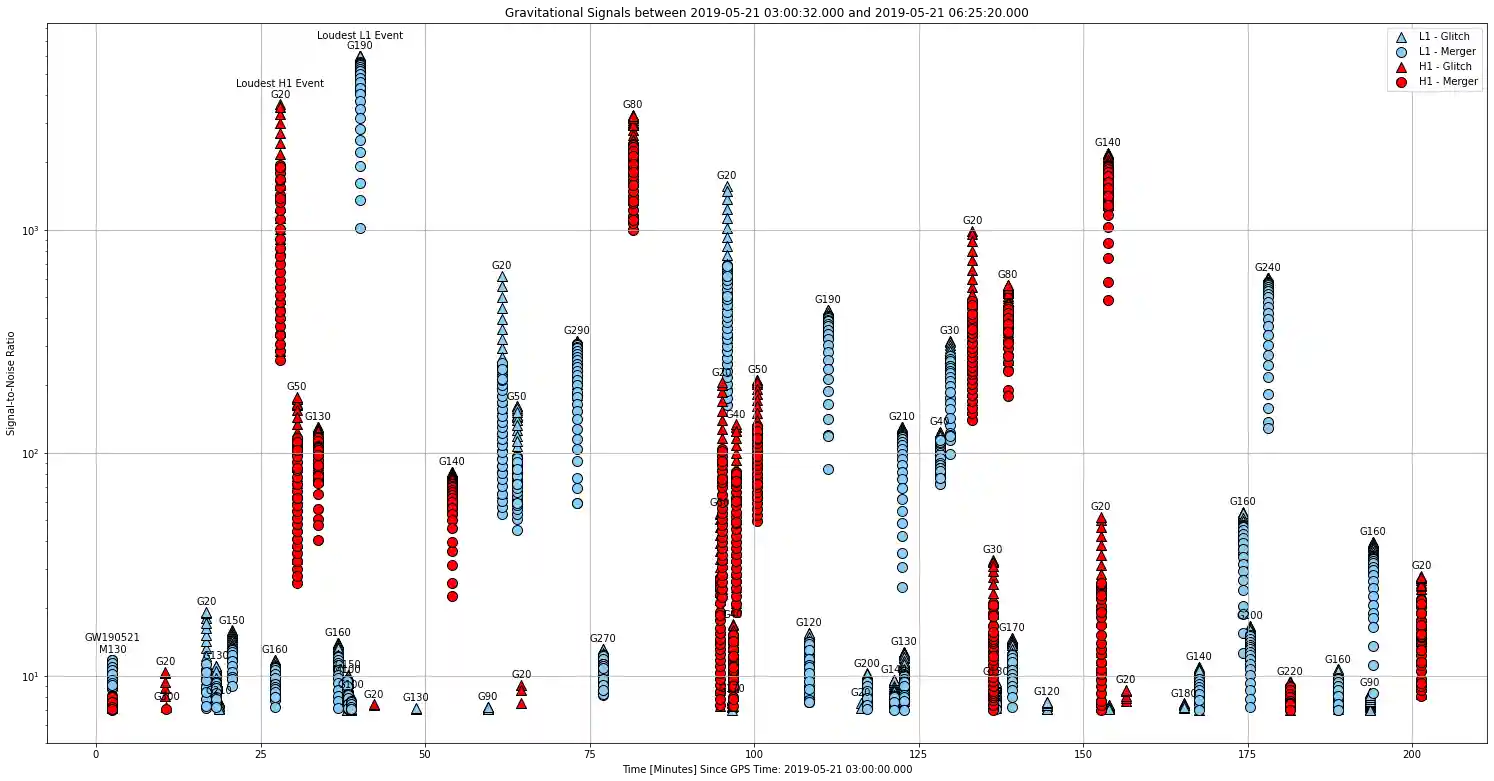
Distinguishing Intermediate Mass Black Hole Mergers From Short Duration Glitches
Jack Lloyd-Walters
May 2021
Glitches are a frequent occurrence with LIGO data, on the order of 10 an hour, and represent unwanted noise when searching for gravitational wave signals. Due to their similarity to IMBH merger events, they represent an obstacle to any search that deals with higher mass black holes. With a viable model of these glitch events, a full search could more easily distinguish IMBH mergers from short duration glitches. The glitch model created for this report was found to be accurate when searching against LIGO data using traditional matched filtering, and showed high similarity to events identified using the omicron scan, despite the difference in methods for detection. This glitch model was shown to not hinder a search for IMBH’s, as merger templates for GW190521 still responded more strongly than the glitch model, showing it’s safety in respect to true mergers. As such, this could pose a viable model for an extended search across a much larger swathe of LIGO data, with higher mass resolutions providing a logical improvement.


selected repositories