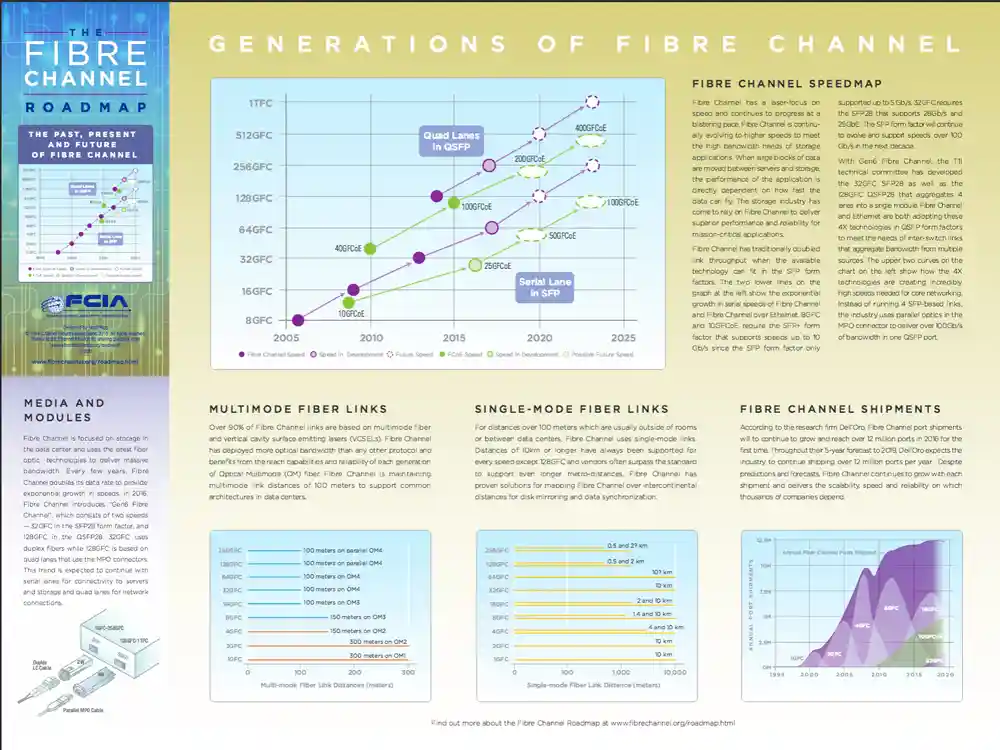
Roadmap Illustration
Featured Video
Webcasts

Presenters:
- Roger Hathorn, IBM
- Mark Jones, Broadcom
Data breaches are becoming more frequent and more expensive. In industries categorized as critical infrastructure – health care, financial services, pharmaceutical, energy, transportation, and industrial – the losses are significantly higher than in other sectors. Powerful new quantum computers will bring grave new threats on top of the increasing baseline risk. Cybersecurity experts fear that quantum computers will be able to crack cryptographic algorithms that have long resisted cyberattack by traditional computers.
In response, governments around the world have developed new laws and regulations aimed at modernizing data centers. With the recent INCITS FC-SP-3 standard, the Fibre Channel industry has responded with new standards that tighten the security on what is already considered the world most secure – and in fact, air-gapped – network technology upon which critical infrastructures rely for their most valuable data assets.
In this webinar, industry experts will discuss:
- Significant recent data center security breaches that are forcing the industry to respond
- The new Zero-Trust government regulations that will require more stringent storage network security.
- Updates and changes in INCITS FC-SP-3
- Data encryption approaches – Application based encryption vs FC In-flight and Storage at-rest data encryption
- Real world implementation examples and use cases
Presenters:
- Howard Johnson, Broadcom
- Ed Mazurek, Cisco
- Dave Peterson, Broadcom
Click here to view on-demand.
Click here to watch on Youtube.
Click here to view the presentation slides.
Storage networking consumers are fully aware of the classic benefits of Fibre Channel as a dedicated storage networking solution that provides reliable and lossless data transfer as well as high availability and redundancy. What is less known is that Fibre Channel supports several Upper Layer Protocols (ULPs) including SCSI, FICON, NVMe, Avionics and RDMA. In this webinar, we explore the FC-4 layer of the Fibre Channel architecture that provides the services used by the various ULPs deployed in Fibre Channel products. Join us for an exploration into:
• The history of Fibre Channel’s versatility
• Fibre Channel architectural layers
• Overview of the current FC-4 transports: FCP, FC-SB, FC-NVMe, FC-RDMA
Attendees of the webinar will become well versed in the scope and capabilities of Fibre Channel and develop a well-rounded understanding of the technology.
Presenters:
- Andy Adams, Adtran
- Gene Cannella, Adtran
- Moderator: David Rodgers, EXFO
Watch on FCIA Youtube Channel
Watch on-Demand on BrightTalk
Click here to view the presentation slides.
Organizations often operate data centers in multiple locations and are often geographically distributed to provide scale and disaster recovery capabilities. As with any fabric topology, scalability, data integrity and security are key requirements. This webinar will discuss how Fibre Channel can be effectively deployed in these applications using optical transport technology. Topics to be covered:
- Optical Transport 101: A brief survey of optical networking (DWDM) technology
- Fibre Channel transport via OTN
- Robustness: Optical transport protection options: Resiliency against fiber outages
- Security: Optical transport OTN encryption: No-overhead layer 1 encryption that can be combined with IPSec or other higher-layer security protocols
Presenters:
- Kamal Bakshi, Cisco
- Mark Jones, Broadcom
- Nishant Lodha, Marvell
- David Rodgers, EXFO
Watch on FCIA Youtube Channel
Watch on-demand on BrightTalk
Click here to view the presentation slides.
The majority of today’s SAN infrastructure leverage the traditional SCSI/FCP protocol. The relatively new NVMe/FC protocol has become ubiquitous in enterprise storage offerings, delivering multiple advantages including high performance, low tail latency, and precision error recovery that can run on the same FC SAN infrastructure. In this talk we will discuss:
- The architecture of NVMe/FC at protocol level
- Building blocks of NVMe like NVMe subsystem
- NVMe controllers, Namespaces etc.
- Overview of FC-NVMe T11 standards
- Key advantages of NVMe/FC, including application use cases
Fibre Channel Solutions Guide
Happy Anniversary to the Fibre Channel Industry Association (FCIA) – 30 years and still going strong! For three decades…
In-memory databases have been around for a long time. They operate by managing data in random access memory (RAM) instead of the non-volatile storage that traditional relational database management system (RDBMS) databases rely on. An in-memory database runs…
I cannot wait for self-driving cars! I want to be able to hop in my car, say, “go to work,” and have it get me there safe and sound – under any circumstances. Yet, with all of the advancements…
As data demands continue to grow exponentially, the need for robust and reliable high-speed data transport solutions is paramount. 64G Fibre Channel (64GFC) technology is becoming a critical tool in the arsenal of modern data centers…
Data breaches are becoming more frequent and more expensive. In industries categorized as critical infrastructure – health care, financial services, pharmaceutical, energy, transportation, and industrial – the losses are significantly higher than in other sectors…
The technology landscape is continuously evolving with ever-growing demands for faster data access, storage, and transmission. One of the latest advancements in this domain is the introduction of the 128GFC (128 Gigabit Fibre Channel), often called Gen 8. Fibre Channel has long been the go-to protocol for mission critical, high-performance storage networks, primarily in data centers. This new iteration promises to significantly boost data throughput, reduce latency, and provide greater scalability….
Sponsor Members
Principal Members
Observer Member