tf.gather
Gather slices from params axis axis according to indices. (deprecated arguments)
tf.gather(
    params, indices, validate_indices=None, axis=None, batch_dims=0, name=None
)
Used in the notebooks
| Used in the guide | Used in the tutorials |
|---|---|
Gather slices from params axis axis according to indices. indices
must be an integer tensor of any dimension (often 1-D).
Tensor.getitem works for scalars, tf.newaxis, and
python slices
tf.gather extends indexing to handle tensors of indices.
In the simplest case it's identical to scalar indexing:
params = tf.constant(['p0', 'p1', 'p2', 'p3', 'p4', 'p5'])params[3].numpy()b'p3'tf.gather(params, 3).numpy()b'p3'
The most common case is to pass a single axis tensor of indices (this can't be expressed as a python slice because the indices are not sequential):
indices = [2, 0, 2, 5]tf.gather(params, indices).numpy()array([b'p2', b'p0', b'p2', b'p5'], dtype=object)
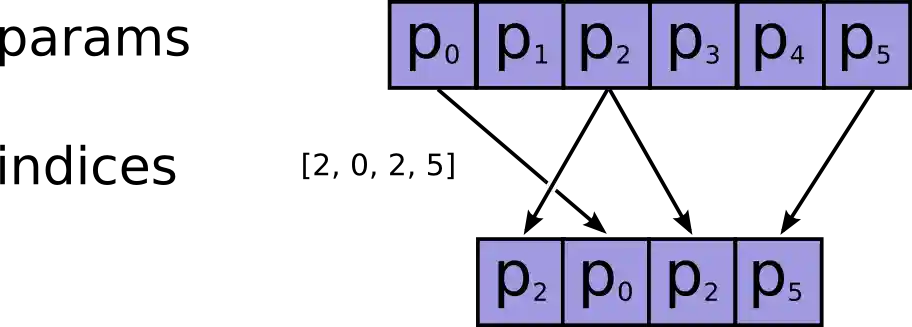
The indices can have any shape. When the params has 1 axis, the
output shape is equal to the input shape:
tf.gather(params, [[2, 0], [2, 5]]).numpy()array([[b'p2', b'p0'],[b'p2', b'p5']], dtype=object)
The params may also have any shape. gather can select slices
across any axis depending on the axis argument (which defaults to 0).
Below it is used to gather first rows, then columns from a matrix:
params = tf.constant([[0, 1.0, 2.0],[10.0, 11.0, 12.0],[20.0, 21.0, 22.0],[30.0, 31.0, 32.0]])tf.gather(params, indices=[3,1]).numpy()array([[30., 31., 32.],[10., 11., 12.]], dtype=float32)tf.gather(params, indices=[2,1], axis=1).numpy()array([[ 2., 1.],[12., 11.],[22., 21.],[32., 31.]], dtype=float32)
More generally: The output shape has the same shape as the input, with the indexed-axis replaced by the shape of the indices.
def result_shape(p_shape, i_shape, axis=0):return p_shape[:axis] + i_shape + p_shape[axis+1:]result_shape([1, 2, 3], [], axis=1)[1, 3]result_shape([1, 2, 3], [7], axis=1)[1, 7, 3]result_shape([1, 2, 3], [7, 5], axis=1)[1, 7, 5, 3]
Here are some examples:
params.shape.as_list()[4, 3]indices = tf.constant([[0, 2]])tf.gather(params, indices=indices, axis=0).shape.as_list()[1, 2, 3]tf.gather(params, indices=indices, axis=1).shape.as_list()[4, 1, 2]
params = tf.random.normal(shape=(5, 6, 7, 8))indices = tf.random.uniform(shape=(10, 11), maxval=7, dtype=tf.int32)result = tf.gather(params, indices, axis=2)result.shape.as_list()[5, 6, 10, 11, 8]
This is because each index takes a slice from params, and
places it at the corresponding location in the output. For the above example
# For any location in indicesa, b = 0, 1tf.reduce_all(# the corresponding slice of the resultresult[:, :, a, b, :] ==# is equal to the slice of `params` along `axis` at the index.params[:, :, indices[a, b], :]).numpy()True
Batching:
The batch_dims argument lets you gather different items from each element
of a batch.
Using batch_dims=1 is equivalent to having an outer loop over the first
axis of params and indices:
params = tf.constant([[0, 0, 1, 0, 2],[3, 0, 0, 0, 4],[0, 5, 0, 6, 0]])indices = tf.constant([[2, 4],[0, 4],[1, 3]])
tf.gather(params, indices, axis=1, batch_dims=1).numpy()array([[1, 2],[3, 4],[5, 6]], dtype=int32)
This is equivalent to:
def manually_batched_gather(params, indices, axis):batch_dims=1result = []for p,i in zip(params, indices):r = tf.gather(p, i, axis=axis-batch_dims)result.append(r)return tf.stack(result)manually_batched_gather(params, indices, axis=1).numpy()array([[1, 2],[3, 4],[5, 6]], dtype=int32)
Higher values of batch_dims are equivalent to multiple nested loops over
the outer axes of params and indices. So the overall shape function is
def batched_result_shape(p_shape, i_shape, axis=0, batch_dims=0):return p_shape[:axis] + i_shape[batch_dims:] + p_shape[axis+1:]batched_result_shape(p_shape=params.shape.as_list(),i_shape=indices.shape.as_list(),axis=1,batch_dims=1)[3, 2]
tf.gather(params, indices, axis=1, batch_dims=1).shape.as_list()[3, 2]
This comes up naturally if you need to use the indices of an operation like
tf.argsort, or tf.math.top_k where the last dimension of the indices
indexes into the last dimension of input, at the corresponding location.
In this case you can use tf.gather(values, indices, batch_dims=-1).
See also:
tf.Tensor.getitem: The direct tensor index operation (t[]), handles scalars and python-slicestensor[..., 7, 1:-1]tf.scatter: A collection of operations similar to__setitem__(t[i] = x)tf.gather_nd: An operation similar totf.gatherbut gathers across multiple axis at once (it can gather elements of a matrix instead of rows or columns)tf.boolean_mask,tf.where: Binary indexing.tf.sliceandtf.strided_slice: For lower level access to the implementation of__getitem__'s python-slice handling (t[1:-1:2])
Returns | |
|---|---|
A Tensor. Has the same type as params.
|