tf.math.unsorted_segment_sum
Computes the sum along segments of a tensor.
View aliases
Compat aliases for migration
See Migration guide for more details.
tf.compat.v1.math.unsorted_segment_sum, tf.compat.v1.unsorted_segment_sum
tf.math.unsorted_segment_sum(
    data: Annotated[Any, tf.raw_ops.Any],
    segment_ids: Annotated[Any, tf.raw_ops.Any],
    num_segments: Annotated[Any, tf.raw_ops.Any],
    name=None
) -> Annotated[Any, tf.raw_ops.Any]
Read the section on segmentation for an explanation of segments.
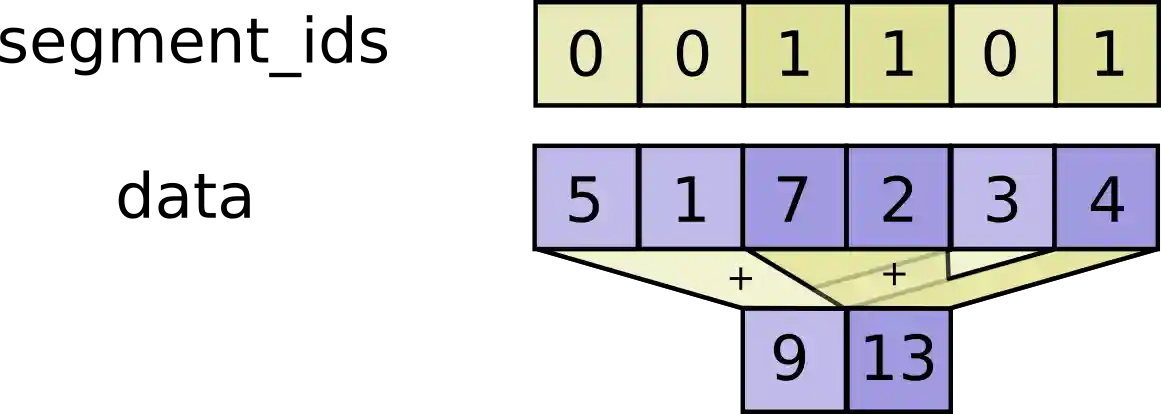
Computes a tensor such that
\(output[i] = \sum_{j...} data[j...]\) where the sum is over tuples j... such
that segment_ids[j...] == i. Unlike SegmentSum, segment_ids
need not be sorted and need not cover all values in the full
range of valid values.
If the sum is empty for a given segment ID i, output[i] = 0.
If the given segment ID i is negative, the value is dropped and will not be
added to the sum of the segment.
num_segments should equal the number of distinct segment IDs.
c = [[1,2,3,4], [5,6,7,8], [4,3,2,1]]tf.math.unsorted_segment_sum(c, [0, 1, 0], num_segments=2).numpy()array([[5, 5, 5, 5],[5, 6, 7, 8]], dtype=int32)
Returns | |
|---|---|
A Tensor. Has the same type as data.
|