WebRTC: Real-Time Communication in Browsers
Abstract
This document defines a set of ECMAScript APIs in WebIDL to allow media and generic application data to be sent to and received from another browser or device implementing the appropriate set of real-time protocols. This specification is being developed in conjunction with a protocol specification developed by the IETF RTCWEB group and an API specification to get access to local media devices.
Status of This Document
This section describes the status of this document at the time of its publication. A list of current W3C publications and the latest revision of this technical report can be found in the W3C technical reports index at https://www.w3.org/TR/.
This document includes Candidate Amendments.
Its associated test suite has been used to build an implementation report of the API at the time of its initial publication as a Recommendation. That test suite has been updated to integrate proposed and candidates amendments identified since then, and an updated implementation report focused on the implementation status of these amendments has been used to select features with double implementation as proposed amendments, now fully incorporated in this version of the Recommendation.
This document was published by the Web Real-Time Communications Working Group as a Recommendation using the Recommendation track. It includes candidate amendments, introducing substantive changes and new features since the previous Recommendation.
W3C recommends the wide deployment of this specification as a standard for the Web.
A W3C Recommendation is a specification that, after extensive consensus-building, is endorsed by W3C and its Members, and has commitments from Working Group members to royalty-free licensing for implementations. Future updates to this Recommendation may incorporate new features.
Candidate additions are marked in the document.
Candidate corrections are marked in the document.
This document was produced by a group operating under the W3C Patent Policy. W3C maintains a public list of any patent disclosures made in connection with the deliverables of the group; that page also includes instructions for disclosing a patent. An individual who has actual knowledge of a patent which the individual believes contains Essential Claim(s) must disclose the information in accordance with section 6 of the W3C Patent Policy.
This document is governed by the 03 November 2023 W3C Process Document.
This section is non-normative.
There are a number of facets to peer-to-peer communications and video-conferencing in HTML covered by this specification:
- Connecting to remote peers using NAT-traversal technologies such as ICE, STUN, and TURN.
- Sending the locally-produced tracks to remote peers and receiving tracks from remote peers.
- Sending arbitrary data directly to remote peers.
This document defines the APIs used for these features. This specification is being developed in conjunction with a protocol specification developed by the IETF RTCWEB group and an API specification to get access to local media devices [GETUSERMEDIA] developed by the WebRTC Working Group. An overview of the system can be found in [RFC8825] and [RFC8826].
As well as sections marked as non-normative, all authoring guidelines, diagrams, examples, and notes in this specification are non-normative. Everything else in this specification is normative.
The key words MAY, MUST, MUST NOT, and SHOULD in this document are to be interpreted as described in BCP 14 [RFC2119] [RFC8174] when, and only when, they appear in all capitals, as shown here.
This specification defines conformance criteria that apply to a single product: the user agent that implements the interfaces that it contains.
Conformance requirements phrased as algorithms or specific steps may be implemented in any manner, so long as the end result is equivalent. (In particular, the algorithms defined in this specification are intended to be easy to follow, and not intended to be performant.)
Implementations that use ECMAScript to implement the APIs defined in this specification MUST implement them in a manner consistent with the ECMAScript Bindings defined in the Web IDL specification [WEBIDL], as this specification uses that specification and terminology.
The EventHandler interface, representing a callback used for event
handlers, is defined in [HTML].
The concepts queue a task and networking task source are defined in [HTML].
The concept fire an event is defined in [DOM].
The terms event, event handlers and event handler event types are defined in [HTML].
Performance.timeOrigin and Performance.now() are defined in
[hr-time].
The terms serializable objects, serialization steps, and deserialization steps are defined in [HTML].
The terms MediaStream, MediaStreamTrack, and
MediaStreamConstraints are defined in [GETUSERMEDIA]. Note that
MediaStream is extended in 9.2
MediaStream
in this document while MediaStreamTrack is extended in 9.3
MediaStreamTrack in this document.
The term Blob is defined in [FILEAPI].
The term media description is defined in [RFC4566].
The term media transport is defined in [RFC7656].
The term generation is defined in [RFC8838] Section 2.
The terms stats object and monitored object are defined in [WEBRTC-STATS].
When referring to exceptions, the terms throw and created are defined in [WEBIDL].
The callback VoidFunction is defined in [WEBIDL].
The term "throw" is used as specified in [INFRA]: it terminates the current processing steps.
The terms fulfilled, rejected, resolved, and settled used in the context of Promises are defined in [ECMASCRIPT-6.0].
The AlgorithmIdentifier is defined in [WebCryptoAPI].
Note
The general principles for Javascript APIs apply, including the
principle of run-to-completion
and no-data-races as defined in [API-DESIGN-PRINCIPLES]. That is,
while a task is running, external events do not influence what's
visible to the Javascript application. For example, the amount of data
buffered on a data channel will increase due to "send" calls while
Javascript is executing, and the decrease due to packets being sent
will be visible after a task checkpoint.
It is the responsibility of the user agent to make sure the set of
values presented to the application is consistent - for instance that
getContributingSources() (which is synchronous) returns values for all
sources measured at the same time.
This section is non-normative.
An RTCPeerConnection instance allows an application to establish
peer-to-peer communications with another RTCPeerConnection
instance in another browser, or to another endpoint implementing the
required protocols. Communications are coordinated by the exchange of
control messages (called a signaling protocol) over a signaling
channel which is provided by unspecified means, but generally by a
script in the page via the server, e.g. using WebSocket or
XMLHttpRequest.
The RTCConfiguration defines a set of parameters to configure
how the peer-to-peer communication established via
RTCPeerConnection is established or re-established.
dictionary RTCConfiguration {
  sequence<RTCIceServer> iceServers = [];
  RTCIceTransportPolicy iceTransportPolicy = "all";
  RTCBundlePolicy bundlePolicy = "balanced";
  RTCRtcpMuxPolicy rtcpMuxPolicy = "require";
  sequence<RTCCertificate> certificates = [];
  [EnforceRange] octet iceCandidatePoolSize = 0;
};-
iceServersof type sequence<RTCIceServer>, defaulting to[]. -
An array of objects describing servers available to be used by ICE, such as STUN and TURN servers. If the number of ICE servers exceeds an implementation-defined limit, ignore the ICE servers above the threshold. This implementation defined limit MUST be at least 32.
-
iceTransportPolicyof typeRTCIceTransportPolicy, defaulting to"all". -
Indicates which candidates the ICE Agent is allowed to use.
-
bundlePolicyof typeRTCBundlePolicy, defaulting to"balanced". -
Indicates which media-bundling policy to use when gathering ICE candidates.
-
rtcpMuxPolicyof typeRTCRtcpMuxPolicy, defaulting to"require". -
Indicates which rtcp-mux policy to use when gathering ICE candidates.
-
certificatesof type sequence<RTCCertificate>, defaulting to[]. -
A set of certificates that the
RTCPeerConnectionuses to authenticate.Valid values for this parameter are created through calls to the
generateCertificate()function.Although any given DTLS connection will use only one certificate, this attribute allows the caller to provide multiple certificates that support different algorithms. The final certificate will be selected based on the DTLS handshake, which establishes which certificates are allowed. The
RTCPeerConnectionimplementation selects which of the certificates is used for a given connection; how certificates are selected is outside the scope of this specification.Note
Existing implementations only utilize the first certificate provided; the others are ignored.
If this value is absent, then a default set of certificates is generated for each
RTCPeerConnectioninstance.This option allows applications to establish key continuity. An
RTCCertificatecan be persisted in [INDEXEDDB] and reused. Persistence and reuse also avoids the cost of key generation.The value for this configuration option cannot change after its value is initially selected.
-
iceCandidatePoolSizeof type octet, defaulting to0 -
Size of the prefetched ICE pool as defined in [RFC9429] (section 3.5.4. and section 4.1.1.).
The RTCIceServer dictionary is used to describe the STUN and
TURN servers that can be used by the ICE Agent to establish a
connection with a peer.
dictionary RTCIceServer {
  required (DOMString or sequence<DOMString>) urls;
  DOMString username;
  DOMString credential;
};-
urlsof type (DOMString or sequence<DOMString>), required -
STUN or TURN URI(s) as defined in [RFC7064] and [RFC7065] or other URI types.
-
usernameof type DOMString -
If this
RTCIceServerobject represents a TURN server, then this attribute specifies the username to use with that TURN server. -
credentialof typeDOMString -
If this
RTCIceServerobject represents a TURN server, then this attribute specifies the credential to use with that TURN server.credentialrepresents a long-term authentication password, as described in [RFC5389], Section 10.2.
An example array of RTCIceServer objects is:
[
  {urls: 'stun:stun1.example.net'},
  {urls: ['turns:turn.example.org', 'turn:turn.example.net'],
    username: 'user',
    credential: 'myPassword',
];
As described in [RFC9429] (section 4.1.1.), if
the iceTransportPolicy member of the
RTCConfiguration is specified, it defines the ICE candidate policy [RFC9429] (section 3.5.3.) the
browser uses to surface the permitted candidates to the
application; only these candidates will be used for connectivity
checks.
enum RTCIceTransportPolicy {
  "relay",
  "all"
};| Enum value | Description |
|---|---|
relay
|
The ICE Agent uses only media relay candidates such as candidates passing through a TURN server. Note This can be used to prevent the remote endpoint from learning the user's IP addresses, which may be desired in certain use cases. For example, in a "call"-based application, the application may want to prevent an unknown caller from learning the callee's IP addresses until the callee has consented in some way. |
all
|
The ICE Agent can use any type of candidate when this value is specified. Note
The implementation can still use its own candidate
filtering policy in order to limit the IP addresses
exposed to the application, as noted in the description
of |
As described in [RFC9429] (section 4.1.1.), bundle policy affects which media tracks are negotiated if the remote endpoint is not bundle-aware, and what ICE candidates are gathered. If the remote endpoint is bundle-aware, all media tracks and data channels are bundled onto the same transport.
enum RTCBundlePolicy {
  "balanced",
  "max-compat",
  "max-bundle"
};| Enum value | Description |
|---|---|
balanced
|
Gather ICE candidates for each media type in use (audio, video, and data). If the remote endpoint is not bundle-aware, negotiate only one audio and video track on separate transports. |
max-compat
|
Gather ICE candidates for each track. If the remote endpoint is not bundle-aware, negotiate all media tracks on separate transports. |
max-bundle
|
Gather ICE candidates for only one track. If the remote endpoint is not bundle-aware, negotiate only one media track. |
As described in [RFC9429] (section 4.1.1.), the
RTCRtcpMuxPolicy affects what ICE candidates are gathered to
support non-multiplexed RTCP. The only value defined in this spec
is "require".
enum RTCRtcpMuxPolicy {
  "require"
};| Enum value | Description |
|---|---|
require
|
Gather ICE candidates only for RTP and multiplex RTCP on the RTP candidates. If the remote endpoint is not capable of rtcp-mux, session negotiation will fail. |
These dictionaries describe the options that can be used to control the offer/answer creation process.
dictionary RTCOfferAnswerOptions {};dictionary RTCOfferOptions : RTCOfferAnswerOptions {
boolean iceRestart = false;
};-
iceRestartof type boolean, defaulting tofalse -
When the value of this dictionary member is
true, or the relevantRTCPeerConnectionobject's[[LocalIceCredentialsToReplace]]slot is not empty, then the generated description will have ICE credentials that are different from the current credentials (as visible in thecurrentLocalDescriptionattribute's SDP). Applying the generated description will restart ICE, as described in section 9.1.1.1 of [RFC5245].When the value of this dictionary member is
false, and the relevantRTCPeerConnectionobject's[[LocalIceCredentialsToReplace]]slot is empty, and thecurrentLocalDescriptionattribute has valid ICE credentials, then the generated description will have the same ICE credentials as the current value from thecurrentLocalDescriptionattribute.Note
Performing an ICE restart is recommended when
iceConnectionStatetransitions to "failed". An application may additionally choose to listen for theiceConnectionStatetransition to "disconnected" and then use other sources of information (such as usinggetStatsto measure if the number of bytes sent or received over the next couple of seconds increases) to determine whether an ICE restart is advisable.
The RTCAnswerOptions dictionary describe options
specific to session description of type "answer"
(none in this version of the specification).
dictionary RTCAnswerOptions : RTCOfferAnswerOptions {};enum RTCSignalingState {
"stable",
"have-local-offer",
"have-remote-offer",
"have-local-pranswer",
"have-remote-pranswer",
"closed"
};| Enum value | Description |
|---|---|
stable
|
There is no offer/answer exchange in progress. This is also the initial state, in which case the local and remote descriptions are empty. |
have-local-offer
|
A local description, of type "offer", has
been successfully applied.
|
have-remote-offer
|
A remote description, of type "offer", has
been successfully applied.
|
have-local-pranswer
|
A remote description of type "offer" has
been successfully applied and a local description of type
"pranswer" has been successfully applied.
|
have-remote-pranswer
|
A local description of type "offer" has been
successfully applied and a remote description of type
"pranswer" has been successfully applied.
|
closed
|
The RTCPeerConnection has been closed; its
[[IsClosed]] slot is true.
|
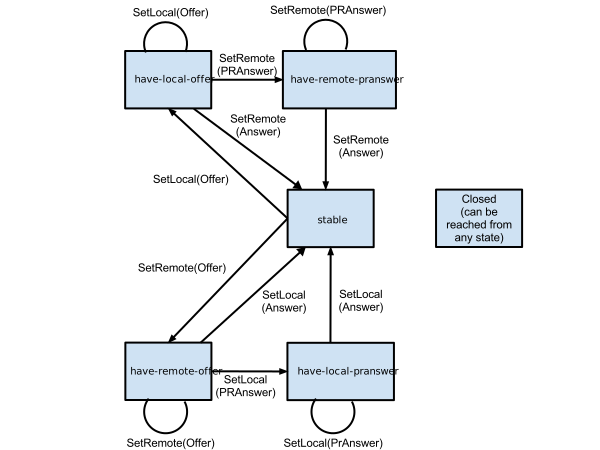
An example set of transitions might be:
- Caller transition:
-
- new RTCPeerConnection(): "
stable" - setLocalDescription(offer):
"
have-local-offer" - setRemoteDescription(pranswer):
"
have-remote-pranswer" - setRemoteDescription(answer):
"
stable"
- new RTCPeerConnection(): "
- Callee transition:
-
- new RTCPeerConnection(): "
stable" - setRemoteDescription(offer):
"
have-remote-offer" - setLocalDescription(pranswer):
"
have-local-pranswer" - setLocalDescription(answer): "
stable"
- new RTCPeerConnection(): "
enum RTCIceGatheringState {
  "new",
  "gathering",
  "complete"
};| Enum value | Description |
|---|---|
new
|
Any of the RTCIceTransports are in the
"new" gathering state and none of
the transports are in the
"gathering" state, or there are no
transports.
|
gathering
|
Any of the RTCIceTransports are in the
"gathering" state.
|
complete
|
At least one RTCIceTransport exists, and all
RTCIceTransports are in the
"complete" gathering state.
|
The set of transports considered is the one
presently referenced by the RTCPeerConnection's
set of transceivers and the RTCPeerConnection's
[[SctpTransport]]
internal slot if not null.
enum RTCPeerConnectionState {
  "closed",
  "failed",
  "disconnected",
  "new",
  "connecting",
  "connected"
};| Enum value | Description |
|---|---|
closed
|
[[IceConnectionState]] is
"closed".
|
failed
|
The previous state doesn't apply, and either
[[IceConnectionState]] is
"failed" or any
RTCDtlsTransports are in the
"failed" state.
|
disconnected
|
None of the previous states apply, and
[[IceConnectionState]] is
"disconnected".
|
new
|
None of the previous states apply, and either
[[IceConnectionState]] is
"new", and all
RTCDtlsTransports are in the
"new" or
"closed" state, or there are no
transports.
|
connected
|
None of the previous states apply,
[[IceConnectionState]] is
"connected", and all
RTCDtlsTransports are in the
"connected" or
"closed" state.
|
connecting
|
None of the previous states apply. |
Note
In the "connecting" state, one or more
RTCIceTransports are in the "new"
or "checking" state, or one or more
RTCDtlsTransports are in the "new"
or "connecting" state.
The set of transports considered is the one
presently referenced by the RTCPeerConnection's
set of transceivers and the RTCPeerConnection's
[[SctpTransport]]
internal slot if not null.
enum RTCIceConnectionState {
  "closed",
  "failed",
  "disconnected",
  "new",
  "checking",
  "completed",
  "connected"
};| Enum value | Description |
|---|---|
closed
|
The RTCPeerConnection object's [[IsClosed]]
slot is true.
|
failed
|
The previous state doesn't apply and any
RTCIceTransports are in the
"failed" state.
|
disconnected
|
None of the previous states apply and any
RTCIceTransports are in the
"disconnected" state.
|
new
|
None of the previous states apply and all
RTCIceTransports are in the
"new" or
"closed" state, or there are no
transports.
|
checking
|
None of the previous states apply and any
RTCIceTransports are in the
"new" or
"checking" state.
|
completed
|
None of the previous states apply and all
RTCIceTransports are in the
"completed" or
"closed" state.
|
connected
|
None of the previous states apply and all
RTCIceTransports are in the
"connected",
"completed" or
"closed" state.
|
The set of transports considered is the one
presently referenced by the RTCPeerConnection's
set of transceivers and the RTCPeerConnection's
[[SctpTransport]]
internal slot if not null.
Note that if an RTCIceTransport is discarded as a result of
signaling (e.g. RTCP mux or bundling), or created as a result of
signaling (e.g. adding a new media description), the state
may advance directly from one state to another.
The [RFC9429] specification, as a whole, describes the details of how
the RTCPeerConnection operates. References to specific
subsections of [RFC9429] are provided as appropriate.
Calling new
creates an
RTCPeerConnection(configuration)RTCPeerConnection object.
configuration.iceServers contains
information used to find and access the servers used by ICE. The
application can supply multiple servers of each type, and any TURN
server MAY also be used as a STUN server for the purposes of
gathering server reflexive candidates.
An RTCPeerConnection object has a
[[SignalingState]], and the aggregated states
[[ConnectionState]],
[[IceGatheringState]], and
[[IceConnectionState]].
These are initialized when the object is created.
The ICE protocol implementation of an RTCPeerConnection is
represented by an ICE agent [RFC5245]. Certain
RTCPeerConnection methods involve interactions with the ICE Agent, namely addIceCandidate, setConfiguration,
setLocalDescription, setRemoteDescription and close.
These interactions are described in the relevant sections in this
document and in [RFC9429]. The ICE Agent also provides
indications to the user agent when the state of its internal
representation of an RTCIceTransport changes, as described in
5.6
RTCIceTransport Interface.
The task source for the tasks listed in this section is the networking task source.
Note
The state of the SDP negotiation is represented by the internal variables
[[SignalingState]],
[[CurrentLocalDescription]],
[[CurrentRemoteDescription]],
[[PendingLocalDescription]] and
[[PendingRemoteDescription]]. These are only set inside the
setLocalDescription and setRemoteDescription operations,
and modified by the addIceCandidate operation and the surface a candidate procedure. In each case, all the
modifications to all the five variables are completed before the
procedures fire any events or invoke any callbacks, so the
modifications are made visible at a single point in time.
As one of the unloading document cleanup steps, run the following steps:
-
Let window be document's relevant global object.
-
For each
RTCPeerConnectionobject connection whose relevant global object is window, close the connection with connection and the valuetrue.
When the RTCPeerConnection.constructor() is
invoked, the user agent MUST run the following steps:
-
If any of the steps enumerated below fails for a reason not specified here, throw an
UnknownErrorwith themessageattribute set to an appropriate description. -
Let connection be a newly created
RTCPeerConnectionobject. -
Let connection have a [[DocumentOrigin]] internal slot, initialized to the relevant settings object's origin.
- Let configuration be the method's first argument.
-
If the
certificatesvalue in configuration is non-empty, run the following steps for each certificate in certificates:-
If the value of certificate.
expiresis less than the current time, throw anInvalidAccessError. -
If certificate.
[[Origin]]is not same origin with connection.[[DocumentOrigin]], throw anInvalidAccessError. -
Store certificate.
-
-
Else, generate one or more new
RTCCertificateinstances with thisRTCPeerConnectioninstance and store them. This MAY happen asynchronously and the value ofcertificatesremainsundefinedfor the subsequent steps. As noted in Section 4.3.2.3 of [RFC8826], WebRTC utilizes self-signed rather than Public Key Infrastructure (PKI) certificates, so that the expiration check is to ensure that keys are not used indefinitely and additional certificate checks are unnecessary. -
Initialize connection's ICE Agent.
-
Let connection have a [[Configuration]] internal slot, initialized to
null. Set the configuration specified by configuration. -
Let connection have an [[IsClosed]] internal slot, initialized to
false. -
Let connection have a [[NegotiationNeeded]] internal slot, initialized to
false. -
Let connection have an [[SctpTransport]] internal slot, initialized to
null. -
Let connection have a [[DataChannels]] internal slot, initialized to an empty ordered set.
-
Let connection have an [[Operations]] internal slot, representing an operations chain, initialized to an empty list.
-
Let connection have a [[UpdateNegotiationNeededFlagOnEmptyChain]] internal slot, initialized to
false. -
Let connection have an [[LastCreatedOffer]] internal slot, initialized to
"". -
Let connection have an [[LastCreatedAnswer]] internal slot, initialized to
"". -
Let connection have an [[EarlyCandidates]] internal slot, initialized to an empty list.
-
Let connection have an [[SignalingState]] internal slot, initialized to "
stable". -
Let connection have an [[IceConnectionState]] internal slot, initialized to "
new". -
Let connection have an [[IceGatheringState]] internal slot, initialized to "
new". -
Let connection have an [[ConnectionState]] internal slot, initialized to "
new". -
Let connection have a [[PendingLocalDescription]] internal slot, initialized to
null. -
Let connection have a [[CurrentLocalDescription]] internal slot, initialized to
null. -
Let connection have a [[PendingRemoteDescription]] internal slot, initialized to
null. -
Let connection have a [[CurrentRemoteDescription]] internal slot, initialized to
null. -
Let connection have a [[LocalIceCredentialsToReplace]] internal slot, initialized to an empty set.
-
Return connection.
An RTCPeerConnection object has an operations
chain, [[Operations]], which ensures that only one
asynchronous operation in the chain executes concurrently. If
subsequent calls are made while the returned promise of a
previous call is still not settled, they are added to the
chain and executed when all the previous calls have finished
executing and their promises have settled.
To chain an operation to an
RTCPeerConnection object's operations chain, run the
following steps:
-
Let connection be the
RTCPeerConnectionobject. -
If connection.
[[IsClosed]]istrue, return a promise rejected with a newly createdInvalidStateError. -
Let operation be the operation to be chained.
-
Let p be a new promise.
-
Append operation to
[[Operations]]. -
If the length of
[[Operations]]is exactly 1, execute operation. -
Upon fulfillment or rejection of the promise returned by the operation, run the following steps:
-
If connection.
[[IsClosed]]istrue, abort these steps. -
If the promise returned by operation was fulfilled with a value, fulfill p with that value.
-
If the promise returned by operation was rejected with a value, reject p with that value.
-
Upon fulfillment or rejection of p, execute the following steps:
-
If connection.
[[IsClosed]]istrue, abort these steps. -
Remove the first element of
[[Operations]]. -
If
[[Operations]]is non-empty, execute the operation represented by the first element of[[Operations]], and abort these steps. -
If connection.
[[UpdateNegotiationNeededFlagOnEmptyChain]]isfalse, abort these steps. -
Set connection.
[[UpdateNegotiationNeededFlagOnEmptyChain]]tofalse. -
Update the negotiation-needed flag for connection.
-
-
-
Return p.
An RTCPeerConnection object has an aggregated
[[ConnectionState]].
Whenever the state of an RTCDtlsTransport changes,
the user agent MUST queue a task that runs the following steps:
-
Let connection be this
RTCPeerConnectionobject associated with theRTCDtlsTransportobject whose state changed. -
If connection.
[[IsClosed]]istrue, abort these steps. -
Let newState be the value of deriving a new state value as described by the
RTCPeerConnectionStateenum. -
If connection.
[[ConnectionState]]is equal to newState, abort these steps. -
Set connection.
[[ConnectionState]]to newState. -
Fire an event named
connectionstatechangeat connection.
To
set a local session description description on
an RTCPeerConnection object connection, set the session description
description on connection with the additional
value false.
To
set a remote session description description
on an RTCPeerConnection object connection, set the session description
description on connection with the additional
value true.
To set
a session description description on an
RTCPeerConnection object connection, given a
remote boolean, run the following steps:
-
Let p be a new promise.
-
If description.
typeis "rollback" and connection.[[SignalingState]]is either "stable", "have-local-pranswer", or "have-remote-pranswer", then reject p with a newly createdInvalidStateErrorand abort these steps. -
Let jsepSetOfTransceivers be a shallow copy of connection's set of transceivers.
-
In parallel, start the process to apply description as described in [RFC9429] (section 5.5. and section 5.6.), with these additional restrictions:
-
Use jsepSetOfTransceivers as the source of truth with regard to what "RtpTransceivers" exist, and their
[[JsepMid]]internal slot as their "mid property". Candidate Correction 5:Forbid ICE gathering and connectivity checks on administrative prohibited candidates (PR #2708)
If remote is
falseand this triggers the ICE candidate gathering process in [RFC9429] (section 5.9.), the ICE Agent MUST NOT gather candidates that would be administratively prohibited.Candidate Correction 5:Forbid ICE gathering and connectivity checks on administrative prohibited candidates (PR #2708)
If remote is
trueand this triggers ICE connectivity checks in [RFC9429] (section 5.10.), the ICE Agent MUST NOT attempt to connect to candidates that are administratively prohibited.-
If remote is
true, validate back-to-back offers as if answers were applied in between, by running the check for subsequent offers as if it were in stable state. Candidate Correction 37:Don't fail sRD(offer) over rid mismatch, just answer with unicast. (PR #2794)
If applying description leads to modifying a transceiver transceiver, and transceiver.[[Sender]].[[SendEncodings]] is non-empty, and not equal to the encodings that would result from processing description, the process of applying description fails. This specification does not allow remotely initiated RID renegotiation.
-
If the process to apply description fails for any reason, then the user agent MUST queue a task that runs the following steps:
-
If connection.
[[IsClosed]]istrue, then abort these steps. -
If description.
typeis invalid for the current connection.[[SignalingState]]as described in [RFC9429] (section 5.5. and section 5.6.), then reject p with a newly createdInvalidStateErrorand abort these steps. -
If the content of description is not valid SDP syntax, then reject p with an
RTCError(witherrorDetailset to "sdp-syntax-error" and thesdpLineNumberattribute set to the line number in the SDP where the syntax error was detected) and abort these steps. -
If remote is
true, the connection'sRTCRtcpMuxPolicyisrequireand the description does not use RTCP mux, then reject p with a newly createdInvalidAccessErrorand abort these steps. -
If the description attempted to renegotiate RIDs, as described above, then reject p with a newly created
InvalidAccessErrorand abort these steps. -
If the content of description is invalid, then reject p with a newly created
InvalidAccessErrorand abort these steps. -
For all other errors, reject p with a newly created
OperationError.
-
-
If description is applied successfully, the user agent MUST queue a task that runs the following steps:
-
If connection.
[[IsClosed]]istrue, then abort these steps. -
If remote is
trueand description is of type "offer", then if anyaddTrack()methods on connection succeeded during the process to apply description, abort these steps and start the process over as if they had succeeded prior, to include the extra transceiver(s) in the process. -
If any promises from
setParametersmethods onRTCRtpSenders associated with connection are not settled, abort these steps and start the process over. -
If description is of type "
offer" and connection.[[SignalingState]]is "stable" then for each transceiver in connection's set of transceivers, run the following steps:-
Set transceiver.
[[Sender]].[[LastStableStateSenderTransport]]to transceiver.[[Sender]].[[SenderTransport]]. Candidate Correction 13:Rollback restores ridless encoding trounced by sRD(simulcastOffer). (PR #2797)
If transceiver.
[[Sender]].[[SendEncodings]].length is1and the lone encoding contains noridmember, then set transceiver.[[Sender]].[[LastStableRidlessSendEncodings]]to transceiver.[[Sender]].[[SendEncodings]]; Otherwise, set transceiver.[[Sender]].[[LastStableRidlessSendEncodings]]tonull.-
Set transceiver.
[[Receiver]].[[LastStableStateReceiverTransport]]to transceiver.[[Receiver]].[[ReceiverTransport]]. -
Set transceiver.
[[Receiver]].[[LastStableStateAssociatedRemoteMediaStreams]]to transceiver.[[Receiver]].[[AssociatedRemoteMediaStreams]]. -
Set transceiver.
[[Receiver]].[[LastStableStateReceiveCodecs]]to transceiver.[[Receiver]].[[ReceiveCodecs]].
-
-
If remote is
false, then run one of the following steps:-
If description is of type "
offer", set connection.[[PendingLocalDescription]]to a newRTCSessionDescriptionobject constructed from description, set connection.[[SignalingState]]to "have-local-offer", and release early candidates. -
If description is of type "
answer", then this completes an offer answer negotiation. Set connection.[[CurrentLocalDescription]]to a newRTCSessionDescriptionobject constructed from description, and set connection.[[CurrentRemoteDescription]]to connection.[[PendingRemoteDescription]]. Set both connection.[[PendingRemoteDescription]]and connection.[[PendingLocalDescription]]tonull. Set both connection.[[LastCreatedOffer]]and connection.[[LastCreatedAnswer]]to"", set connection.[[SignalingState]]to "stable", and release early candidates. Finally, if none of the ICE credentials in connection.[[LocalIceCredentialsToReplace]]are present in description, then set connection.[[LocalIceCredentialsToReplace]]to an empty set. -
If description is of type "
pranswer", then set connection.[[PendingLocalDescription]]to a newRTCSessionDescriptionobject constructed from description, set connection.[[SignalingState]]to "have-local-pranswer", and release early candidates.
-
-
Otherwise, (if remote is
true) run one of the following steps:-
If description is of type "
offer", set connection.[[PendingRemoteDescription]]attribute to a newRTCSessionDescriptionobject constructed from description, and set connection.[[SignalingState]]to "have-remote-offer". -
If description is of type "
answer", then this completes an offer answer negotiation. Set connection.[[CurrentRemoteDescription]]to a newRTCSessionDescriptionobject constructed from description, and set connection.[[CurrentLocalDescription]]to connection.[[PendingLocalDescription]]. Set both connection.[[PendingRemoteDescription]]and connection.[[PendingLocalDescription]]tonull. Set both connection.[[LastCreatedOffer]]and connection.[[LastCreatedAnswer]]to"", and set connection.[[SignalingState]]to "stable". Finally, if none of the ICE credentials in connection.[[LocalIceCredentialsToReplace]]are present in the newly set connection.[[CurrentLocalDescription]], then set connection.[[LocalIceCredentialsToReplace]]to an empty set. -
If description is of type "
pranswer", then set connection.[[PendingRemoteDescription]]to a newRTCSessionDescriptionobject constructed from description and set connection.[[SignalingState]]to "have-remote-pranswer".
-
-
If description is of type "
answer", and it initiates the closure of an existing SCTP association, as defined in [RFC8841], Sections 10.3 and 10.4, set the value of connection.[[SctpTransport]]tonull. -
Let trackEventInits, muteTracks, addList, removeList and errorList be empty lists.
-
If description is of type "
answer" or "pranswer", then run the following steps:-
If description initiates the establishment of a new SCTP association, as defined in [RFC8841], Sections 10.3 and 10.4, create an RTCSctpTransport with an initial state of "
connecting" and assign the result to the[[SctpTransport]]slot. Otherwise, if an SCTP association is established, but themax-message-sizeSDP attribute is updated, update the data max message size of connection.[[SctpTransport]]. -
If description negotiates the DTLS role of the SCTP transport, then for each
RTCDataChannel, channel, with anullid, run the following step:- Give channel a new ID generated
according to [RFC8832]. If no
available ID could be generated, set
channel.
[[ReadyState]]to "closed", and add channnel to errorList.
- Give channel a new ID generated
according to [RFC8832]. If no
available ID could be generated, set
channel.
-
-
If description is not of type "
rollback", then run the following steps:-
If remote is
false, then run the following steps for each media description in description:Candidate Correction 26:Prune createAnswer()'s encodings and SendEncodings in sLD(answer). (PR #2801)
If the media description was not yet associated with an
RTCRtpTransceiverobject then run the following steps:Let transceiver be the
RTCRtpTransceiverused to create the media description.Set transceiver.
[[Mid]]to transceiver.[[JsepMid]].If transceiver.
[[Stopped]]istrue, abort these sub steps.If the media description is indicated as using an existing
mediamedia transport according to [RFC8843], let transport be theRTCDtlsTransportOtherwise, let transport be a newly created
RTCDtlsTransportobject with a new underlyingRTCIceTransport.Set transceiver.
[[Sender]].[[SenderTransport]]to transport.Set transceiver.
[[Receiver]].[[ReceiverTransport]]to transport.
Let transceiver be the
RTCRtpTransceiverassociated with the media description.If transceiver.
[[Stopped]]istrue, abort these sub steps.Let direction be an
RTCRtpTransceiverDirectionvalue representing the direction from themediamedia description.If direction is "
sendrecv" or "recvonly", set transceiver.[[Receptive]]totrue, otherwise set it tofalse.Set transceiver.
[[Receiver]].[[ReceiveCodecs]]to the codecs that description negotiates for receiving and which the user agent is currently prepared to receive.If description is of type "
answer" or "pranswer", then run the following steps:If transceiver.
[[Sender]].[[SendEncodings]].length is greater than1, then run the following steps:If description is missing all of the previously negotiated layers, then remove all dictionaries in transceiver.
[[Sender]].[[SendEncodings]]except the first one, and skip the next step.If description is missing any of the previously negotiated layers, then remove the dictionaries that correspond to the missing layers from transceiver.
[[Sender]].[[SendEncodings]].
Set transceiver.
[[Sender]].[[SendCodecs]]to the codecs that description negotiates for sending and which the user agent is currently capable of sending, and set transceiver.[[Sender]].[[LastReturnedParameters]]tonull.If direction is "
sendonly" or "inactive", and transceiver.[[FiredDirection]]is either "sendrecv" or "recvonly", then run the following steps:Set the associated remote streams given transceiver.
[[Receiver]], an empty list, another empty list, and removeList.process the removal of a
remoteremote track for the media description, given transceiver and muteTracks.
Set transceiver.
[[CurrentDirection]]and transceiver.[[FiredDirection]]to direction.
-
Otherwise, (if remote is
true) run the following steps for each media description in description:Candidate Correction 12:Remove interaction between encoding.active and simulcast ~rid (PR #2754)
Candidate Correction 14:Make RTCTransceiver.direction reflects local preference in offers and answers (PR #2759)
Candidate Correction 22:Allow remote offer rid pruning of encodings through the client answer. (PR #2758)
Candidate Correction 37:Don't fail sRD(offer) over rid mismatch, just answer with unicast. (PR #2794)
Candidate Correction 25:Remove duplicate rids in proposedSendEncodings. (PR #2800)
Candidate Correction 27:Ignore comma-separated rid alternatives. (PR #2813)
If the description is of type "
offer" and the media description contains a request to receive simulcast, use the order of the rid values specified in the simulcast attribute to create anRTCRtpEncodingParametersdictionary for each of the simulcast layers, populating theridvaluevalue (using only the first value if comma-separated alternatives exist), and letsendEncodingsproposedSendEncodings bethe listthe list containing the created dictionaries. Otherwise, letsendEncodingsproposedSendEncodings beanan empty list.For each encoding, encoding, in proposedSendEncodings in reverse order, if encoding's
ridmatches that of another encoding in proposedSendEncodings, remove encoding from proposedSendEncodings.- Let supportedEncodings be the
maximum number of encodings that the
implementation can support. If the length of
sendEncodingsproposedSendEncodings is greater than supportedEncodings, truncatesendEncodingsproposedSendEncodings so that its length is supportedEncodings. - If
sendEncodingsproposedSendEncodings is non-empty,setset each encoding'sscaleResolutionDownByto2^(length of.sendEncodingsproposedSendEncodings - encoding index - 1) As described by [
RFC8829RFC9429] (section 5.10.), attempt to find an existingRTCRtpTransceiverobject, transceiver, to represent the media description.If a suitable transceiver was found (transceiver is set), and
sendEncodingsproposedSendEncodings is non-empty,set transceiver.[[Sender]].[[SendEncodings]]to sendEncodings, and set transceiver.[[Sender]].[[LastReturnedParameters]] torun the following steps:null.If the length of transceiver.
[[Sender]].[[SendEncodings]]is1, and the lone encoding contains noridmember, set transceiver.[[Sender]].[[SendEncodings]]to proposedSendEncodings, and set transceiver.[[Sender]].[[LastReturnedParameters]]tonull.
If no suitable transceiver was found (transceiver is unset), run the following steps:
Create an RTCRtpSender, sender, from the
mediamedia description usingsendEncodingsproposedSendEncodings.Create an RTCRtpReceiver, receiver, from the
mediamedia description.Create an RTCRtpTransceiver with sender, receiver and an
RTCRtpTransceiverDirectionvalue of "recvonly", and let transceiver be the result.Add transceiver to the connection's set
ofof transceivers.
If description is of type "
answer" or "pranswer", and transceiver.[[Sender]].[[SendEncodings]].length is greater than1, then run the following steps:If description indicates that simulcast is not supported or desired, or description is missing all of the previously negotiated layers, then remove all dictionaries in transceiver.
[[Sender]].[[SendEncodings]]except the first one and abort these sub steps.If description
rejectsis missing any of theofferedpreviously negotiated layers,thenthen removethethe dictionaries that correspondto rejectedto the missing layers from transceiver.[[Sender]].[[SendEncodings]].Update the paused status as indicated by [RFC8853] of each simulcast layer by setting the
activetruefor unpaused or tofalsefor paused.
Set transceiver.
[[Mid]]to transceiver.[[JsepMid]].Let direction be an
RTCRtpTransceiverDirectionvalue representing the direction from themediamedia description, but with the send and receive directions reversed to represent this peer's point of view. If the media description is rejected, set direction to "inactive".If direction is "
sendrecv" or "recvonly", let msids be a list of the MSIDs that the media description indicates transceiver.[[Receiver]].[[ReceiverTrack]]is to be associated with. Otherwise, let msids be an empty list.Note
msids will be an empty list here if media description is rejected.
Process remote tracks with transceiver, direction, msids, addList, removeList, and trackEventInits.
Set transceiver.
[[Receiver]].[[ReceiveCodecs]]to the codecs that description negotiates for receiving and which the user agent is currently prepared to receive.If description is of type "
answer" or "pranswer", then run the following steps:Set transceiver.
[[Sender]].[[SendCodecs]]to the codecs that description negotiates for sending and which the user agent is currently capable of sending.Set transceiver.
[[CurrentDirection]]and transceiver.[[Direction]]sto direction.Let transport be the
RTCDtlsTransportmediamedia transport used by transceiver's associated media description, according to [RFC8843].Set transceiver.
[[Sender]].[[SenderTransport]]to transport.Set transceiver.
[[Receiver]].[[ReceiverTransport]]to transport.Set the
[[IceRole]]of transport according to the rules of [RFC8445].Note
The rules of [RFC8445] that apply here are:
- If
[[IceRole]]is notunknown, do not modify[[IceRole]]. - If description is a
local offer, set it to
controlling. - If description is a
remote offer, and contains
a=ice-lite, set[[IceRole]]tocontrolling. - If description is a
remote offer, and does not contain
a=ice-lite, set[[IceRole]]tocontrolled.
This ensures that
[[IceRole]]always has a value after the first offer is processed.- If
If the media description is rejected, and transceiver.
[[Stopped]]isfalse, then stopthethe RTCRtpTransceiver transceiver.
-
-
Otherwise, (if description is of type "
rollback") run the following steps:-
Let pendingDescription be either connection.
[[PendingLocalDescription]]or connection.[[PendingRemoteDescription]], whichever one is notnull. -
For each transceiver in the connection's set of transceivers run the following steps:
-
If transceiver was not associated with a media description prior to pendingDescription being set, disassociate it and set both transceiver.
[[JsepMid]]and transceiver.[[Mid]]tonull. -
Set transceiver.
[[Sender]].[[SenderTransport]]to transceiver.[[Sender]].[[LastStableStateSenderTransport]]. Candidate Correction 13:Rollback restores ridless encoding trounced by sRD(simulcastOffer). (PR #2797)
If transceiver.
[[Sender]].[[LastStableRidlessSendEncodings]]is notnull, and any encoding in transceiver.[[Sender]].[[SendEncodings]]contains aridmember, then set transceiver.[[Sender]].[[SendEncodings]]to transceiver.[[Sender]].[[LastStableRidlessSendEncodings]].-
Set transceiver.
[[Receiver]].[[ReceiverTransport]]to transceiver.[[Receiver]].[[LastStableStateReceiverTransport]]. -
Set transceiver.
[[Receiver]].[[ReceiveCodecs]]to transceiver.[[Receiver]].[[LastStableStateReceiveCodecs]]. -
If connection.
[[SignalingState]]is "have-remote-offer", run the following sub steps:-
Let msids be a list of the
ids of allMediaStreamobjects in transceiver.[[Receiver]].[[LastStableStateAssociatedRemoteMediaStreams]], or an empty list if there are none. -
Process remote tracks with transceiver, transceiver.
[[CurrentDirection]], msids, addList, removeList, and trackEventInits.
-
-
If transceiver was created when pendingDescription was set, and a track has never been attached to it via
addTrack(), then stop the RTCRtpTransceiver transceiver, and remove it from connection's set of transceivers.
-
-
Set connection.
[[PendingLocalDescription]]and connection.[[PendingRemoteDescription]]tonull, and set connection.[[SignalingState]]to "stable".
-
-
If description is of type "
answer", then run the following steps:-
For each transceiver in the connection's set of transceivers run the following steps:
-
If transceiver is
stopped, associated with an m= section and the associated m= section is rejected in connection.[[CurrentLocalDescription]]or connection.[[CurrentRemoteDescription]], remove the transceiver from the connection's set of transceivers.
-
-
-
If connection.
[[SignalingState]]is now "stable", run the following steps:-
For any transceiver that was removed from the set of transceivers in a previous step, if any of its transports (transceiver.
[[Sender]].[[SenderTransport]]or transceiver.[[Receiver]].[[ReceiverTransport]]) are still not closed and they're no longer referenced by a non-stopped transceiver, close theRTCDtlsTransports and their associatedRTCIceTransports. This results in events firing on these objects in a queued task. Candidate Addition 49:Add codec to RTCRtpEncodingParameters (PR #2985)
For each transceiver in connection's set of transceivers:
-
Let codecs be transceiver.
[[Sender]].[[SendCodecs]]. -
If codecs is not an empty list:
-
For each encoding in transceiver.
[[Sender]].[[SendEncodings]], if encoding.codecdoes not match any entry in codecs, using the codec dictionary match algorithm with ignoreLevels set totrue, remove encoding.codec.
-
-
-
Clear the negotiation-needed flag and update the negotiation-needed flag.
-
-
If connection.
[[SignalingState]]changed above, fire an event namedsignalingstatechangeat connection. -
For each channel in errorList, fire an event named
errorusing theRTCErrorEventinterface with theerrorDetailattribute set to "data-channel-failure" at channel. -
For each track in muteTracks, set the muted state of track to the value
true. -
For each stream and track pair in removeList, remove the track track from stream.
-
For each stream and track pair in addList, add the track track to stream.
-
For each entry entry in trackEventInits, fire an event named
trackusing theRTCTrackEventinterface with itsreceiverattribute initialized to entry.receiver, itstrackattribute initialized to entry.track, itsstreamsattribute initialized to entry.streamsand itstransceiverattribute initialized to entry.transceiverat the connection object. -
Resolve p with
undefined.
-
-
-
Return p.
To set a configuration with configuration, run the following steps:
-
Let connection be the target
RTCPeerConnectionobject. -
Let oldConfig be connection.
[[Configuration]]. -
If oldConfig is not
null, run the following steps, and if any of them fail, throw anInvalidModificationError:-
If the length of configuration.
certificatesis different from the length of oldConfig.certificates, fail. -
Let index be 0.
-
While index is less than the length of configuration.
certificates, run the following steps:-
If the ECMAScript object represented by the value of configuration.
certificatesat index is not the same as the ECMAScript object represented by the value of oldConfig.certificatesat index, then fail. -
Increment index by 1.
-
-
If the value of configuration.
bundlePolicydiffers from oldConfig.bundlePolicy, then fail. -
If the value of configuration.
rtcpMuxPolicydiffers from oldConfig.rtcpMuxPolicy, then fail. -
If the value of configuration.
iceCandidatePoolSizediffers from oldConfig.iceCandidatePoolSize, andsetLocalDescriptionhas already been called, then fail.
-
-
Let iceServers be configuration.
iceServers. -
Truncate iceServers to the maximum number of supported elements.
-
For each server in iceServers, run the following steps:
-
Let urls be server.
urls. -
If urls is a string, set urls to a list consisting of just that string.
-
If urls is empty, throw a "
SyntaxError"DOMException. -
For each url in urls, run the validate an ICE server URL algorithm on url.
-
-
Set the ICE Agent's ICE transports setting to the value of configuration.
iceTransportPolicy. As defined in [RFC9429] (section 4.1.18.), if the new ICE transports setting changes the existing setting, no action will be taken until the next gathering phase. If a script wants this to happen immediately, it should do an ICE restart. -
Set the ICE Agent's prefetched ICE candidate pool size as defined in [RFC9429] (section 3.5.4. and section 4.1.1.) to the value of configuration.
iceCandidatePoolSize. If the new ICE candidate pool size changes the existing setting, this may result in immediate gathering of new pooled candidates, or discarding of existing pooled candidates, as defined in [RFC9429] (section 4.1.18.). -
Set the ICE Agent's ICE servers list to iceServers.
As defined in [RFC9429] (section 4.1.18.), if a new list of servers replaces the ICE Agent's existing ICE servers list, no action will be taken until the next gathering phase. If a script wants this to happen immediately, it should do an ICE restart. However, if the ICE candidate pool has a nonzero size, any existing pooled candidates will be discarded, and new candidates will be gathered from the new servers.
-
Store configuration in the
[[Configuration]]internal slot.
To validate an ICE server URL url, run the following steps:
Parse the url using the generic URI syntax defined in [RFC3986] and obtain the scheme name. If the parsing based on the syntax defined in [RFC3986] fails, throw a
SyntaxError. If the scheme name is not implemented by the browser throw aNotSupportedError. If scheme name isturnorturns, and parsing the url using the syntax defined in [RFC7065] fails, throw aSyntaxError. If scheme name isstunorstuns, and parsing the url using the syntax defined in [RFC7064] fails, throw aSyntaxError.Let parsedURL be the result of parsing url.
If any of the following conditions apply, then throw a "
SyntaxError"DOMException:- parsedURL is failure
- parsedURL's scheme is neither
"stun","stuns","turn", nor"turns" - parsedURL does not have an opaque path
- parsedURL's opaque path contains one or more
"/"or"@" - parsedURL's fragment is non-null
- parsedURL's scheme is
"stun"or"stuns", and parsedURL's query is non-null
If parsedURL's scheme is not implemented by the user agent, then throw a
NotSupportedError.Let hostAndPortURL be result of parsing the concatenation of
"https://"and parsedURL's path.If hostAndPortURL is failure, then throw a "
SyntaxError"DOMException.If hostAndPortURL's path, username, or password is non-null, then throw a "
SyntaxError"DOMException.If parsedURL's query is non-null and if parsedURL's query is different from either
"transport=udp"or"transport=tcp", throw a "SyntaxError"DOMException.If
scheme nameparsedURL's' scheme isturn"turn"ororturns"turns", and either of server.usernameor server.credentialare omitteddo not exist, then throw anInvalidAccessErrorIf scheme name is
turnorturns, and server.credentialTypeis "passwordcredentialis not a DOMString, then throw anInvalidAccessError.
The RTCPeerConnection interface presented in this
section is extended by several partial interfaces throughout this
specification. Notably, the RTP Media API section, which adds
the APIs to send and receive MediaStreamTrack objects.
[Exposed=Window]
interface RTCPeerConnection : EventTarget  {
  constructor(optional RTCConfiguration configuration = {});
  Promise<RTCSessionDescriptionInit> createOffer(optional RTCOfferOptions options = {});
  Promise<RTCSessionDescriptionInit> createAnswer(optional RTCAnswerOptions options = {});
  Promise<undefined> setLocalDescription(optional RTCLocalSessionDescriptionInit description = {});
  readonly attribute RTCSessionDescription? localDescription;
  readonly attribute RTCSessionDescription? currentLocalDescription;
  readonly attribute RTCSessionDescription? pendingLocalDescription;
  Promise<undefined> setRemoteDescription(RTCSessionDescriptionInit description);
  readonly attribute RTCSessionDescription? remoteDescription;
  readonly attribute RTCSessionDescription? currentRemoteDescription;
  readonly attribute RTCSessionDescription? pendingRemoteDescription;
  Promise<undefined> addIceCandidate(optional RTCIceCandidateInit candidate = {});
  readonly attribute RTCSignalingState signalingState;
  readonly attribute RTCIceGatheringState iceGatheringState;
  readonly attribute RTCIceConnectionState iceConnectionState;
  readonly attribute RTCPeerConnectionState connectionState;
  readonly attribute boolean? canTrickleIceCandidates;
  undefined restartIce();
  RTCConfiguration getConfiguration();
  undefined setConfiguration(optional RTCConfiguration configuration = {});
  undefined close();
  attribute EventHandler onnegotiationneeded;
  attribute EventHandler onicecandidate;
  attribute EventHandler onicecandidateerror;
  attribute EventHandler onsignalingstatechange;
  attribute EventHandler oniceconnectionstatechange;
  attribute EventHandler onicegatheringstatechange;
  attribute EventHandler onconnectionstatechange;

  // Legacy Interface Extensions
  // Supporting the methods in this section is optional.
  // If these methods are supported
  // they must be implemented as defined
  // in section "Legacy Interface Extensions"
  Promise<undefined> createOffer(RTCSessionDescriptionCallback successCallback,
                            RTCPeerConnectionErrorCallback failureCallback,
                            optional RTCOfferOptions options = {});
  Promise<undefined> setLocalDescription(RTCLocalSessionDescriptionInit description,
                                    VoidFunction successCallback,
                                    RTCPeerConnectionErrorCallback failureCallback);
  Promise<undefined> createAnswer(RTCSessionDescriptionCallback successCallback,
                             RTCPeerConnectionErrorCallback failureCallback);
  Promise<undefined> setRemoteDescription(RTCSessionDescriptionInit description,
                                     VoidFunction successCallback,
                                     RTCPeerConnectionErrorCallback failureCallback);
  Promise<undefined> addIceCandidate(RTCIceCandidateInit candidate,
                                VoidFunction successCallback,
                                RTCPeerConnectionErrorCallback failureCallback);
};-
localDescriptionof typeRTCSessionDescription, readonly, nullable -
The
localDescriptionattribute MUST return[[PendingLocalDescription]]if it is notnulland otherwise it MUST return[[CurrentLocalDescription]].Note that
[[CurrentLocalDescription]].sdpand[[PendingLocalDescription]].sdpneed not be string-wise identical to thesdpvalue passed to the correspondingsetLocalDescriptioncall (i.e. SDP may be parsed and reformatted, and ICE candidates may be added). -
currentLocalDescriptionof typeRTCSessionDescription, readonly, nullable -
The
currentLocalDescriptionattribute MUST return[[CurrentLocalDescription]].It represents the local description that was successfully negotiated the last time the
RTCPeerConnectiontransitioned into the stable state plus any local candidates that have been generated by the ICE Agent since the offer or answer was created. -
pendingLocalDescriptionof typeRTCSessionDescription, readonly, nullable -
The
pendingLocalDescriptionattribute MUST return[[PendingLocalDescription]].It represents a local description that is in the process of being negotiated plus any local candidates that have been generated by the ICE Agent since the offer or answer was created. If the
RTCPeerConnectionis in the stable state, the value isnull. -
remoteDescriptionof typeRTCSessionDescription, readonly, nullable -
The
remoteDescriptionattribute MUST return[[PendingRemoteDescription]]if it is notnulland otherwise it MUST return[[CurrentRemoteDescription]].Note that
[[CurrentRemoteDescription]].sdpand[[PendingRemoteDescription]].sdpneed not be string-wise identical to thesdpvalue passed to the correspondingsetRemoteDescriptioncall (i.e. SDP may be parsed and reformatted, and ICE candidates may be added). -
currentRemoteDescriptionof typeRTCSessionDescription, readonly, nullable -
The
currentRemoteDescriptionattribute MUST return[[CurrentRemoteDescription]].It represents the last remote description that was successfully negotiated the last time the
RTCPeerConnectiontransitioned into the stable state plus any remote candidates that have been supplied viaaddIceCandidate()since the offer or answer was created. -
pendingRemoteDescriptionof typeRTCSessionDescription, readonly, nullable -
The
pendingRemoteDescriptionattribute MUST return[[PendingRemoteDescription]].It represents a remote description that is in the process of being negotiated, complete with any remote candidates that have been supplied via
addIceCandidate()since the offer or answer was created. If theRTCPeerConnectionis in the stable state, the value isnull. -
signalingStateof typeRTCSignalingState, readonly -
The
signalingStateattribute MUST return theRTCPeerConnectionobject's[[SignalingState]]. -
iceGatheringStateof typeRTCIceGatheringState, readonly -
The
iceGatheringStateattribute MUST return theRTCPeerConnectionobject's[[IceGatheringState]]. -
iceConnectionStateof typeRTCIceConnectionState, readonly -
The
iceConnectionStateattribute MUST return theRTCPeerConnectionobject's[[IceConnectionState]]. -
connectionStateof typeRTCPeerConnectionState, readonly -
The
connectionStateattribute MUST return theRTCPeerConnectionobject's[[ConnectionState]]. -
canTrickleIceCandidatesof type boolean, readonly, nullable -
The
canTrickleIceCandidatesattribute indicates whether the remote peer is able to accept trickled ICE candidates [RFC8838]. The value is determined based on whether a remote description indicates support for trickle ICE, as defined in [RFC9429] (section 4.1.17.). Prior to the completion ofsetRemoteDescription, this value isnull. -
onnegotiationneededof type EventHandler -
The event type of this event handler is
negotiationneeded. -
onicecandidateof type EventHandler -
The event type of this event handler is
icecandidate. -
onicecandidateerrorof type EventHandler -
The event type of this event handler is
icecandidateerror. -
onsignalingstatechangeof type EventHandler -
The event type of this event handler is
signalingstatechange. -
oniceconnectionstatechangeof type EventHandler -
The event type of this event handler is
iceconnectionstatechange -
onicegatheringstatechangeof type EventHandler -
The event type of this event handler is
icegatheringstatechange. -
onconnectionstatechangeof type EventHandler -
The event type of this event handler is
connectionstatechange.
-
createOffer -
The
createOffermethod generates a blob of SDP that contains an RFC 3264 offer with the supported configurations for the session, including descriptions of the localMediaStreamTracks attached to thisRTCPeerConnection, the codec/RTP/RTCP capabilities supported by this implementation, and parameters of the ICE agent and the DTLS connection. The options parameter may be supplied to provide additional control over the offer generated.If a system has limited resources (e.g. a finite number of decoders),
createOfferneeds to return an offer that reflects the current state of the system, so thatsetLocalDescriptionwill succeed when it attempts to acquire those resources. The session descriptions MUST remain usable bysetLocalDescriptionwithout causing an error until at least the end of the fulfillment callback of the returned promise.Creating the SDP MUST follow the appropriate process for generating an offer described in [RFC9429], except the user agent MUST treat a
stoppingtransceiver asstoppedfor the purposes of RFC9429 in this case.As an offer, the generated SDP will contain the full set of codec/RTP/RTCP capabilities supported or preferred by the session (as opposed to an answer, which will include only a specific negotiated subset to use). In the event
createOfferis called after the session is established,createOfferwill generate an offer that is compatible with the current session, incorporating any changes that have been made to the session since the last complete offer-answer exchange, such as addition or removal of tracks. If no changes have been made, the offer will include the capabilities of the current local description as well as any additional capabilities that could be negotiated in an updated offer.The generated SDP will also contain the ICE agent's
usernameFragment,passwordand ICE options (as defined in [RFC5245], Section 14) and may also contain any local candidates that have been gathered by the agent.The
certificatesvalue in configuration for theRTCPeerConnectionprovides the certificates configured by the application for theRTCPeerConnection. These certificates, along with any default certificates are used to produce a set of certificate fingerprints. These certificate fingerprints are used in the construction of SDP.The process of generating an SDP exposes a subset of the media capabilities of the underlying system, which provides generally persistent cross-origin information on the device. It thus increases the fingerprinting surface of the application. In privacy-sensitive contexts, browsers can consider mitigations such as generating SDP matching only a common subset of the capabilities.

When the method is called, the user agent MUST run the following steps:
-
Let connection be the
RTCPeerConnectionobject on which the method was invoked. -
If connection.
[[IsClosed]]istrue, return a promise rejected with a newly createdInvalidStateError. -
Return the result of chaining the result of creating an offer with connection to connection's operations chain.
To create an offer given connection run the following steps:
-
If connection.
[[SignalingState]]is neither "stable" nor "have-local-offer", return a promise rejected with a newly createdInvalidStateError. -
Let p be a new promise.
-
In parallel, begin the in-parallel steps to create an offer given connection and p.
-
Return p.
The in-parallel steps to create an offer given connection and a promise p are as follows:
-
If connection was not constructed with a set of certificates, and one has not yet been generated, wait for it to be generated.
-
Inspect the offerer's system state to determine the currently available resources as necessary for generating the offer, as described in [RFC9429] (section 4.1.8.).
-
If this inspection failed for any reason, reject p with a newly created
OperationErrorand abort these steps. -
Queue a task that runs the final steps to create an offer given connection and p.
The final steps to create an offer given connection and a promise p are as follows:
-
If connection.
[[IsClosed]]istrue, then abort these steps. -
If connection was modified in such a way that additional inspection of the offerer's system state is necessary, then in parallel begin the in-parallel steps to create an offer again, given connection and p, and abort these steps.
Note
This may be necessary if, for example,
createOfferwas called when only an audioRTCRtpTransceiverwas added to connection, but while performing the in-parallel steps to create an offer, a videoRTCRtpTransceiverwas added, requiring additional inspection of video system resources. -
Given the information that was obtained from previous inspection, the current state of connection and its
RTCRtpTransceivers, generate an SDP offer, sdpString, as described in [RFC9429] (section 5.2.).-
As described in [RFC8843] (Section 7), if bundling is used (see
RTCBundlePolicy) an offerer tagged m= section must be selected in order to negotiate a BUNDLE group. The user agent MUST choose the m= section that corresponds to the first non-stopped transceiver in the set of transceivers as the offerer tagged m= section. This allows the remote endpoint to predict which transceiver is the offerer tagged m= section without having to parse the SDP. -
Let filteredCodecs be the result of applying the following filter on transceiver.
[[PreferredCodecs]]. The filtering MUST NOT change the order of the codec preferences:-
Let kind be transceiver's
[[Receiver]]'s[[ReceiverTrack]]'skind. -
If transceiver.
directionis "sendonly" or "sendrecv", exclude any codecs not included in the list of implemented send codecs for kind, using the codec dictionary match algorithm with ignoreLevels set totrue. -
If transceiver.
directionis "recvonly" or "sendrecv", exclude any codecs not included in the list of implemented receive codecs for kind, using the codec dictionary match algorithm with ignoreLevels set totrue.
The codec preferences of a media description's associated transceiver, transceiver, is said to be the value of filteredCodecs if non-empty and said to be unset otherwise.
-
-
If the length of the
[[SendEncodings]]slot of theRTCRtpSenderis larger than 1, then for each encoding given in[[SendEncodings]]of theRTCRtpSender, add ana=rid sendline to the corresponding media section, and add ana=simulcast:sendline giving the RIDs in the same order as given in theencodingsfield. No RID restrictions are set.Note
[RFC8853] section 5.2 specifies that the order of RIDs in the a=simulcast line suggests a proposed order of preference. If the browser decides not to transmit all encodings, one should expect it to stop sending the last encoding in the list first.
-
-
Let offer be a newly created
RTCSessionDescriptionInitdictionary with itstypemember initialized to the string "offer" and itssdpmember initialized to sdpString. -
Set the
[[LastCreatedOffer]]internal slot to sdpString. -
Resolve p with offer.
-
-
createAnswer -
The
createAnswermethod generates an [SDP] answer with the supported configuration for the session that is compatible with the parameters in the remote configuration. LikecreateOffer, the returned blob of SDP contains descriptions of the localMediaStreamTracks attached to thisRTCPeerConnection, the codec/RTP/RTCP options negotiated for this session, and any candidates that have been gathered by the ICE Agent. The options parameter may be supplied to provide additional control over the generated answer.Like
createOffer, the returned description SHOULD reflect the current state of the system. The session descriptions MUST remain usable bysetLocalDescriptionwithout causing an error until at least the end of the fulfillment callback of the returned promise.As an answer, the generated SDP will contain a specific codec/RTP/RTCP configuration that, along with the corresponding offer, specifies how the media plane should be established. The generation of the SDP MUST follow the appropriate process for generating an answer described in [RFC9429].
The generated SDP will also contain the ICE agent's
usernameFragment,passwordand ICE options (as defined in [RFC5245], Section 14) and may also contain any local candidates that have been gathered by the agent.The
certificatesvalue in configuration for theRTCPeerConnectionprovides the certificates configured by the application for theRTCPeerConnection. These certificates, along with any default certificates are used to produce a set of certificate fingerprints. These certificate fingerprints are used in the construction of SDP.An answer can be marked as provisional, as described in [RFC9429] (section 4.1.10.1.), by setting the
typeto "pranswer".When the method is called, the user agent MUST run the following steps:
-
Let connection be the
RTCPeerConnectionobject on which the method was invoked. -
If connection.
[[IsClosed]]istrue, return a promise rejected with a newly createdInvalidStateError. -
Return the result of chaining the result of creating an answer with connection to connection's operations chain.
To create an answer given connection run the following steps:
-
If connection.
[[SignalingState]]is neither "have-remote-offer" nor "have-local-pranswer", return a promise rejected with a newly createdInvalidStateError. -
Let p be a new promise.
-
In parallel, begin the in-parallel steps to create an answer given connection and p.
-
Return p.
The in-parallel steps to create an answer given connection and a promise p are as follows:
-
If connection was not constructed with a set of certificates, and one has not yet been generated, wait for it to be generated.
-
Inspect the answerer's system state to determine the currently available resources as necessary for generating the answer, as described in [RFC9429] (section 4.1.9.).
-
If this inspection failed for any reason, reject p with a newly created
OperationErrorand abort these steps. -
Queue a task that runs the final steps to create an answer given p.
The final steps to create an answer given a promise p are as follows:
-
If connection.
[[IsClosed]]istrue, then abort these steps. -
If connection was modified in such a way that additional inspection of the answerer's system state is necessary, then in parallel begin the in-parallel steps to create an answer again given connection and p, and abort these steps.
Note
This may be necessary if, for example,
createAnswerwas called when anRTCRtpTransceiver's direction was "recvonly", but while performing the in-parallel steps to create an answer, the direction was changed to "sendrecv", requiring additional inspection of video encoding resources. -
Given the information that was obtained from previous inspection and the current state of connection and its
RTCRtpTransceivers, generate an SDP answer, sdpString, as described in [RFC9429] (section 5.3.).Candidate Correction 26:Prune createAnswer()'s encodings and SendEncodings in sLD(answer). (PR #2801)
Candidate Correction 27:Ignore comma-separated rid alternatives. (PR #2813)
The codec preferences of an m= section's associated transceiver is said to be the value of the
RTCRtpTransceiverIf the
directionsendrecv", exclude any codecs not included in the intersection ofRTCRtpSendergetCapabilitiescodecsRTCRtpReceivergetCapabilitiescodecsIf the
directionsendonlyRTCRtpSendergetCapabilitiescodecsIf the
directionrecvonlyRTCRtpReceivergetCapabilitiescodecs
The filtering MUST NOT change the order of the codec preferences.
If the length of the [[SendEncodings]] slot of the
RTCRtpSenderRTCRtpSendera=rid sendline to the corresponding media section, and add ana=simulcast:sendline giving the RIDs in the same order as given in theencodingsLet filteredCodecs be the result of applying the following filter on transceiver.
[[PreferredCodecs]]. The filtering MUST NOT change the order of the codec preferences:Let kind be transceiver's
[[Receiver]]'s[[ReceiverTrack]]'skind.If transceiver.
directionis "sendonly" or "sendrecv", exclude any codecs not included in the list of implemented send codecs for kind, using the codec dictionary match algorithm with ignoreLevels set totrue.If transceiver.
directionis "recvonly" or "sendrecv", exclude any codecs not included in the list of implemented receive codecs for kind, using the codec dictionary match algorithm with ignoreLevels set totrue.
The codec preferences of a media description's associated transceiver, transceiver, is said to be the value of filteredCodecs if non-empty and said to be unset otherwise.
If this is an answer to an offer to receive simulcast, then for each media section requesting to receive simulcast, run the following steps:
If the
a=simulcastattribute contains comma-separated alternatives for RIDs, remove all but the first ones.If there are any identically named RIDs in the
a=simulcastattribute, remove all but the first one. No RID restrictions are set.Exclude from the media section in the answer any RID not found in the corresponding transceiver's
[[Sender]].[[SendEncodings]].
Note
When a
setRemoteDescription(offer)establishes a sender's proposed envelope, the sender's[[SendEncodings]]is updated in "have-remote-offer", exposing it to rollback. However, once a simulcast envelope has been established for the sender, subsequent pruning of the sender's[[SendEncodings]]happen when this answer is set withsetLocalDescription.
-
Let answer be a newly created
RTCSessionDescriptionInitdictionary with itstypemember initialized to the string "answer" and itssdpmember initialized to sdpString. -
Set the
[[LastCreatedAnswer]]internal slot to sdpString. -
Resolve p with answer.
-
-
setLocalDescription -
The
setLocalDescriptionmethod instructs theRTCPeerConnectionto apply the suppliedRTCLocalSessionDescriptionInitas the local description.This API changes the local media state. In order to successfully handle scenarios where the application wants to offer to change from one media format to a different, incompatible format, the
RTCPeerConnectionMUST be able to simultaneously support use of both the current and pending local descriptions (e.g. support codecs that exist in both descriptions) until a final answer is received, at which point theRTCPeerConnectioncan fully adopt the pending local description, or rollback to the current description if the remote side rejected the change.Passing in a description is optional. If left out, then
setLocalDescriptionwill implicitly create an offer or create an answer, as needed. As noted in [RFC9429] (section 5.4.), if a description with SDP is passed in, that SDP is not allowed to have changed from when it was returned from eithercreateOfferorcreateAnswer.When the method is invoked, the user agent MUST run the following steps:
-
Let description be the method's first argument.
-
Let connection be the
RTCPeerConnectionobject on which the method was invoked. -
Let sdp be description.
sdp. -
Return the result of chaining the following steps to connection's operations chain:
-
Let type be description.
typeif present, or "offer" if not present and connection.[[SignalingState]]is either "stable", "have-local-offer", or "have-remote-pranswer"; otherwise "answer". -
If type is "
offer", and sdp is not the empty string and not equal to connection.[[LastCreatedOffer]], then return a promise rejected with a newly createdInvalidModificationErrorand abort these steps. -
If type is "
answer" or "pranswer", and sdp is not the empty string and not equal to connection.[[LastCreatedAnswer]], then return a promise rejected with a newly createdInvalidModificationErrorand abort these steps. -
If sdp is the empty string, and type is "
offer", then run the following sub steps:-
Set sdp to the value of connection.
[[LastCreatedOffer]]. -
If sdp is the empty string, or if it no longer accurately represents the offerer's system state of connection, then let p be the result of creating an offer with connection, and return the result of reacting to p with a fulfillment step that sets the local session description indicated by its first argument.
-
-
If sdp is the empty string, and type is "
answer" or "pranswer", then run the following sub steps:-
Set sdp to the value of connection.
[[LastCreatedAnswer]]. -
If sdp is the empty string, or if it no longer accurately represents the answerer's system state of connection, then let p be the result of creating an answer with connection, and return the result of reacting to p with the following fulfillment steps:
-
Let answer be the first argument to these fulfillment steps.
-
Return the result of setting the local session description indicated by
{type, answer..sdp}
-
-
-
Return the result of setting the local session description indicated by
{type, sdp}.
-
Note
As noted in [RFC9429] (section 5.9.), calling this method may trigger the ICE candidate gathering process by the ICE Agent.
-
-
setRemoteDescription -
The
setRemoteDescriptionmethod instructs theRTCPeerConnectionto apply the suppliedRTCSessionDescriptionInitas the remote offer or answer. This API changes the local media state.When the method is invoked, the user agent MUST run the following steps:
-
Let description be the method's first argument.
-
Let connection be the
RTCPeerConnectionobject on which the method was invoked. -
Return the result of chaining the following steps to connection's operations chain:
-
If description.
typeis "offer" and is invalid for the current connection.[[SignalingState]]as described in [RFC9429] (section 5.5. and section 5.6.), then run the following sub steps:-
Let p be the result of setting the local session description indicated by
{type: ".rollback"} -
Return the result of reacting to p with a fulfillment step that sets the remote session description description, and abort these steps.
-
-
Return the result of setting the remote session description description.
-
-
-
addIceCandidate -
The
addIceCandidatemethod provides a remote candidate to the ICE Agent. This method can also be used to indicate the end of remote candidates when called with an empty string for thecandidatemember. The only members of the argument used by this method arecandidate,sdpMid,sdpMLineIndex, andusernameFragment; the rest are ignored. When the method is invoked, the user agent MUST run the following steps:-
Let candidate be the method's argument.
-
Let connection be the
RTCPeerConnectionobject on which the method was invoked. -
If candidate.
candidateis not an empty string and both candidate.sdpMidand candidate.sdpMLineIndexarenull, return a promise rejected with a newly createdTypeError. -
Return the result of chaining the following steps to connection's operations chain:
-
If
remoteDescriptionisnullreturn a promise rejected with a newly createdInvalidStateError. -
If candidate.
sdpMidis notnull, run the following steps:-
If candidate.
sdpMidis not equal to the mid of any media description inremoteDescription, return a promise rejected with a newly createdOperationError.
-
-
Else, if candidate.
sdpMLineIndexis notnull, run the following steps:-
If candidate.
sdpMLineIndexis equal to or larger than the number of media descriptions inremoteDescription, return a promise rejected with a newly createdOperationError.
-
-
If either candidate.
sdpMidor candidate.sdpMLineIndexindicate a media description inremoteDescriptionwhose associated transceiver isstopped, return a promise resolved withundefined. -
If candidate.
usernameFragmentis notnull, and is not equal to any username fragment present in the corresponding media description of an applied remote description, return a promise rejected with a newly createdOperationError. -
Let p be a new promise.
-
In parallel, if the candidate is not administratively prohibited, add the ICE candidate candidate as described in [RFC9429] (section 4.1.19.). Use candidate.
usernameFragmentto identify the ICE generation; ifusernameFragmentisnull, process the candidate for the most recent ICE generation.If candidate.
candidateis an empty string, process candidate as an end-of-candidates indication for the corresponding media description and ICE candidate generation. If both candidate.sdpMidand candidate.sdpMLineIndexarenull, then this end-of-candidates indication applies to all media descriptions.-
If candidate could not be successfully added the user agent MUST queue a task that runs the following steps:
-
If connection.
[[IsClosed]]istrue, then abort these steps. -
Reject p with a newly created
OperationErrorand abort these steps.
-
-
If candidate is applied successfully, or if the candidate was administratively prohibited the user agent MUST queue a task that runs the following steps:
-
If connection.
[[IsClosed]]istrue, then abort these steps. -
If connection.
[[PendingRemoteDescription]]is notnull, and represents the ICE generation for which candidate was processed, add candidate to connection.[[PendingRemoteDescription]].sdp. -
If connection.
[[CurrentRemoteDescription]]is notnull, and represents the ICE generation for which candidate was processed, add candidate to connection.[[CurrentRemoteDescription]].sdp. -
Resolve p with
undefined.
-
-
-
Return p.
-
A candidate is administratively prohibited if the UA has decided not to allow connection attempts to this address.
For privacy reasons, there is no indication to the developer about whether or not an address/port is blocked; it behaves exactly as if there was no response from the address.
The UA MUST prohibit connections to addresses on the [Fetch] block bad port list, and MAY choose to prohibit connections to other addresses.
If the
iceTransportPolicymember of theRTCConfigurationisrelay, candidates requiring external resolution, such as mDNS candidates and DNS candidates, MUST be prohibited.Note
Due to WebIDL processing,
addIceCandidate(null) is interpreted as a call with the default dictionary present, which, in the above algorithm, indicates end-of-candidates for all media descriptions and ICE candidate generation. This is by design for legacy reasons. -
-
restartIce -
The
restartIcemethod tells theRTCPeerConnectionthat ICE should be restarted. Subsequent calls tocreateOfferwill create descriptions that will restart ICE, as described in section 9.1.1.1 of [RFC5245].When this method is invoked, the user agent MUST run the following steps:
-
Let connection be the
RTCPeerConnectionon which the method was invoked. -
Empty connection.
[[LocalIceCredentialsToReplace]], and populate it with all ICE credentials (ice-ufrag and ice-pwd as defined in section 15.4 of [RFC5245]) found in connection.[[CurrentLocalDescription]], as well as all ICE credentials found in connection.[[PendingLocalDescription]]. -
Update the negotiation-needed flag for connection.
-
-
getConfiguration -
Returns an
RTCConfigurationobject representing the current configuration of thisRTCPeerConnectionobject.When this method is called, the user agent MUST return the
RTCConfigurationobject stored in the[[Configuration]]internal slot. -
setConfiguration -
The
setConfigurationmethod updates the configuration of thisRTCPeerConnectionobject. This includes changing the configuration of the ICE Agent. As noted in [RFC9429] (section 3.5.1.), when the ICE configuration changes in a way that requires a new gathering phase, an ICE restart is required.When the
setConfigurationmethod is invoked, the user agent MUST run the following steps:-
Let connection be the
RTCPeerConnectionon which the method was invoked. -
If connection.
[[IsClosed]]istrue, throw anInvalidStateError. -
Set the configuration specified by configuration.
-
-
close -
When the
closemethod is invoked, the user agent MUST run the following steps:-
Let connection be the
RTCPeerConnectionobject on which the method was invoked. - close the connection with
connection and the value
false.
The close the connection algorithm given a connection and a disappear boolean, is as follows:
-
If connection.
[[IsClosed]]istrue, abort these steps. -
Set connection.
[[IsClosed]]totrue. -
Set connection.
[[SignalingState]]to "closed". This does not fire any event. -
Let transceivers be the result of executing the
CollectTransceiversalgorithm. For everyRTCRtpTransceivertransceiver in transceivers, run the following steps:-
If transceiver.
[[Stopped]]istrue, abort these sub steps. -
Stop the RTCRtpTransceiver with transceiver and disappear.
-
-
Set the
[[ReadyState]]slot of each of connection'sRTCDataChannels to "closed".Note
The
RTCDataChannels will be closed abruptly and the closing procedure will not be invoked. -
If connection.
[[SctpTransport]]is notnull, tear down the underlying SCTP association by sending an SCTP ABORT chunk and set the[[SctpTransportState]]to "closed". -
Set the
[[DtlsTransportState]]slot of each of connection'sRTCDtlsTransports to "closed". -
Destroy connection's ICE Agent, abruptly ending any active ICE processing and releasing any relevant resources (e.g. TURN permissions).
-
Set the
[[IceTransportState]]slot of each of connection'sRTCIceTransports to "closed". -
Set connection.
[[IceConnectionState]]to "closed". This does not fire any event. -
Set connection.
[[ConnectionState]]to "closed". This does not fire any event.
-
Note
The IDL
definition of these methods are documented in the main
definition of the RTCPeerConnection interface since overloaded
functions are not allowed to be defined in partial interfaces.
Supporting the methods in this section is optional. However, if these methods are supported it is mandatory to implement according to what is specified here.
Note
The addStream method that used to exist on
RTCPeerConnection is easy to polyfill as:
RTCPeerConnection.prototype.addStream = function(stream) {
  stream.getTracks().forEach((track) => this.addTrack(track, stream));
};-
createOffer -
When the
createOffermethod is called, the user agent MUST run the following steps:-
Let successCallback be the method's first argument.
-
Let failureCallback be the callback indicated by the method's second argument.
-
Let options be the callback indicated by the method's third argument.
-
Run the steps specified by
RTCPeerConnection'screateOffer()method with options as the sole argument, and let p be the resulting promise. -
Upon fulfillment of p with value offer, invoke successCallback with offer as the argument.
-
Upon rejection of p with reason r, invoke failureCallback with r as the argument.
-
Return a promise resolved with
undefined.
-
-
setLocalDescription -
When the
setLocalDescriptionmethod is called, the user agent MUST run the following steps:-
Let description be the method's first argument.
-
Let successCallback be the callback indicated by the method's second argument.
-
Let failureCallback be the callback indicated by the method's third argument.
-
Run the steps specified by
RTCPeerConnection'ssetLocalDescriptionmethod with description as the sole argument, and let p be the resulting promise. -
Upon fulfillment of p, invoke successCallback with
undefinedas the argument. -
Upon rejection of p with reason r, invoke failureCallback with r as the argument.
-
Return a promise resolved with
undefined.
-
-
createAnswer -
Note
The legacy
createAnswermethod does not take anRTCAnswerOptionsparameter, since no known legacycreateAnswerimplementation ever supported it.When the
createAnswermethod is called, the user agent MUST run the following steps:-
Let successCallback be the method's first argument.
-
Let failureCallback be the callback indicated by the method's second argument.
-
Run the steps specified by
RTCPeerConnection'screateAnswer()method with no arguments, and let p be the resulting promise. -
Upon fulfillment of p with value answer, invoke successCallback with answer as the argument.
-
Upon rejection of p with reason r, invoke failureCallback with r as the argument.
-
Return a promise resolved with
undefined.
-
-
setRemoteDescription -
When the
setRemoteDescriptionmethod is called, the user agent MUST run the following steps:-
Let description be the method's first argument.
-
Let successCallback be the callback indicated by the method's second argument.
-
Let failureCallback be the callback indicated by the method's third argument.
-
Run the steps specified by
RTCPeerConnection'ssetRemoteDescriptionmethod with description as the sole argument, and let p be the resulting promise. -
Upon fulfillment of p, invoke successCallback with
undefinedas the argument. -
Upon rejection of p with reason r, invoke failureCallback with r as the argument.
-
Return a promise resolved with
undefined.
-
-
addIceCandidate -
When the
addIceCandidatemethod is called, the user agent MUST run the following steps:-
Let candidate be the method's first argument.
-
Let successCallback be the callback indicated by the method's second argument.
-
Let failureCallback be the callback indicated by the method's third argument.
-
Run the steps specified by
RTCPeerConnection'saddIceCandidate()method with candidate as the sole argument, and let p be the resulting promise. -
Upon fulfillment of p, invoke successCallback with
undefinedas the argument. -
Upon rejection of p with reason r, invoke failureCallback with r as the argument.
-
Return a promise resolved with
undefined.
-
These callbacks are only used on the legacy APIs.
callback RTCSessionDescriptionCallback = undefined (RTCSessionDescriptionInit description);-
description of type
RTCSessionDescriptionInit - The object containing the SDP [SDP].
This section describes a set of legacy extensions that may be
used to influence how an offer is created, in addition to the
media added to the RTCPeerConnection. Developers are
encouraged to use the RTCRtpTransceiver API instead.
When createOffer is called with any of the
legacy options specified in this section, run the followings
steps instead of the regular createOffer
steps:
-
Let options be the methods first argument.
-
Let connection be the current
RTCPeerConnectionobject. -
For each
offerToReceive<Kind>member in options with kind, kind, run the following steps:- If the value of the dictionary member is false,
-
For each non-stopped "
sendrecv" transceiver of transceiver kind kind, set transceiver.[[Direction]]to "sendonly". -
For each non-stopped "
recvonly" transceiver of transceiver kind kind, set transceiver.[[Direction]]to "inactive".
Continue with the next option, if any.
-
-
If connection has any non-stopped "
sendrecv" or "recvonly" transceivers of transceiver kind kind, continue with the next option, if any. -
Let transceiver be the result of invoking the equivalent of connection.
addTransceiver(kind), except that this operation MUST NOT update the negotiation-needed flag. -
If transceiver is unset because the previous operation threw an error, abort these steps.
-
Set transceiver.
[[Direction]]to "recvonly".
- If the value of the dictionary member is false,
-
Run the steps specified by
createOfferto create the offer.
partial dictionary RTCOfferOptions {
  boolean offerToReceiveAudio;
  boolean offerToReceiveVideo;
};-
offerToReceiveAudioof type boolean -
This setting provides additional control over the directionality of audio. For example, it can be used to ensure that audio can be received, regardless if audio is sent or not.
-
offerToReceiveVideoof type boolean -
This setting provides additional control over the directionality of video. For example, it can be used to ensure that video can be received, regardless if video is sent or not.
An RTCPeerConnection object MUST not be garbage collected as
long as any event can cause an event handler to be triggered on the
object. When the object's [[IsClosed]] internal slot is
true, no such event handler can be triggered and it is
therefore safe to garbage collect the object.
All RTCDataChannel and MediaStreamTrack objects that are
connected to an RTCPeerConnection have a strong reference to
the RTCPeerConnection object.
All methods that return promises are governed by the standard error handling rules of promises. Methods that do not return promises may throw exceptions to indicate errors.
The RTCSdpType enum describes the type of an
RTCSessionDescriptionInit, RTCLocalSessionDescriptionInit,
or RTCSessionDescription instance.
enum RTCSdpType {
  "offer",
  "pranswer",
  "answer",
  "rollback"
};| Enum value | Description |
|---|---|
offer
|
An |
pranswer
|
An |
answer
|
An |
rollback
|
An |
The RTCSessionDescription class is used by
RTCPeerConnection to expose local and remote session
descriptions.
[Exposed=Window]
interface RTCSessionDescription {
  constructor(RTCSessionDescriptionInit descriptionInitDict);
  readonly attribute RTCSdpType type;
  readonly attribute DOMString sdp;
  [Default] RTCSessionDescriptionInit toJSON();
};-
constructor() -
The
RTCSessionDescription()constructor takes a dictionary argument, description, whose content is used to initialize the newRTCSessionDescriptionobject. This constructor is deprecated; it exists for legacy compatibility reasons only.
-
typeof typeRTCSdpType, readonly - The type of this session description.
-
sdpof type DOMString, readonly, defaulting to"" - The string representation of the SDP [SDP].
-
toJSON() - When called, run [WEBIDL]'s default toJSON steps.
dictionary RTCSessionDescriptionInit {
  required RTCSdpType type;
  DOMString sdp = "";
};-
typeof typeRTCSdpType, required - The type of this session description.
-
sdpof type DOMString -
The string representation of the SDP [SDP]; if
typeis "rollback", this member is unused.
dictionary RTCLocalSessionDescriptionInit {
  RTCSdpType type;
  DOMString sdp = "";
};-
typeof typeRTCSdpType -
The type of this description. If not present, then
setLocalDescriptionwill infer the type based on theRTCPeerConnection's[[SignalingState]]. -
sdpof type DOMString -
The string representation of the SDP [SDP]; if
typeis "rollback", this member is unused.
Many changes to state of an RTCPeerConnection will require
communication with the remote side via the signaling channel, in
order to have the desired effect. The app can be kept informed as to
when it needs to do signaling, by listening to the
negotiationneeded event. This event is fired
according
to the state of the connection's negotiation-needed flag,
represented by a [[NegotiationNeeded]] internal slot.
This section is non-normative.
If an operation is performed on an RTCPeerConnection that
requires signaling, the connection will be marked as needing
negotiation. Examples of such operations include adding or stopping
an RTCRtpTransceiver, or adding the first RTCDataChannel.
Internal changes within the implementation can also result in the connection being marked as needing negotiation.
Note that the exact procedures for updating the negotiation-needed flag are specified below.
This section is non-normative.
The negotiation-needed flag is cleared when a session description
of type "answer" is set successfully, and the supplied description
matches the state of the RTCRtpTransceivers and
RTCDataChannels that currently exist on the
RTCPeerConnection. Specifically, this means that all
non-stopped transceivers have an associated section in the local description with matching
properties, and, if any data channels have been created, a data
section exists in the local description.
Note that the exact procedures for updating the negotiation-needed flag are specified below.
The process below occurs where referenced elsewhere in this document. It also may occur as a result of internal changes within the implementation that affect negotiation. If such changes occur, the user agent MUST update the negotiation-needed flag.
To update the negotiation-needed flag for connection, run the following steps:
-
If the length of connection.
[[Operations]]is not0, then set connection.[[UpdateNegotiationNeededFlagOnEmptyChain]]totrue, and abort these steps. -
Queue a task to run the following steps:
-
If connection.
[[IsClosed]]istrue, abort these steps. -
If the length of connection.
[[Operations]]is not0, then set connection.[[UpdateNegotiationNeededFlagOnEmptyChain]]totrue, and abort these steps. -
If connection.
[[SignalingState]]is not "stable", abort these steps.Note
The negotiation-needed flag will be updated once the state transitions to "
stable", as part of the steps for setting a session description. -
If the result of checking if negotiation is needed is
false, clear the negotiation-needed flag by setting connection.[[NegotiationNeeded]]tofalse, and abort these steps. -
If connection.
[[NegotiationNeeded]]is alreadytrue, abort these steps. -
Set connection.
[[NegotiationNeeded]]totrue. -
Fire an event named
negotiationneededat connection.
Note
The task queueing prevents
negotiationneededfrom firing prematurely, in the common situation where multiple modifications to connection are being made at once.Additionally, we avoid racing with negotiation methods by only firing
negotiationneededwhen the operations chain is empty. -
To check if negotiation is needed for connection, perform the following checks:
-
If any implementation-specific negotiation is required, as described at the start of this section, return
true. -
If connection.
[[LocalIceCredentialsToReplace]]is not empty, returntrue. -
Let description be connection.
[[CurrentLocalDescription]]. -
If connection has created any
RTCDataChannels, and no m= section in description has been negotiated yet for data, returntrue. -
For each transceiver in connection's set of transceivers, perform the following checks:
-
If transceiver.
[[Stopping]]istrueand transceiver.[[Stopped]]isfalse, returntrue. -
If transceiver isn't
stoppedand isn't yet associated with an m= section in description, returntrue. -
If transceiver isn't
stoppedand is associated with an m= section in description then perform the following checks:-
If transceiver.
[[Direction]]is "sendrecv" or "sendonly", and the associated m= section in description either doesn't contain a singlea=msidline, or the number of MSIDs from thea=msidlines in thism=section, or the MSID values themselves, differ from what is in transceiver.sender.[[AssociatedMediaStreamIds]], returntrue. -
If description is of type "
offer", and the direction of the associated m= section in neither connection.[[CurrentLocalDescription]]nor connection.[[CurrentRemoteDescription]]matches transceiver.[[Direction]], returntrue. In this step, when the direction is compared with a direction found in[[CurrentRemoteDescription]], the description's direction must be reversed to represent the peer's point of view. -
If description is of type "
answer", and the direction of the associated m= section in the description does not match transceiver.[[Direction]]intersected with the offered direction (as described in [RFC9429] (section 5.3.1.)), returntrue.
-
-
If transceiver is
stoppedand is associated with an m= section, but the associated m= section is not yet rejected in connection.[[CurrentLocalDescription]]or connection.[[CurrentRemoteDescription]], returntrue.
-
-
If all the preceding checks were performed and
truewas not returned, nothing remains to be negotiated; returnfalse.
This interface describes an ICE candidate, described in [RFC5245]
Section 2. Other than candidate,
sdpMid,
sdpMLineIndex, and
usernameFragment, the remaining attributes
are derived from parsing the candidate
member in candidateInitDict, if it is well formed.
Candidate Addition 16:Add RTCIceCandidate.relayProtocol (PR #2763)
Candidate Addition 23:Add RTCIceCandidate.url (PR #2773)
[Exposed=Window]
interface RTCIceCandidate {
  constructor(optional RTCIceCandidateInit candidateInitDict = {});
  readonly attribute DOMString candidate;
  readonly attribute DOMString? sdpMid;
  readonly attribute unsigned short? sdpMLineIndex;
  readonly attribute DOMString? foundation;
  readonly attribute RTCIceComponent? component;
  readonly attribute unsigned long? priority;
  readonly attribute DOMString? address;
  readonly attribute RTCIceProtocol? protocol;
  readonly attribute unsigned short? port;
  readonly attribute RTCIceCandidateType? type;
  readonly attribute RTCIceTcpCandidateType? tcpType;
  readonly attribute DOMString? relatedAddress;
  readonly attribute unsigned short? relatedPort;
  readonly attribute DOMString? usernameFragment;
  readonly attribute RTCIceServerTransportProtocol? relayProtocol;
  readonly attribute DOMString? url;
  RTCIceCandidateInit toJSON();
};
-
constructor() -
The
RTCIceCandidate()constructor takes a dictionary argument, candidateInitDict, whose content is used to initialize the newRTCIceCandidateobject.When invoked, run the following steps:
- If both
the
sdpMidandsdpMLineIndexmembers of candidateInitDict arenull, throw aTypeError. -
Return the result of creating an RTCIceCandidate with candidateInitDict.
To create an RTCIceCandidate with a candidateInitDict dictionary, run the following steps:
- Let iceCandidate be a newly created
RTCIceCandidateobject. - Create internal slots for the following attributes of
iceCandidate, initilized to
null:foundation,component,priority,address,protocol,port,type,tcpType,relatedAddress, andrelatedPort. - Create internal slots for the following attributes of
iceCandidate, initilized to their namesakes in
candidateInitDict:
candidate,sdpMid,sdpMLineIndex,usernameFragment. - Let candidate be the
candidatedictionary member of candidateInitDict. If candidate is not an empty string, run the following steps:- Parse candidate using the
candidate-attributegrammar. - If parsing of
candidate-attributehas failed, abort these steps. - If any field in the parse result represents an invalid value for the corresponding attribute in iceCandidate, abort these steps.
- Set the corresponding internal slots in iceCandidate to the field values of the parsed result.
- Parse candidate using the
- Return iceCandidate.
Note
The constructor for
RTCIceCandidateonly does basic parsing and type checking for the dictionary members in candidateInitDict. Detailed validation on the well-formedness ofcandidate,sdpMid,sdpMLineIndex,usernameFragmentwith the corresponding session description is done when passing theRTCIceCandidateobject toaddIceCandidate().To maintain backward compatibility, any error on parsing the candidate attribute is ignored. In such case, the
candidateattribute holds the rawcandidatestring given in candidateInitDict, but derivative attributes such asfoundation,priority, etc are set tonull. - If both
the
Most attributes below are defined in section 15.1 of [RFC5245].
-
candidateof type DOMString, readonly -
This carries the
candidate-attributeas defined in section 15.1 of [RFC5245]. If thisRTCIceCandidaterepresents an end-of-candidates indication or a peer reflexive remote candidate,candidateis an empty string. -
sdpMidof type DOMString, readonly, nullable -
If not
null, this contains the media stream "identification-tag" defined in [RFC5888] for the media component this candidate is associated with. -
sdpMLineIndexof type unsigned short, readonly, nullable -
If not
null, this indicates the index (starting at zero) of the media description in the SDP this candidate is associated with. -
foundationof type DOMString, readonly, nullable -
A unique identifier that allows ICE to correlate candidates
that appear on multiple
RTCIceTransports. -
componentof typeRTCIceComponent, readonly, nullable -
The assigned network component of the candidate
("
rtp" or "rtcp"). This corresponds to thecomponent-idfield incandidate-attribute, decoded to the string representation as defined inRTCIceComponent. -
priorityof type unsigned long, readonly, nullable - The assigned priority of the candidate.
-
addressof type DOMString, readonly, nullable -
The address of the candidate, allowing for IPv4 addresses, IPv6 addresses, and fully qualified domain names (FQDNs). This corresponds to the
connection-addressfield incandidate-attribute.Remote candidates may be exposed, for instance via
[[SelectedCandidatePair]].remote. By default, the user agent MUST leave theaddressattribute asnullfor any exposed remote candidate. Once aRTCPeerConnectioninstance learns on an address by the web application usingaddIceCandidate, the user agent can expose theaddressattribute value in anyRTCIceCandidateof theRTCPeerConnectioninstance representing a remote candidate with that newly learnt address.Note
The addresses exposed in candidates gathered via ICE and made visibile to the application in
RTCIceCandidateinstances can reveal more information about the device and the user (e.g. location, local network topology) than the user might have expected in a non-WebRTC enabled browser.These addresses are always exposed to the application, and potentially exposed to the communicating party, and can be exposed without any specific user consent (e.g. for peer connections used with data channels, or to receive media only).
These addresses can also be used as temporary or persistent cross-origin states, and thus contribute to the fingerprinting surface of the device.
Applications can avoid exposing addresses to the communicating party, either temporarily or permanently, by forcing the ICE Agent to report only relay candidates via the
iceTransportPolicymember ofRTCConfiguration.To limit the addresses exposed to the application itself, browsers can offer their users different policies regarding sharing local addresses, as defined in [RFC8828].
-
protocolof typeRTCIceProtocol, readonly, nullable -
The protocol of the candidate
("
udp"/"tcp"). This corresponds to thetransportfield incandidate-attribute. -
portof type unsigned short, readonly, nullable - The port of the candidate.
-
typeof typeRTCIceCandidateType, readonly, nullable -
The type of the candidate. This corresponds to the
candidate-typesfield incandidate-attribute. -
tcpTypeof typeRTCIceTcpCandidateType, readonly, nullable -
If
protocolis "tcp",tcpTyperepresents the type of TCP candidate. Otherwise,tcpTypeisnull. This corresponds to thetcp-typefield incandidate-attribute. -
relatedAddressof type DOMString, readonly, nullable -
For a candidate that is derived from another, such as a relay
or reflexive candidate, the
relatedAddressis the IP address of the candidate that it is derived from. For host candidates, therelatedAddressisnull. This corresponds to therel-addressfield incandidate-attribute. -
relatedPortof type unsigned short, readonly, nullable -
For a candidate that is derived from another, such as a relay
or reflexive candidate, the
relatedPortis the port of the candidate that it is derived from. For host candidates, therelatedPortisnull. This corresponds to therel-portfield incandidate-attribute. -
usernameFragmentof type DOMString, readonly, nullable -
This carries the
ufragas defined in section 15.4 of [RFC5245].
-
toJSON() -
To invoke the
toJSON()operation of theRTCIceCandidateinterface, run the following steps:- Let json be a new
RTCIceCandidateInitdictionary. - For each attribute identifier
attr in «
candidate,sdpMid,sdpMLineIndex,usernameFragment»:- Let value be the result of getting the
underlying value of the attribute identified by
attr, given this
RTCIceCandidateobject. - Set
json[attr]to value.
- Let value be the result of getting the
underlying value of the attribute identified by
attr, given this
- Return json.
- Let json be a new
dictionary RTCIceCandidateInit {
  DOMString candidate = "";
  DOMString? sdpMid = null;
  unsigned short? sdpMLineIndex = null;
  DOMString? usernameFragment = null;
};-
candidateof type DOMString, defaulting to"" -
This carries the
candidate-attributeas defined in section 15.1 of [RFC5245]. If this represents an end-of-candidates indication,candidateis an empty string. -
sdpMidof type DOMString, nullable, defaulting tonull -
If not
null, this contains the media stream "identification-tag" defined in [RFC5888] for the media component this candidate is associated with. -
sdpMLineIndexof type unsigned short, nullable, defaulting tonull -
If not
null, this indicates the index (starting at zero) of the media description in the SDP this candidate is associated with. -
usernameFragmentof type DOMString, nullable, defaulting tonull -
If not
null, this carries theufragas defined in section 15.4 of [RFC5245].
The candidate-attribute grammar is used to parse the
candidate member of
candidateInitDict in the RTCIceCandidate()
constructor.
The primary grammar for candidate-attribute is defined in
section 15.1 of [RFC5245]. In addition, the browser MUST support
the grammar extension for ICE TCP as defined in section 4.5 of
[RFC6544].
The browser MAY support other grammar extensions for candidate-attribute as defined in other RFCs.
The RTCIceProtocol represents the protocol of the ICE
candidate.
enum RTCIceProtocol {
  "udp",
  "tcp"
};| Enum value | Description |
|---|---|
udp
|
A UDP candidate, as described in [RFC5245]. |
tcp
|
A TCP candidate, as described in [RFC6544]. |
The RTCIceTcpCandidateType represents the type of the ICE TCP
candidate, as defined in [RFC6544].
enum RTCIceTcpCandidateType {
  "active",
  "passive",
  "so"
};| Enum value | Description |
|---|---|
active
|
An "active" TCP candidate is
one for which the transport will attempt to open an
outbound connection but will not receive incoming
connection requests.
|
passive
|
A "passive" TCP candidate is
one for which the transport will receive incoming
connection attempts but not attempt a connection.
|
so
|
An "so" candidate is one for
which the transport will attempt to open a connection
simultaneously with its peer.
|
Note
The user agent will typically only gather
active ICE TCP candidates.
The RTCIceCandidateType represents the type of the ICE
candidate, as defined in [RFC5245] section 15.1.
enum RTCIceCandidateType {
  "host",
  "srflx",
  "prflx",
  "relay"
};| Enum value | Description |
|---|---|
host
|
A host candidate, as defined in Section 4.1.1.1 of [RFC5245]. |
srflx
|
A server reflexive candidate, as defined in Section 4.1.1.2 of [RFC5245]. |
prflx
|
A peer reflexive candidate, as defined in Section 4.1.1.2 of [RFC5245]. |
relay
|
A relay candidate, as defined in Section 7.1.3.2.1 of [RFC5245]. |
Candidate Addition 16:Add RTCIceCandidate.relayProtocol (PR #2763)
The RTCIceServerTransportProtocol represents the type of the transport
protocol used between the client and the server, as defined in [RFC8656] section 3.1.
enum RTCIceServerTransportProtocol {
  "udp",
  "tcp",
  "tls",
};| Enum value | Description |
|---|---|
udp
|
The TURN client is using UDP as transport to the server. |
tcp
|
The TURN client is using TCP as transport to the server. |
tls
|
The TURN client is using TLS as transport to the server. |
The icecandidate event of the
RTCPeerConnection uses the RTCPeerConnectionIceEvent
interface.
When firing an RTCPeerConnectionIceEvent event that contains an
RTCIceCandidate object, it MUST include values for both
sdpMid and sdpMLineIndex.
If the RTCIceCandidate is of type
"srflx" or type
"relay", the
url property of the event MUST be set
to the URL of the ICE server from which the candidate was obtained.
Note
The icecandidate event is used for three different types of
indications:
-
A candidate has been gathered. The
candidatemember of the event will be populated normally. It should be signaled to the remote peer and passed intoaddIceCandidate. -
An
RTCIceTransporthas finished gathering a generation of candidates, and is providing an end-of-candidates indication as defined by Section 8.2 of [RFC8838]. This is indicated bycandidate.candidatebeing set to an empty string. Thecandidateobject should be signaled to the remote peer and passed intoaddIceCandidatelike a typical ICE candidate, in order to provide the end-of-candidates indication to the remote peer. -
All
RTCIceTransports have finished gathering candidates, and theRTCPeerConnection'sRTCIceGatheringStatehas transitioned to "complete". This is indicated by thecandidatemember of the event being set tonull. This only exists for backwards compatibility, and this event does not need to be signaled to the remote peer. It's equivalent to anicegatheringstatechangeevent with the "complete" state.
[Exposed=Window]
interface RTCPeerConnectionIceEvent : Event {
  constructor(DOMString type, optional RTCPeerConnectionIceEventInit eventInitDict = {});
  readonly attribute RTCIceCandidate? candidate;
  readonly attribute DOMString? url;
};-
RTCPeerConnectionIceEvent.constructor()
-
candidateof typeRTCIceCandidate, readonly, nullable -
The
candidateattribute is theRTCIceCandidateobject with the new ICE candidate that caused the event.This attribute is set to
nullwhen an event is generated to indicate the end of candidate gathering.Note
Even where there are multiple media components, only one event containing a
nullcandidate is fired. -
urlof type DOMString, readonly, nullable -
The
urlattribute is the STUN or TURN URL that identifies the STUN or TURN server used to gather this candidate. If the candidate was not gathered from a STUN or TURN server, this parameter will be set tonull.Candidate Correction 23:Mark RTCPeerConnectionIceEvent.url as deprecated (PR #2773)
This attribute is deprecated; it exists for legacy compatibility reasons only. Prefer the candidate
url.
dictionary RTCPeerConnectionIceEventInit : EventInit {
  RTCIceCandidate? candidate;
  DOMString? url;
};-
candidateof typeRTCIceCandidate, nullable -
See the
candidateattribute of theRTCPeerConnectionIceEventinterface. -
urlof type DOMString, nullable -
The
urlattribute is the STUN or TURN URL that identifies the STUN or TURN server used to gather this candidate.
The icecandidateerror event of the
RTCPeerConnection uses the RTCPeerConnectionIceErrorEvent
interface.
[Exposed=Window]
interface RTCPeerConnectionIceErrorEvent : Event {
  constructor(DOMString type, RTCPeerConnectionIceErrorEventInit eventInitDict);
  readonly attribute DOMString? address;
  readonly attribute unsigned short? port;
  readonly attribute DOMString url;
  readonly attribute unsigned short errorCode;
  readonly attribute USVString errorText;
};-
RTCPeerConnectionIceErrorEvent.constructor()
-
addressof type DOMString, readonly, nullable -
The
addressattribute is the local IP address used to communicate with the STUN or TURN server.On a multihomed system, multiple interfaces may be used to contact the server, and this attribute allows the application to figure out on which one the failure occurred.
If the local IP address value is not already exposed as part of a local candidate, the
addressattribute will be set tonull. -
portof type unsigned short, readonly, nullable -
The
portattribute is the port used to communicate with the STUN or TURN server.If the
addressattribute isnull, theportattribute is also set tonull. -
urlof type DOMString, readonly -
The
urlattribute is the STUN or TURN URL that identifies the STUN or TURN server for which the failure occurred. -
errorCodeof type unsigned short, readonly -
The
errorCodeattribute is the numeric STUN error code returned by the STUN or TURN server [STUN-PARAMETERS].If no host candidate can reach the server,
errorCodewill be set to the value 701 which is outside the STUN error code range. This error is only fired once per server URL while in theRTCIceGatheringStateof "gathering". -
errorTextof type USVString, readonly -
The
errorTextattribute is the STUN reason text returned by the STUN or TURN server [STUN-PARAMETERS].If the server could not be reached,
errorTextwill be set to an implementation-specific value providing details about the error.
dictionary RTCPeerConnectionIceErrorEventInit : EventInit {
  DOMString? address;
  unsigned short? port;
  DOMString url;
  required unsigned short errorCode;
  USVString errorText;
};-
addressof type DOMString, nullable -
The local address used to communicate with the STUN or TURN server, or
null. -
portof type unsigned short, nullable -
The local port used to communicate with the STUN or TURN server, or
null. -
urlof type DOMString -
The STUN or TURN URL that identifies the STUN or TURN server for which the failure occurred.
-
errorCodeof type unsigned short, required -
The numeric STUN error code returned by the STUN or TURN server.
-
errorTextof type USVString -
The STUN reason text returned by the STUN or TURN server.
The certificates that RTCPeerConnection instances use to
authenticate with peers use the RTCCertificate interface. These
objects can be explicitly generated by applications using the
generateCertificate method and can be provided
in the RTCConfiguration when constructing a new
RTCPeerConnection instance.
The explicit certificate management functions provided here are
optional. If an application does not provide the
certificates configuration option when
constructing an RTCPeerConnection a new set of certificates MUST
be generated by the user agent. That set MUST include an ECDSA
certificate with a private key on the P-256 curve and a signature
with a SHA-256 hash.
partial interface RTCPeerConnection {
  static Promise<RTCCertificate>
      generateCertificate(AlgorithmIdentifier keygenAlgorithm);
};-
generateCertificate, static -
The
generateCertificatefunction causes the user agent to create an X.509 certificate [X509V3] and corresponding private key. A handle to information is provided in the form of theRTCCertificateinterface. The returnedRTCCertificatecan be used to control the certificate that is offered in the DTLS sessions established byRTCPeerConnection.The keygenAlgorithm argument is used to control how the private key associated with the certificate is generated. The keygenAlgorithm argument uses the WebCrypto [WebCryptoAPI] AlgorithmIdentifier type.
The following values MUST be supported by a user agent:
{ name: "RSASSA-PKCS1-v1_5",
                  modulusLength: 2048, publicExponent: new Uint8Array([1, 0,
                  1]), hash: "SHA-256" }
, and{ name: "ECDSA", namedCurve: "P-256" }.Note
It is expected that a user agent will have a small or even fixed set of values that it will accept.
The certificate produced by this process also contains a signature. The validity of this signature is only relevant for compatibility reasons. Only the public key and the resulting certificate fingerprint are used by
RTCPeerConnection, but it is more likely that a certificate will be accepted if the certificate is well formed. The browser selects the algorithm used to sign the certificate; a browser SHOULD select SHA-256 [FIPS-180-4] if a hash algorithm is needed.The resulting certificate MUST NOT include information that can be linked to a user or user agent. Randomized values for distinguished name and serial number SHOULD be used.
When the method is called, the user agent MUST run the following steps:
-
Let keygenAlgorithm be the first argument to
generateCertificate. -
Let expires be a value of 2592000000 (30*24*60*60*1000)
Note
This means the certificate will by default expire in 30 days from the time of the
generateCertificatecall. -
If keygenAlgorithm is an object, run the following steps:
-
Let certificateExpiration be the result of converting the ECMAScript object represented by keygenAlgorithm to an
RTCCertificateExpirationdictionary. -
If the conversion fails with an error, return a promise that is rejected with error.
-
If certificateExpiration.
expiresis notundefined, set expires to certificateExpiration.expires. -
If expires is greater than 31536000000, set expires to 31536000000.
Note
This means the certificate cannot be valid for longer than 365 days from the time of the
generateCertificatecall.A user agent MAY further cap the value of expires.
-
-
Let normalizedKeygenAlgorithm be the result of normalizing an algorithm with an operation name of
generateKeyand a supportedAlgorithms value specific to production of certificates forRTCPeerConnection. -
If the above normalization step fails with an error, return a promise that is rejected with error.
-
If the normalizedKeygenAlgorithm parameter identifies an algorithm that the user agent cannot or will not use to generate a certificate for
RTCPeerConnection, return a promise that is rejected with aDOMExceptionof typeNotSupportedError. In particular, normalizedKeygenAlgorithm MUST be an asymmetric algorithm that can be used to produce a signature used to authenticate DTLS connections. -
Let p be a new promise.
-
Run the following steps in parallel:
-
Perform the generate key operation specified by normalizedKeygenAlgorithm using keygenAlgorithm.
-
Let generatedKeyingMaterial and generatedKeyCertificate be the private keying material and certificate generated by the above step.
-
Let certificate be a new
RTCCertificateobject. -
Set certificate.[[Expires]] to the current time plus expires value.
-
Set certificate.
[[Origin]]to the relevant settings object's origin. -
Store the generatedKeyingMaterial in a secure module, and let handle be a reference identifier to it.
-
Set certificate.
[[KeyingMaterialHandle]]to handle. -
Set certificate.
[[Certificate]]to generatedCertificate. -
Queue a global task on the networking task source given the current realm's global object as global to resolve p with certificate.
-
-
Return p.
-
RTCCertificateExpiration is used to set an expiration date on
certificates generated by
generateCertificate.
dictionary RTCCertificateExpiration {
  [EnforceRange] unsigned long long expires;
};-
expires, of type unsigned long long -
An optional
expiresattribute MAY be added to the definition of the algorithm that is passed togenerateCertificate. If this parameter is present it indicates the maximum time in milliseconds that theRTCCertificateis valid for, measured from the time the certificate is created.
The RTCCertificate interface represents a certificate used to
authenticate WebRTC communications. In addition to the visible
properties, internal slots contain a handle to the generated
private keying materal ([[KeyingMaterialHandle]]), a
certificate ([[Certificate]]) that
RTCPeerConnection uses to authenticate with a peer, and the
origin ([[Origin]]) that created the object.
[Exposed=Window, Serializable]
interface RTCCertificate {
  readonly attribute EpochTimeStamp expires;
  sequence<RTCDtlsFingerprint> getFingerprints();
};-
expiresof typeEpochTimeStamp, readonly -
The expires attribute indicates the date and time in milliseconds relative to 1970-01-01T00:00:00Z after which the certificate will be considered invalid by the browser. After this time, attempts to construct an
RTCPeerConnectionusing this certificate fail.Note that this value might not be reflected in a
notAfterparameter in the certificate itself.
-
getFingerprints -
Returns the list of certificate fingerprints, one of which is computed with the digest algorithm used in the certificate signature.
For the purposes of this API, the [[Certificate]] slot
contains unstructured binary data. No mechanism is provided for
applications to access the [[KeyingMaterialHandle]]
internal slot or the keying material it references. Implementations
MUST support applications storing and retrieving RTCCertificate
objects from persistent storage, in a manner that also preserves
the keying material referenced by [[KeyingMaterialHandle]].
Implementations SHOULD store the sensitive keying material in a
secure module safe from same-process memory attacks. This allows
the private key to be stored and used, but not easily read using a
memory attack.
RTCCertificate objects are serializable objects
[HTML]. Their serialization steps, given value
and serialized, are:
- Set serialized.[[Expires]] to the value of
value.
expiresattribute. - Set serialized.[[Certificate]] to a copy of the
unstructured binary data in
value.
[[Certificate]]. - Set serialized.[[Origin]] to a copy of the
unstructured binary data in value.
[[Origin]]. - Set serialized.[[KeyingMaterialHandle]] to a
serialization of the handle in
value.
[[KeyingMaterialHandle]](not the private keying material itself).
Their deserialization steps, given serialized and value, are:
- Initialize value.
expiresattribute to contain serialized.[[Expires]]. - Set value.
[[Certificate]]to a copy of serialized.[[Certificate]] - Set value.
[[Origin]]to a copy of serialized.[[Origin]] - Set value.
[[KeyingMaterialHandle]]to the private keying material handle resulting from deserializing serialized.[[KeyingMaterialHandle]]
Note
Supporting structured cloning in this manner allows
RTCCertificate instances to be persisted to stores. It also
allows instances to be passed to other origins using APIs like
postMessage(message, options) [html]. However, the object cannot
be used by any other origin than the one that originally created
it.
The RTP media API lets a web application send and receive
MediaStreamTracks over a peer-to-peer connection. Tracks, when
added to an RTCPeerConnection, result in signaling; when this
signaling is forwarded to a remote peer, it causes corresponding tracks
to be created on the remote side.
Note
There is not an exact 1:1 correspondence between tracks sent by one
RTCPeerConnection and received by the other. For one, IDs of tracks
sent have no mapping to the IDs of tracks received. Also,
replaceTrack changes the track sent by an
RTCRtpSender without creating a new track on the receiver side; the
corresponding RTCRtpReceiver will only have a single track,
potentially representing multiple sources of media stitched together.
Both addTransceiver and
replaceTrack can be used to cause the same track to be
sent multiple times, which will be observed on the receiver side as
multiple receivers each with its own separate track. Thus it's more
accurate to think of a 1:1 relationship between an RTCRtpSender on
one side and an RTCRtpReceiver's track on the other side, matching
senders and receivers using the RTCRtpTransceiver's
mid if necessary.
When sending media, the sender may need to rescale or resample the media to meet various requirements, including the envelope negotiated by SDP, alignment restrictions of the encoder, or even CPU overuse detection or bandwidth estimation.
Following the rules in [RFC9429] (section 3.6.), the video MAY be downscaled. The media MUST NOT be upscaled to create fake data that did not occur in the input source, the media MUST NOT be cropped except as needed to satisfy constraints on pixel counts, and the aspect ratio MUST NOT be changed.
Note
The WebRTC Working Group is seeking implementation feedback on the need and timeline for a more complex handling of this situation. Some possible designs have been discussed in GitHub issue 1283.
Whenever video is rescaled as a result of
scaleResolutionDownBy,
situations when the resulting width or height is not an integer
may occur. The user agent MUST NOT transmit video larger than
the integer part
of the scaled width and height from
scaleResolutionDownBy, except to respect an
encoder's minimum resolution. What to transmit if the integer part of
the scaled width or height is zero is implementation-defined.
The actual encoding and transmission of MediaStreamTracks is
managed through objects called RTCRtpSenders. Similarly, the
reception and decoding of MediaStreamTracks is managed through
objects called RTCRtpReceivers. Each RTCRtpSender is associated
with at most one track, and each track to be received is associated
with exactly one RTCRtpReceiver.
The encoding and transmission of each MediaStreamTrack SHOULD be
made such that its characteristics (width,
height and frameRate
for video tracks; sampleSize, sampleRate and
channelCount for audio tracks) are to a
reasonable degree retained by the track created on the remote side.
There are situations when this does not apply, there may for example be
resource constraints at either endpoint or in the network or there may
be RTCRtpSender settings applied that instruct the implementation
to act differently.
An RTCPeerConnection object contains a set of RTCRtpTransceivers,
representing the paired senders and receivers with some shared state.
This set is
initialized to the empty set when the RTCPeerConnection object is
created. RTCRtpSenders and RTCRtpReceivers are always
created at the same time as an RTCRtpTransceiver, which they will
remain attached to for their lifetime. RTCRtpTransceivers are
created implicitly when the application attaches a MediaStreamTrack
to an RTCPeerConnection via the addTrack()
method, or explicitly when the application uses the
addTransceiver method. They are also created when
a remote description is applied that includes a new media description.
Additionally, when a remote description is applied that indicates the
remote endpoint has media to send, the relevant MediaStreamTrack
and RTCRtpReceiver are surfaced to the application via the
track event.
In order for an RTCRtpTransceiver to send and/or receive media with
another endpoint this must be negotiated with SDP such that both
endpoints have an RTCRtpTransceiver object that is associated
with the same media description.
When creating an offer, enough media descriptions will be generated to cover all transceivers on that end. When this offer is set as the local description, any disassociated transceivers get associated with media descriptions in the offer.
When an offer is set as the remote description, any media descriptions
in it not yet associated with a transceiver get associated with a new
or existing transceiver. In this case, only disassociated transceivers
that were created via the addTrack() method may
be associated. Disassociated transceivers created via the
addTransceiver() method, however, won't get
associated even if media descriptions are available in the remote
offer. Instead, new transceivers will be created and associated if
there aren't enough addTrack()-created
transceivers. This sets addTrack()-created and
addTransceiver()-created transceivers apart in a
critical way that is not observable from inspecting their attributes.
When creating an answer, only media descriptions that were
present in the offer may be listed in the answer. As a consequence, any
transceivers that were not associated when setting the remote offer
remain disassociated after setting the local answer. This can be
remedied by the answerer creating a follow-up offer, initiating another
offer/answer exchange, or in the case of using
addTrack()-created transceivers, making sure that
enough media descriptions are offered in the initial exchange.
The RTP media API extends the RTCPeerConnection interface as
described below.
          partial interface RTCPeerConnection {
  sequence<RTCRtpSender> getSenders();
  sequence<RTCRtpReceiver> getReceivers();
  sequence<RTCRtpTransceiver> getTransceivers();
  RTCRtpSender addTrack(MediaStreamTrack track, MediaStream... streams);
  undefined removeTrack(RTCRtpSender sender);
  RTCRtpTransceiver addTransceiver((MediaStreamTrack or DOMString) trackOrKind,
                                   optional RTCRtpTransceiverInit init = {});
  attribute EventHandler ontrack;
};-
ontrackof type EventHandler -
The event type of this event handler is
track.
-
getSenders -
Returns a sequence of
RTCRtpSenderobjects representing the RTP senders that belong to non-stoppedRTCRtpTransceiverobjects currently attached to thisRTCPeerConnectionobject.When the
getSendersmethod is invoked, the user agent MUST return the result of executing theCollectSendersalgorithm.We define the CollectSenders algorithm as follows:
- Let
transceivers be the result of executing the
CollectTransceiversalgorithm. - Let senders be a new empty sequence.
- For each transceiver in
transceivers,
- If
transceiver.
[[Stopped]]isfalse, add transceiver.[[Sender]]to senders.
- If
transceiver.
- Return senders.
- Let
transceivers be the result of executing the
-
getReceivers -
Returns a sequence of
RTCRtpReceiverobjects representing the RTP receivers that belong to non-stoppedRTCRtpTransceiverobjects currently attached to thisRTCPeerConnectionobject.When the
getReceiversmethod is invoked, the user agent MUST run the following steps:- Let
transceivers be the result of executing the
CollectTransceiversalgorithm. - Let receivers be a new empty sequence.
- For each
transceiver in transceivers,
- If transceiver.
[[Stopped]]isfalse, add transceiver.[[Receiver]]to receivers.
- If transceiver.
- Return receivers.
- Let
transceivers be the result of executing the
-
getTransceivers -
Returns a sequence of
RTCRtpTransceiverobjects representing the RTP transceivers that are currently attached to thisRTCPeerConnectionobject.The
getTransceiversmethod MUST return the result of executing theCollectTransceiversalgorithm.We define the CollectTransceivers algorithm as follows:
- Let
transceivers be a new sequence consisting of all
RTCRtpTransceiverobjects in thisRTCPeerConnectionobject's set of transceivers, in insertion order. - Return transceivers.
- Let
transceivers be a new sequence consisting of all
-
addTrack -
Adds a new track to the
RTCPeerConnection, and indicates that it is contained in the specifiedMediaStreams.When the
addTrackmethod is invoked, the user agent MUST run the following steps:-
Let connection be the
RTCPeerConnectionobject on which this method was invoked. -
Let track be the
MediaStreamTrackobject indicated by the method's first argument. -
Let kind be track.kind.
-
Let streams be a list of
MediaStreamobjects constructed from the method's remaining arguments, or an empty list if the method was called with a single argument. -
If connection.
[[IsClosed]]istrue, throw anInvalidStateError. -
Let senders be the result of executing the
CollectSendersalgorithm. If anRTCRtpSenderfor track already exists in senders, throw anInvalidAccessError. -
The steps below describe how to determine if an existing sender can be reused. Doing so will cause future calls to
createOfferandcreateAnswerto mark the corresponding media description assendrecvorsendonlyand add the MSID of the sender's streams, as defined in [RFC9429] (section 5.2.2. and section 5.3.2.).If any
RTCRtpSenderobject in senders matches all the following criteria, let sender be that object, ornullotherwise:-
The sender's track is null.
-
The transceiver kind of the
RTCRtpTransceiver, associated with the sender, matches kind. -
The
[[Stopping]]slot of theRTCRtpTransceiverassociated with the sender isfalse. -
The sender has never been used to send. More precisely, the
[[CurrentDirection]]slot of theRTCRtpTransceiverassociated with the sender has never had a value of "sendrecv" or "sendonly".
-
-
If sender is not
null, run the following steps to use that sender:-
Set sender.
[[SenderTrack]]to track. -
Set sender.
[[AssociatedMediaStreamIds]]to an empty set. -
For each stream in streams, add stream.id to
[[AssociatedMediaStreamIds]]if it's not already there. -
Let transceiver be the
RTCRtpTransceiverassociated with sender. -
If transceiver.
[[Direction]]is "recvonly", set transceiver.[[Direction]]to "sendrecv". -
If transceiver.
[[Direction]]is "inactive", set transceiver.[[Direction]]to "sendonly".
-
-
If sender is
null, run the following steps:-
Create an RTCRtpSender with track, kind and streams, and let sender be the result.
-
Create an RTCRtpReceiver with kind, and let receiver be the result.
-
Create an RTCRtpTransceiver with sender, receiver and an
RTCRtpTransceiverDirectionvalue of "sendrecv", and let transceiver be the result. -
Add transceiver to connection's set of transceivers.
-
-
A track could have contents that are inaccessible to the application. This can be due to anything that would make a track CORS cross-origin. These tracks can be supplied to the
addTrack()method, and have anRTCRtpSendercreated for them, but content MUST NOT be transmitted. Silence (audio), black frames (video) or equivalently absent content is sent in place of track content.Note that this property can change over time.
-
Update the negotiation-needed flag for connection.
-
Return sender.
-
-
removeTrack -
Stops sending media from sender. The
RTCRtpSenderwill still appear ingetSenders. Doing so will cause future calls tocreateOfferto mark the media description for the corresponding transceiver as "recvonly" or "inactive", as defined in [RFC9429] (section 5.2.2.).When the other peer stops sending a track in this manner, the track is removed from any remote
MediaStreams that were initially revealed in thetrackevent, and if theMediaStreamTrackis not already muted, amuteevent is fired at the track.Note
The same effect as
removeTrack()can be achieved by setting theRTCRtpTransceiver.directionattribute of the corresponding transceiver and invokingRTCRtpSender.replaceTrack(null) on the sender. One minor difference is thatreplaceTrack()is asynchronous andremoveTrack()is synchronous.When the
removeTrackmethod is invoked, the user agent MUST run the following steps:-
Let sender be the argument to
removeTrack. -
Let connection be the
RTCPeerConnectionobject on which the method was invoked. -
If connection.
[[IsClosed]]istrue, throw anInvalidStateError. -
If sender was not created by connection, throw an
InvalidAccessError. -
Let transceiver be the
RTCRtpTransceiverobject corresponding to sender. -
If transceiver.
[[Stopping]]istrue, abort these steps. -
Let senders be the result of executing the
CollectSendersalgorithm. -
If sender is not in senders (which indicates its transceiver was stopped or removed due to setting a session description of
type"rollback"), then abort these steps. -
If sender.
[[SenderTrack]]is null, abort these steps. -
Set sender.
[[SenderTrack]]to null. -
If transceiver.
[[Direction]]is "sendrecv", set transceiver.[[Direction]]to "recvonly". -
If transceiver.
[[Direction]]is "sendonly", set transceiver.[[Direction]]to "inactive". -
Update the negotiation-needed flag for connection.
-
-
addTransceiver -
Create a new
RTCRtpTransceiverand add it to the set of transceivers.Adding a transceiver will cause future calls to
createOfferto add a media description for the corresponding transceiver, as defined in [RFC9429] (section 5.2.2.).The initial value of
midis null. Setting a session description may later change it to a non-null value.The
sendEncodingsargument can be used to specify the number of offered simulcast encodings, and optionally their RIDs and encoding parameters.When this method is invoked, the user agent MUST run the following steps:
-
Let init be the second argument.
-
Let streams be init.
streams. -
Let sendEncodings be init.
sendEncodings. -
Let direction be init.
direction. -
If the first argument is a string, let kind be the first argument and run the following steps:
-
If the first argument is a
MediaStreamTrack, let track be the first argument and let kind be track.kind. -
If connection.
[[IsClosed]]istrue, throw anInvalidStateError. -
Validate sendEncodings by running the following addTransceiver sendEncodings validation steps, where each
RTCRtpEncodingParametersdictionary in it is an "encoding":Candidate Correction 18:TypeError unless all or none of encodings have rids and on duplicate rids (PR #2774, PR #2775)
Verify that each
ridTypeError.TypeError:-
Any encoding contains a
ridmember whose value does not conform to the grammar requirements specified in Section 10 of [RFC8851]. -
Some but not all encodings contain a
ridmember. -
Any encoding contains a
ridmember whose value is the same as that of aridcontained in another encoding in sendEncodings.
-
Any encoding contains a
-
If any encoding contains a read-only parameter other than
rid, throw anInvalidAccessError. Candidate Addition 49:Add codec to RTCRtpEncodingParameters (PR #2985)
If any encoding contains a
codecmember whose value does not match any codec inRTCRtpSender.getCapabilities(kind).codecs, throw anOperationError.Candidate Addition 49:Add codec to RTCRtpEncodingParameters (PR #2985)
If the user agent does not support changing codecs without negotiation or does not support setting codecs for individual encodings, return a promise rejected with a newly created
OperationError.-
If kind is
"audio", remove thescaleResolutionDownByandmaxFrameratemembers from all encodings that contain any of them. -
If any encoding contains a
scaleResolutionDownBymember whose value is less than1.0, throw aRangeError. -
Verify that the value of each
maxFrameratemember in sendEncodings that is defined is greater than 0.0. If one of themaxFrameratevalues does not meet this requirement, throw aRangeError. -
Let maxN be the maximum number of total simultaneous encodings the user agent may support for this kind, at minimum
1.This should be an optimistic number since the codec to be used is not known yet. -
If any encoding contains a
scaleResolutionDownBymember, then for each encoding without one, add ascaleResolutionDownBymember with the value1.0. -
If the number of encodings stored in sendEncodings exceeds maxN, then trim sendEncodings from the tail until its length is maxN.
-
If kind is
"video"and none of the encodings contain ascaleResolutionDownBymember, then for each encoding, add ascaleResolutionDownBymember with the value2^(length of sendEncodings - encoding index - 1). This results in smaller-to-larger resolutions where the last encoding has no scaling applied to it, e.g. 4:2:1 if the length is 3. -
If the number of encodings now stored in sendEncodings is
1, then remove anyridmember from the lone entry.Note
Providing a single, default
RTCRtpEncodingParametersin sendEncodings allows the application to subsequently set encoding parameters usingsetParameters, even when simulcast isn't used.
-
Create an RTCRtpSender with track, kind, streams and sendEncodings and let sender be the result.
If sendEncodings is set, then subsequent calls to
createOfferwill be configured to send multiple RTP encodings as defined in [RFC9429] (section 5.2.2. and section 5.2.1.). WhensetRemoteDescriptionis called with a corresponding remote description that is able to receive multiple RTP encodings as defined in [RFC9429] (section 3.7.), theRTCRtpSendermay send multiple RTP encodings and the parameters retrieved via the transceiver'ssender.getParameters()will reflect the encodings negotiated. -
Create an RTCRtpReceiver with kind and let receiver be the result.
-
Create an RTCRtpTransceiver with sender, receiver and direction, and let transceiver be the result.
-
Add transceiver to connection's set of transceivers.
-
Update the negotiation-needed flag for connection.
-
Return transceiver.
-
dictionary RTCRtpTransceiverInit {
  RTCRtpTransceiverDirection direction = "sendrecv";
  sequence<MediaStream> streams = [];
  sequence<RTCRtpEncodingParameters> sendEncodings = [];
};-
directionof typeRTCRtpTransceiverDirection, defaulting to "sendrecv" -
The direction of the
RTCRtpTransceiver. -
streamsof type sequence<MediaStream> -
When the remote
RTCPeerConnection's track event fires corresponding to theRTCRtpReceiverbeing added, these are the streams that will be put in the event. -
sendEncodingsof type sequence<RTCRtpEncodingParameters> -
A sequence containing parameters for sending RTP encodings of media.
enum RTCRtpTransceiverDirection {
  "sendrecv",
  "sendonly",
  "recvonly",
  "inactive",
  "stopped"
};| Enum value | Description |
|---|---|
sendrecv
|
The RTCRtpTransceiver's RTCRtpSender
sender will offer to send RTP, and will send RTP
if the remote peer accepts and
sender.getParameters().encodings[i].active
is true for any value of i. The
RTCRtpTransceiver's RTCRtpReceiver will offer to
receive RTP, and will receive RTP if the remote peer accepts.
|
sendonly
|
The RTCRtpTransceiver's RTCRtpSender
sender will offer to send RTP, and will send RTP
if the remote peer accepts and
sender.getParameters().encodings[i].active
is true for any value of i. The
RTCRtpTransceiver's RTCRtpReceiver will not offer to
receive RTP, and will not receive RTP.
|
recvonly
|
The RTCRtpTransceiver's RTCRtpSender will not offer
to send RTP, and will not send RTP. The
RTCRtpTransceiver's RTCRtpReceiver will offer to
receive RTP, and will receive RTP if the remote peer accepts.
|
inactive
|
The RTCRtpTransceiver's RTCRtpSender will not offer
to send RTP, and will not send RTP. The
RTCRtpTransceiver's RTCRtpReceiver will not offer to
receive RTP, and will not receive RTP.
|
stopped
|
The RTCRtpTransceiver will neither send nor receive RTP.
It will generate a zero port in the offer. In answers, its
RTCRtpSender will not offer to send RTP, and its
RTCRtpReceiver will not offer to receive RTP. This is a
terminal state.
|
An application can reject incoming media descriptions by setting
the transceiver's direction to either
"inactive" to turn off both
directions temporarily, or to
"sendonly" to reject only the
incoming side. To permanently reject an m-line in a manner that
makes it available for reuse, the application would need to call
RTCRtpTransceiver.stop() and subsequently
initiate negotiation from its end.
To process remote tracks
given an RTCRtpTransceiver transceiver,
direction, msids, addList,
removeList, and trackEventInits, run the
following steps:
-
Set the associated remote streams with transceiver.
[[Receiver]], msids, addList, and removeList. -
If direction is "
sendrecv" or "recvonly" and transceiver.[[FiredDirection]]is neither "sendrecv" nor "recvonly", or the previous step increased the length of addList, process the addition of a remote track with transceiver and trackEventInits. -
If direction is "
sendonly" or "inactive", set transceiver.[[Receptive]]tofalse. -
If direction is "
sendonly" or "inactive", and transceiver.[[FiredDirection]]is either "sendrecv" or "recvonly", process the removal of a remote track for the media description, with transceiver and muteTracks. -
Set transceiver.
[[FiredDirection]]to direction.
To process the addition of
a remote track given an RTCRtpTransceiver
transceiver and trackEventInits, run the
following steps:
-
Let receiver be transceiver.
[[Receiver]]. -
Let track be receiver.
[[ReceiverTrack]]. -
Let streams be receiver.
[[AssociatedRemoteMediaStreams]]. -
Create a new
RTCTrackEventInitdictionary with receiver, track, streams and transceiver as members and add it to trackEventInits.
To process the removal of a
remote track with an RTCRtpTransceiver
transceiver and muteTracks, run the following
steps:
-
Let receiver be transceiver.
[[Receiver]]. -
Let track be receiver.
[[ReceiverTrack]]. -
If track.muted is
false, add track to muteTracks.
To set the associated
remote streams given RTCRtpReceiver receiver,
msids, addList, and removeList,
run the following steps:
-
Let connection be the
RTCPeerConnectionobject associated with receiver. -
For each MSID in msids, unless a
MediaStreamobject has previously been created with thatidfor this connection, create aMediaStreamobject with thatid. -
Let streams be a list of the
MediaStreamobjects created for this connection with theids corresponding to msids. -
Let track be receiver.
[[ReceiverTrack]]. -
For each stream in receiver.
[[AssociatedRemoteMediaStreams]]that is not present in streams, add stream and track as a pair to removeList. -
For each stream in streams that is not present in receiver.
[[AssociatedRemoteMediaStreams]], add stream and track as a pair to addList. -
Set receiver.
[[AssociatedRemoteMediaStreams]]to streams.
The RTCRtpSender interface allows an application to control how a
given MediaStreamTrack is encoded and transmitted to a remote
peer. When setParameters is called on an
RTCRtpSender object, the encoding is changed appropriately.
To create an RTCRtpSender with a MediaStreamTrack,
track, a string, kind, a list of
MediaStream objects, streams, and optionally a list of
RTCRtpEncodingParameters objects, sendEncodings, run
the following steps:
-
Let sender be a new
RTCRtpSenderobject. -
Let sender have a [[SenderTrack]] internal slot initialized to track.
-
Let sender have a [[SenderTransport]] internal slot initialized to
null. -
Let sender have a [[LastStableStateSenderTransport]] internal slot initialized to
null. -
Let sender have a [[Dtmf]] internal slot initialized to
null. -
If kind is
"audio"then create an RTCDTMFSender dtmf and set the[[Dtmf]]internal slot to dtmf. -
Let sender have an [[AssociatedMediaStreamIds]] internal slot, representing a list of Ids of
MediaStreamobjects that this sender is to be associated with. The[[AssociatedMediaStreamIds]]slot is used when sender is represented in SDP as described in [RFC9429] (section 5.2.1.). -
Set sender.
[[AssociatedMediaStreamIds]]to an empty set. -
For each stream in streams, add stream.id to
[[AssociatedMediaStreamIds]]if it's not already there. -
Let sender have a [[SendEncodings]] internal slot, representing a list of
RTCRtpEncodingParametersdictionaries. -
If sendEncodings is given as input to this algorithm, and is non-empty, set the
[[SendEncodings]]slot to sendEncodings. Otherwise, set it to a list containing a single newRTCRtpEncodingParametersdictionary, and if kind is"video", add ascaleResolutionDownBymember with the value1.0to that dictionary.Note
RTCRtpEncodingParametersdictionaries containactivemembers whose values aretrueby default. Candidate Correction 13:Rollback restores ridless encoding trounced by sRD(simulcastOffer). (PR #2797)
Let sender have a [[LastStableRidlessSendEncodings]] internal slot initialized to
null.-
Let sender have a [[SendCodecs]] internal slot, representing a list of
RTCRtpCodecParametersdictionaries, and initialized to an empty list. -
Let sender have a [[LastReturnedParameters]] internal slot, which will be used to match
getParametersandsetParameterstransactions. -
Return sender.
[Exposed=Window]
interface RTCRtpSender {
  readonly attribute MediaStreamTrack? track;
  readonly attribute RTCDtlsTransport? transport;
  static RTCRtpCapabilities? getCapabilities(DOMString kind);
  Promise<undefined> setParameters(RTCRtpSendParameters parameters,
      optional RTCSetParameterOptions setParameterOptions = {});
  RTCRtpSendParameters getParameters();
  Promise<undefined> replaceTrack(MediaStreamTrack? withTrack);
  undefined setStreams(MediaStream... streams);
  Promise<RTCStatsReport> getStats();
};-
trackof typeMediaStreamTrack, readonly, nullable -
The
trackattribute is the track that is associated with thisRTCRtpSenderobject. Iftrackis ended, or if the track's output is disabled, i.e. the track is disabled and/or muted, theRTCRtpSenderMUST send black frames (video) and MUST NOT send (audio). In the case of video, theRTCRtpSenderSHOULD send one black frame per second. Iftrackisnullthen theRTCRtpSenderdoes not send. On getting, the attribute MUST return the value of the[[SenderTrack]]slot. -
transportof typeRTCDtlsTransport, readonly, nullable -
The
transportattribute is the transport over which media fromtrackis sent in the form of RTP packets. Prior to construction of theRTCDtlsTransportobject, thetransportattribute will be null. When bundling is used, multipleRTCRtpSenderobjects will share onetransportand will all send RTP and RTCP over the same transport.On getting, the attribute MUST return the value of the
[[SenderTransport]]slot.
-
getCapabilities, static -
The static
RTCRtpSender.getCapabilities()method provides a way to discover the types of capabilities the user agent supports for sending media of the given kind, without reserving any resources, ports, or other state.When the
getCapabilitiesmethod is called, the user agent MUST run the following steps:-
Let kind be the method's first argument.
-
If kind is neither
"video"nor"audio"returnnull. -
Return a new
RTCRtpCapabilitiesdictionary, with itscodecsmember initialized to the list of implemented send codecs for kind, and itsheaderExtensionsmember initialized to the list of implemented header extensions for sending with kind.
The list of implemented send codecs, given kind, is an implementation-defined list of
RTCRtpCodecdictionaries representing the most optimistic view of the codecs the user agent supports for sending media of the given kind (video or audio).The , given kind, is an implementation-defined list of
RTCRtpHeaderExtensionCapabilitydictionaries representing the most optimistic view of the header extensions the user agent supports for sending media of the given kind (video or audio).These capabilities provide generally persistent cross-origin information on the device and thus increases the fingerprinting surface of the application. In privacy-sensitive contexts, user agents MAY consider mitigations such as reporting only a common subset of the capabilities.
Note
The codec capabilities returned affect the
setCodecPreferences()algorithm and what inputs it throwsInvalidModificationErroron, and should also be consistent with information revealed bycreateOffer()andcreateAnswer()about codecs negotiated for sending, to ensure any privacy mitigations are effective. -
-
setParameters -
The
setParametersmethod updates howtrackis encoded and transmitted to a remote peer.When the
setParametersmethod is called, the user agent MUST run the following steps:- Let parameters be the method's first argument.
- Let sender be the
RTCRtpSenderobject on whichsetParametersis invoked. - Let transceiver be the
RTCRtpTransceiverobject associated with sender (i.e. sender is transceiver.[[Sender]]). -
If transceiver.
[[Stopping]]istrue, return a promise rejected with a newly createdInvalidStateError. - If
sender.
[[LastReturnedParameters]]isnull, return a promise rejected with a newly createdInvalidStateError. -
Validate parameters by running the following
setParameters validation steps:
- Let encodings be
parameters.
encodings. - Let codecs be
parameters.
codecs. Candidate Addition 49:Add codec to RTCRtpEncodingParameters (PR #2985)
Let choosableCodecs be codecs.
Candidate Addition 49:Add codec to RTCRtpEncodingParameters (PR #2985)
If choosableCodecs is an empty list, set choosableCodecs to transceiver.
[[PreferredCodecs]]and exclude any codecs not included in the list of implemented send codecs.Candidate Addition 49:Add codec to RTCRtpEncodingParameters (PR #2985)
If choosableCodecs is still an empty list, set choosableCodecs to the list of implemented send codecs for transceiver's kind.
- Let N be the number
of
RTCRtpEncodingParametersstored in sender.[[SendEncodings]]. - If any of the following conditions are met, return a
promise rejected with a newly created
InvalidModificationError:-
encodings.lengthis different from N. - encodings has been re-ordered.
-
Any parameter in parameters is marked as a
Read-only parameter (such as RID) and has
a value that is different from the corresponding
parameter value in
sender.
[[LastReturnedParameters]]. Note that this also applies to transactionId. - Any encoding in encodings contains a codec not found in choosableCodecs, using the codec dictionary match algorithm with ignoreLevels set to
Candidate Addition 49:Add codec to RTCRtpEncodingParameters (PR #2985)
true.
-
-
If transceiver kind is
"audio", remove thescaleResolutionDownByandmaxFrameratemembers from all encodings that contain any of them. -
If transceiver kind is
"video", then for each encoding in encodings that doesn't contain ascaleResolutionDownBymember, add ascaleResolutionDownBymember with the value1.0. -
If transceiver kind is
"video", and any encoding in encodings contains ascaleResolutionDownBymember whose value is less than1.0, return a promise rejected with a newly createdRangeError. -
Verify that each encoding in encodings has a
maxFrameratemember whose value is greater than or equal to 0.0. If one of themaxFrameratevalues does not meet this requirement, return a promise rejected with a newly createdRangeError. Candidate Addition 49:Add codec to RTCRtpEncodingParameters (PR #2985)
If the user agent does not support setting the codec for any encoding or mixing different codec values on the different encodings, return a promise rejected with a newly created
OperationError.
- Let encodings be
parameters.
- Let p be a new promise.
- In parallel, configure the media stack to use
parameters to transmit
sender.
[[SenderTrack]].- If the media stack is successfully configured with
parameters, queue a task to run the following
steps:
-
Set
sender.
[[LastReturnedParameters]]tonull. - Set sender.
[[SendEncodings]]to parameters.encodings. - Resolve p with
undefined.
-
Set
sender.
- If any error occurred while configuring the media
stack, queue a task to run the following steps:
- If an error occurred due to hardware resources
not being available, reject p with a
newly created
RTCErrorwhoseerrorDetailis set to "hardware-encoder-not-available" and abort these steps. - If an error occurred due to a hardware encoder
not supporting parameters, reject
p with a newly created
RTCErrorwhoseerrorDetailis set to "hardware-encoder-error" and abort these steps. - For all other errors, reject p
with a newly created
OperationError.
- If an error occurred due to hardware resources
not being available, reject p with a
newly created
- If the media stack is successfully configured with
parameters, queue a task to run the following
steps:
- Return p.
setParametersdoes not cause SDP renegotiation and can only be used to change what the media stack is sending or receiving within the envelope negotiated by Offer/Answer. The attributes in theRTCRtpSendParametersdictionary are designed to not enable this, so attributes likecnamethat cannot be changed are read-only. Other things, like bitrate, are controlled using limits such asmaxBitrate, where the user agent needs to ensure it does not exceed the maximum bitrate specified bymaxBitrate, while at the same time making sure it satisfies constraints on bitrate specified in other places such as the SDP. -
getParameters -
The
getParameters()method returns theRTCRtpSenderobject's current parameters for howtrackis encoded and transmitted to a remoteRTCRtpReceiver.When
getParametersis called, the user agent MUST run the following steps:-
Let sender be the
RTCRtpSenderobject on which the getter was invoked. -
If sender.
[[LastReturnedParameters]]is notnull, return sender.[[LastReturnedParameters]], and abort these steps. -
Let result be a new
RTCRtpSendParametersdictionary constructed as follows:-
transactionIdis set to a new unique identifier. -
encodingsis set to the value of the[[SendEncodings]]internal slot. -
The
headerExtensionssequence is populated based on the header extensions that have been negotiated for sending. -
codecsis set to the value of the[[SendCodecs]]internal slot. -
rtcp.cnameis set to the CNAME of the associatedRTCPeerConnection.rtcp.reducedSizeis set totrueif reduced-size RTCP has been negotiated for sending, andfalseotherwise.
-
-
Set sender.
[[LastReturnedParameters]]to result. -
Queue a task that sets sender.
[[LastReturnedParameters]]tonull. -
Return result.
getParametersmay be used withsetParametersto change the parameters in the following way:async function updateParameters() { try { const params = sender.getParameters(); // ... make changes to parameters params.encodings[0].active = false; await sender.setParameters(params); } catch (err) { console.error(err); } }After a completed call to
setParameters, subsequent calls togetParameterswill return the modified set of parameters. -
-
replaceTrack -
Attempts to replace the
RTCRtpSender's currenttrackwith another track provided (or with anulltrack), without renegotiation.When the
replaceTrackmethod is invoked, the user agent MUST run the following steps:-
Let sender be the
RTCRtpSenderobject on whichreplaceTrackis invoked. -
Let transceiver be the
RTCRtpTransceiverobject associated with sender. -
Let connection be the
RTCPeerConnectionobject associated with sender. -
Let withTrack be the argument to this method.
-
If withTrack is non-null and
withTrack.kinddiffers from the transceiver kind of transceiver, return a promise rejected with a newly createdTypeError. -
Return the result of chaining the following steps to connection's operations chain:
-
If transceiver.
[[Stopping]]istrue, return a promise rejected with a newly createdInvalidStateError. -
Let p be a new promise.
-
Let sending be
trueif transceiver.[[CurrentDirection]]is "sendrecv" or "sendonly", andfalseotherwise. -
Run the following steps in parallel:
-
If sending is
true, and withTrack isnull, have the sender stop sending. -
If sending is
true, and withTrack is notnull, determine if withTrack can be sent immediately by the sender without violating the sender's already-negotiated envelope, and if it cannot, then:-
Queue a global task on the networking task source given the
current realm's global object as global to reject
p with a newly created
InvalidModificationError. - Abort these steps.
-
Queue a global task on the networking task source given the
current realm's global object as global to reject
p with a newly created
-
If sending is
true, and withTrack is notnull, have the sender switch seamlessly to transmitting withTrack instead of the sender's existing track. -
Queue a task that runs the following steps:
-
If connection.
[[IsClosed]]istrue, abort these steps. -
Set sender.
[[SenderTrack]]to withTrack. -
Queue a global task on the networking task source given the current realm's global object as global to resolve p with
undefined.
-
-
-
Return p.
-
Note
Changing dimensions and/or frame rates might not require negotiation. Cases that may require negotiation include:
- Changing a resolution to a value outside of the negotiated imageattr bounds, as described in [RFC6236].
- Changing a frame rate to a value that causes the block rate for the codec to be exceeded.
- A video track differing in raw vs. pre-encoded format.
- An audio track having a different number of channels.
- Sources that also encode (typically hardware encoders) might be unable to produce the negotiated codec; similarly, software sources might not implement the codec that was negotiated for an encoding source.
-
-
setStreams -
Sets the
MediaStreams to be associated with this sender's track.When the
setStreamsmethod is invoked, the user agent MUST run the following steps:-
Let sender be the
RTCRtpSenderobject on which this method was invoked. -
Let connection be the
RTCPeerConnectionobject on which this method was invoked. -
If connection.
[[IsClosed]]istrue, throw anInvalidStateError. -
Let streams be a list of
MediaStreamobjects constructed from the method's arguments, or an empty list if the method was called without arguments. -
Set sender.
[[AssociatedMediaStreamIds]]to an empty set. -
For each stream in streams, add stream.id to
[[AssociatedMediaStreamIds]]if it's not already there. -
Update the negotiation-needed flag for connection.
-
-
getStats -
Gathers stats for this sender only and reports the result asynchronously.
When the
getStats()method is invoked, the user agent MUST run the following steps:-
Let selector be the
RTCRtpSenderobject on which the method was invoked. -
Let p be a new promise, and run the following steps in parallel:
-
Gather the stats indicated by selector according to the stats selection algorithm.
-
Queue a global task on the networking task source given the current realm's global object as global to resolve p with the resulting
RTCStatsReportobject, containing the gathered stats.
-
-
Return p.
-
dictionary RTCRtpParameters {
  required sequence<RTCRtpHeaderExtensionParameters> headerExtensions;
  required RTCRtcpParameters rtcp;
  required sequence<RTCRtpCodecParameters> codecs;
};-
of type sequence<
RTCRtpHeaderExtensionParameters>, required -
A sequence containing parameters for RTP header extensions. Read-only parameter.
-
rtcpof typeRTCRtcpParameters, required -
Parameters used for RTCP. Read-only parameter.
-
codecsof type sequence<RTCRtpCodecParameters>, required -
A sequence containing the media codecs that an
RTCRtpSenderwill choose from, as well as entries for RTX, RED and FEC mechanisms. Corresponding to each media codec where retransmission via RTX is enabled, there will be an entry incodecswith amimeTypeattribute indicating retransmission viaaudio/rtxorvideo/rtx, and ansdpFmtpLineattribute (providing the "apt" and "rtx-time" parameters). Read-only parameter.
dictionary RTCRtpSendParameters : RTCRtpParameters {
  required DOMString transactionId;
  required sequence<RTCRtpEncodingParameters> encodings;
};-
transactionIdof type DOMString, required -
A unique identifier for the last set of parameters applied. Ensures that
setParameterscan only be called based on a previousgetParameters, and that there are no intervening changes. Read-only parameter. -
encodingsof type sequence<RTCRtpEncodingParameters>, required -
A sequence containing parameters for RTP encodings of media.
dictionary RTCRtpCodingParameters {
  DOMString rid;
};-
ridof type DOMString -
If set, this RTP encoding will be sent with the RID header extension as defined by [RFC9429] (section 5.2.1.). The RID is not modifiable via
setParameters. It can only be set or modified inaddTransceiveron the sending side. Read-only parameter.
dictionary RTCRtpEncodingParameters : RTCRtpCodingParameters {
  boolean active = true;
  RTCRtpCodec codec;
  unsigned long maxBitrate;
  double maxFramerate;
  double scaleResolutionDownBy;
};-
activeof type boolean, defaulting totrue -
Indicates that this encoding is actively being sent. Setting it to
falsecauses this encoding to no longer be sent. Setting it totruecauses this encoding to be sent. Since setting the value tofalsedoes not cause the SSRC to be removed, an RTCP BYE is not sent. Candidate Addition 49:Add codec to RTCRtpEncodingParameters (PR #2985)
codecof type RTCRtpCodec-
Optional value selecting which codec is used for this encoding's RTP stream. If absent, the user agent can choose to use any codec negotiated for sending.
When
codecis set and[[SendCodecs]]have been negotiated, the user agent SHOULD use the first[[SendCodecs]]matchingcodecfor sending, according to the codec dictionary match algorithm with ignoreLevels set totrue. -
maxBitrateof type unsigned long -
When present, indicates the maximum bitrate that can be used to send this encoding. The user agent is free to allocate bandwidth between the encodings, as long as the
maxBitratevalue is not exceeded. The encoding may also be further constrained by other limits (such as per-transport or per-session bandwidth limits) below the maximum specified here.maxBitrateis computed the same way as the Transport Independent Application Specific Maximum (TIAS) bandwidth defined in [RFC3890] Section 6.2.2, which is the maximum bandwidth needed without counting IP or other transport layers like TCP or UDP. The unit ofmaxBitrateis bits per second.Note
How the bitrate is achieved is media and encoding dependent. For video, a frame will always be sent as fast as possible, but frames may be dropped until bitrate is low enough. Thus, even a bitrate of zero will allow sending one frame. For audio, it might be necessary to stop playing if the bitrate does not allow the chosen encoding enough bandwidth to be sent.
-
maxFramerateof type double -
This member can only be present if the sender's
kindis"video". When present, indicates the maximum frame rate that can be used to send this encoding, in frames per second. The user agent is free to allocate bandwidth between the encodings, as long as themaxFrameratevalue is not exceeded.If changed with
setParameters(), the new frame rate takes effect after the current picture is completed; setting the max frame rate to zero thus has the effect of freezing the video on the next frame. -
scaleResolutionDownByof type double -
This member is only present if the sender's
kindis"video". The video's resolution will be scaled down in each dimension by the given value before sending. For example, if the value is 2.0, the video will be scaled down by a factor of 2 in each dimension, resulting in sending a video of one quarter the size. If the value is 1.0, the video will not be affected. The value must be greater than or equal to 1.0. By default, scaling is applied in reverse order by a factor of two, to produce an order of smaller to higher resolutions, e.g. 4:2:1. If there is only one layer, the sender will by default not apply any scaling, (i.e.scaleResolutionDownBywill be 1.0).
dictionary RTCRtcpParameters {
  DOMString cname;
  boolean reducedSize;
};-
cnameof type DOMString -
The Canonical Name (CNAME) used by RTCP (e.g. in SDES messages). Read-only parameter.
-
reducedSizeof type boolean -
Whether reduced size RTCP [RFC5506] is configured (if true) or compound RTCP as specified in [RFC3550] (if false). Read-only parameter.
dictionary RTCRtpCodec {
  required DOMString mimeType;
  required unsigned long clockRate;
  unsigned short channels;
  DOMString sdpFmtpLine;
};
The RTCRtpCodec dictionary provides information
about codec objects.
-
mimeTypeof type DOMString, required -
The codec MIME media type/subtype. Valid media types and subtypes are listed in [IANA-RTP-2].
-
clockRateof type unsigned long, required -
The codec clock rate expressed in Hertz.
-
channelsof type unsigned short -
If present, indicates the maximum number of channels (mono=1, stereo=2).
-
sdpFmtpLineof type DOMString -
The "format specific parameters" field from the
a=fmtpline in the SDP corresponding to the codec, if one exists, as defined by [RFC9429] (section 5.8.).
dictionary RTCRtpCodecParameters : RTCRtpCodec {
  required octet payloadType;
};
The RTCRtpCodecParameters dictionary provides information
about the negotiated codecs. The fields inherited from
RTCRtpCodec MUST all be Read-only parameters.
For an RTCRtpSender, the sdpFmtpLine parameters come from the
[[CurrentRemoteDescription]], and for an
RTCRtpReceiver, they come from the local description (which is
[[PendingLocalDescription]] if not null, and
[[CurrentLocalDescription]] otherwise).
-
payloadTypeof type octet, required -
The RTP payload type used to identify this codec. Read-only parameter.
dictionary RTCRtpCapabilities {
  required sequence<RTCRtpCodec> codecs;
  required sequence<RTCRtpHeaderExtensionCapability> headerExtensions;
};-
codecsof type sequence<RTCRtpCodec>, required -
Supported media codecs as well as entries for RTX, RED and FEC mechanisms. Only combinations that would utilize distinct payload types in a generated SDP offer are to be provided. For example:
- Two H.264/AVC codecs, one for each of two supported packetization-mode values.
- Two CN codecs with different clock rates.
There MUST only be a single entry in
codecsfor retransmission via RTX, withsdpFmtpLinenot present. -
of type sequence<
RTCRtpHeaderExtensionCapability>, required -
Supported RTP header extensions.
dictionary RTCSetParameterOptions {
};
RTCSetParameterOptions is defined as an empty dictionary to allow for extensibility.
The RTCRtpReceiver interface allows an application to inspect the
receipt of a MediaStreamTrack.
To create an RTCRtpReceiver with a string, kind, run the following steps:
-
Let receiver be a new
RTCRtpReceiverobject. -
Let track be a new
MediaStreamTrackobject [GETUSERMEDIA]. The source of track is a remote source provided by receiver. Note that the track.idis generated by the user agent and does not map to any track IDs on the remote side. -
Initialize track.kind to kind.
-
Initialize track.label to the result of concatenating the string
"remote "with kind. -
Initialize track.readyState to
live. -
Initialize track.muted to
true. See the MediaStreamTrack section about how themutedattribute reflects if aMediaStreamTrackis receiving media data or not. -
Let receiver have a [[ReceiverTrack]] internal slot initialized to track.
-
Let receiver have a [[ReceiverTransport]] internal slot initialized to
null. -
Let receiver have a [[LastStableStateReceiverTransport]] internal slot initialized to
null. -
Let receiver have an [[AssociatedRemoteMediaStreams]] internal slot, representing a list of
MediaStreamobjects that theMediaStreamTrackobject of this receiver is associated with, and initialized to an empty list. -
Let receiver have a [[LastStableStateAssociatedRemoteMediaStreams]] internal slot and initialize it to an empty list.
-
Let receiver have a [[ReceiveCodecs]] internal slot, representing a list of
RTCRtpCodecParametersdictionaries, and initialized to an empty list. -
Let receiver have a [[LastStableStateReceiveCodecs]] internal slot and initialize it to an empty list.
-
Let receiver have a [[JitterBufferTarget]] internal slot initialized to
null. -
Return receiver.
[Exposed=Window]
interface RTCRtpReceiver {
  readonly attribute MediaStreamTrack track;
  readonly attribute RTCDtlsTransport? transport;
  static RTCRtpCapabilities? getCapabilities(DOMString kind);
  RTCRtpReceiveParameters getParameters();
  sequence<RTCRtpContributingSource> getContributingSources();
  sequence<RTCRtpSynchronizationSource> getSynchronizationSources();
  Promise<RTCStatsReport> getStats();
  attribute DOMHighResTimeStamp? jitterBufferTarget;
};-
trackof typeMediaStreamTrack, readonly -
The
trackattribute is the track that is associated with thisRTCRtpReceiverobject receiver.Note that
track.stop()is final, although clones are not affected. Since receiver.track.stop()does not implicitly stop receiver, Receiver Reports continue to be sent. On getting, the attribute MUST return the value of the[[ReceiverTrack]]slot. -
transportof typeRTCDtlsTransport, readonly, nullable -
The
transportattribute is the transport over which media for the receiver'strackis received in the form of RTP packets. Prior to construction of theRTCDtlsTransportobject, thetransportattribute will benull. When bundling is used, multipleRTCRtpReceiverobjects will share onetransportand will all receive RTP and RTCP over the same transport.On getting, the attribute MUST return the value of the
[[ReceiverTransport]]slot. jitterBufferTargetof typeDOMHighResTimeStamp, nullable-
This attribute allows the application to specify a target duration of time in milliseconds of media for the
RTCRtpReceiver's jitter buffer to hold. This influences the amount of buffering done by the user agent, which in turn affects retransmissions and packet loss recovery. Altering the target value allows applications to control the tradeoff between playout delay and the risk of running out of audio or video frames due to network jitter.The user agent MUST have a minimum allowed target and a maximum allowed target reflecting what the user agent is able or willing to provide based on network conditions and memory constraints, which can change at any time.
Note
This is a target value. The resulting change in delay can be gradually observed over time. The receiver's average jitter buffer delay can be measured as the delta
jitterBufferDelaydivided by the deltajitterBufferEmittedCount.An average delay is expected even if DTX is used. For example, if DTX is used and packets start flowing after silence, larger targets can influence the user agent to buffer these packets rather than playing them out.
On getting, this attribute MUST return the value of the
[[JitterBufferTarget]]internal slot.On setting, the user agent MUST run the following steps:
-
Let receiver be the
RTCRtpReceiverobject on which the setter is invoked. -
Let target be the argument to the setter.
-
If target is negative or larger than 4000 milliseconds, then throw a
RangeError. -
Set receiver's
[[JitterBufferTarget]]to target. -
Let track be receiver's
[[ReceiverTrack]]. -
in parallel, begin executing the following steps:
-
Update the underlying system about the new target, or that there is no application preference if target is
null.If track is synchronized with another
RTCRtpReceiver's track for audio/video synchronization, then the user agent SHOULD use the larger of the two receivers'[[JitterBufferTarget]]for both receivers.When the underlying system is applying a jitter buffer target, it will continuously make sure that the actual jitter buffer target is clamped within the minimum allowed target and maximum allowed target.
Note
If the user agent ends up using a target different from the requested one (e.g. due to network conditions or physical memory constraints), this is not reflected in the
[[JitterBufferTarget]]internal slot. -
Modifying the jitter buffer target of the underlying system SHOULD affect the internal audio or video buffering gradually in order not to hurt user experience. Audio samples or video frames SHOULD be accelerated or decelerated before playout, similarly to how it is done for audio/video synchronization or in response to congestion control.
The acceleration or deceleration rate may vary depending on network conditions or the type of audio received (e.g. speech or background noise). It MAY take several seconds to achieve 1 second of buffering but SHOULD not take more than 30 seconds assuming packets are being received. The speed MAY be different for audio and video.
-
-
-
getCapabilities, static -
The static
RTCRtpReceiver.getCapabilities()method provides a way to discover the types of capabilities the user agent supports for receiving media of the given kind, without reserving any resources, ports, or other state.When the
getCapabilitiesmethod is called, the user agent MUST run the following steps:-
Let kind be the method's first argument.
-
If kind is neither
"video"nor"audio"returnnull. -
Return a new
RTCRtpCapabilitiesdictionary, with itscodecsmember initialized to the list of implemented receive codecs for kind, and itsheaderExtensionsmember initialized to the list of implemented header extensions for receiving for kind.
The list of implemented receive codecs, given kind, is an implementation-defined list of
RTCRtpCodecdictionaries representing the most optimistic view of the codecs the user agent supports for receiving media of the given kind (video or audio).The , given kind, is an implementation-defined list of
RTCRtpHeaderExtensionCapabilitydictionaries representing an optimistic view of the header extensions the user agent supports for receiving media of the given kind (video or audio).These capabilities provide generally persistent cross-origin information on the device and thus increases the fingerprinting surface of the application. In privacy-sensitive contexts, user agents MAY consider mitigations such as reporting only a common subset of the capabilities.
Note
The codec capabilities returned affect the
setCodecPreferences()algorithm and what inputs it throwsInvalidModificationErroron, and should also be consistent with information revealed bycreateOffer()andcreateAnswer()about codecs negotiated for reception, to ensure any privacy mitigations are effective. -
-
getParameters -
The
getParameters()method returns theRTCRtpReceiverobject's current parameters for howtrackis decoded.When
getParametersis called, theRTCRtpReceiveParametersdictionary is constructed as follows:- The
headerExtensionssequence is populated based on the header extensions that the receiver is currently prepared to receive. -
codecsis set to the value of the[[ReceiveCodecs]]internal slot.Note
Both the local and remote description may affect this list of codecs. For example, if three codecs are offered, the receiver will be prepared to receive each of them and will return them all from
getParameters. But if the remote endpoint only answers with two, the absent codec will no longer be returned bygetParametersas the receiver no longer needs to be prepared to receive it. -
rtcp.reducedSizeis set totrueif the receiver is currently prepared to receive reduced-size RTCP packets, andfalseotherwise.rtcp.cnameis left out.
- The
-
getContributingSources -
Returns an
RTCRtpContributingSourcefor each unique CSRC identifier received by thisRTCRtpReceiverin the last 10 seconds, in descendingtimestamporder. -
getSynchronizationSources -
Returns an
RTCRtpSynchronizationSourcefor each unique SSRC identifier received by thisRTCRtpReceiverin the last 10 seconds, in descendingtimestamporder. -
getStats -
Gathers stats for this receiver only and reports the result asynchronously.
When the
getStats()method is invoked, the user agent MUST run the following steps:-
Let selector be the
RTCRtpReceiverobject on which the method was invoked. -
Let p be a new promise, and run the following steps in parallel:
-
Gather the stats indicated by selector according to the stats selection algorithm.
-
Queue a global task on the networking task source given the current realm's global object as global to resolve p with the resulting
RTCStatsReportobject, containing the gathered stats.
-
-
Return p.
-
The RTCRtpContributingSource and
RTCRtpSynchronizationSource dictionaries contain
information about a given contributing source (CSRC) or
synchronization source (SSRC) respectively. When an audio or video
frame from one or more RTP packets is delivered to the
RTCRtpReceiver's MediaStreamTrack, the user agent MUST queue
a task to update the relevant information for the
RTCRtpContributingSource and RTCRtpSynchronizationSource
dictionaries based on the content of those packets. The information
relevant to the RTCRtpSynchronizationSource dictionary
corresponding to the SSRC identifier, is updated each time, and if an
RTP packet contains CSRC identifiers, then the information relevant
to the RTCRtpContributingSource dictionaries corresponding to
those CSRC identifiers is also updated. The user agent MUST process
RTP packets in order of ascending RTP timestamps. The user agent MUST
keep information from RTP packets delivered to the
RTCRtpReceiver's MediaStreamTrack in the previous 10 seconds.
Note
Even if the MediaStreamTrack is not attached to any sink for
playout, getSynchronizationSources and
getContributingSources returns up-to-date
information as long as the track is not ended; sinks are not a
prerequisite for decoding RTP packets.
Note
As stated in the conformance section,
requirements phrased as algorithms may be implemented in any manner
so long as the end result is equivalent. So, an implementation does
not need to literally queue a task for every frame, as long as the
end result is that within a single event loop task execution, all
returned RTCRtpSynchronizationSource and
RTCRtpContributingSource dictionaries for a particular
RTCRtpReceiver contain information from a single point in the RTP
stream.
dictionary RTCRtpContributingSource {
  required DOMHighResTimeStamp timestamp;
  required unsigned long source;
  double audioLevel;
  required unsigned long rtpTimestamp;
};-
timestampof typeDOMHighResTimeStamp, required -
The
timestampindicating the most recent time a frame from an RTP packet, originating from this source, was delivered to theRTCRtpReceiver'sMediaStreamTrack. Thetimestampis defined asPerformance.timeOrigin+Performance.now()at that time. -
sourceof type unsigned long, required -
The CSRC or SSRC identifier of the contributing or synchronization source.
-
audioLevelof type double -
Only present for audio receivers. This is a value between 0..1 (linear), where 1.0 represents 0 dBov, 0 represents silence, and 0.5 represents approximately 6 dBSPL change in the sound pressure level from 0 dBov.
For CSRCs, this MUST be converted from the level value defined in [RFC6465] if the RFC 6465 header extension is present, otherwise this member MUST be absent.
For SSRCs, this MUST be converted from the level value defined in [RFC6464]. If the RFC 6464 header extension is not present in the received packets (such as if the other endpoint is not a user agent or is a legacy endpoint), this value SHOULD be absent.
Both RFCs define the level as an integral value from 0 to 127 representing the audio level in negative decibels relative to the loudest signal that the system could possibly encode. Thus, 0 represents the loudest signal the system could possibly encode, and 127 represents silence.
To convert these values to the linear 0..1 range, a value of 127 is converted to 0, and all other values are converted using the equation:
10^(-rfc_level/20). -
rtpTimestampof type unsigned long, required -
The RTP timestamp, as defined in [RFC3550] Section 5.1, of the media played out at timestamp.
dictionary RTCRtpSynchronizationSource : RTCRtpContributingSource {};The RTCRtpSynchronizationSource dictionary is expected to serve as an extension point for the specification to surface data only available in SSRCs.
The RTCRtpTransceiver interface represents a combination of an
RTCRtpSender and an RTCRtpReceiver that share a common media stream "identification-tag". As defined in [RFC9429] (section 3.4.1.), an RTCRtpTransceiver is said
to be associated with a media description if its
"mid" property is non-null and matches a media stream "identification-tag" in the media description; otherwise it
is said to be disassociated with that media description.
Note
A RTCRtpTransceiver may become associated with a new pending
description in RFC9429 while still being disassociated with the
current description. This may happen in check if negotiation is needed.
The transceiver kind of an RTCRtpTransceiver is
defined by the kind of the associated RTCRtpReceiver's
MediaStreamTrack object.
To create an RTCRtpTransceiver with an RTCRtpReceiver
object, receiver, RTCRtpSender object,
sender, and an RTCRtpTransceiverDirection value,
direction, run the following steps:
-
Let transceiver be a new
RTCRtpTransceiverobject. -
Let transceiver have a [[Sender]] internal slot, initialized to sender.
-
Let transceiver have a [[Receiver]] internal slot, initialized to receiver.
-
Let transceiver have a [[Stopping]] internal slot, initialized to
false. -
Let transceiver have a [[Stopped]] internal slot, initialized to
false. -
Let transceiver have a [[Direction]] internal slot, initialized to direction.
-
Let transceiver have a [[Receptive]] internal slot, initialized to
false. -
Let transceiver have a [[CurrentDirection]] internal slot, initialized to
null. -
Let transceiver have a [[FiredDirection]] internal slot, initialized to
null. -
Let transceiver have a [[PreferredCodecs]] internal slot, initialized to an empty list.
-
Let transceiver have a [[JsepMid]] internal slot, initialized to
null. This is the "RtpTransceiver mid property" defined in [RFC9429] (section 5.2.1. and section 5.3.1.), and is only modified there. -
Let transceiver have a [[Mid]] internal slot, initialized to
null. -
Return transceiver.
Note
Creating a transceiver does not create the underlying
RTCDtlsTransport and RTCIceTransport objects. This will only
occur as part of the process of setting a session description.
[Exposed=Window]
interface RTCRtpTransceiver {
  readonly attribute DOMString? mid;
  [SameObject] readonly attribute RTCRtpSender sender;
  [SameObject] readonly attribute RTCRtpReceiver receiver;
  attribute RTCRtpTransceiverDirection direction;
  readonly attribute RTCRtpTransceiverDirection? currentDirection;
  undefined stop();
  undefined setCodecPreferences(sequence<RTCRtpCodec> codecs);
};-
midof type DOMString, readonly, nullable -
The
midattribute is the media stream "identification-tag" negotiated and present in the local and remote descriptions. On getting, the attribute MUST return the value of the[[Mid]]slot. -
senderof typeRTCRtpSender, readonly -
The
senderattribute exposes theRTCRtpSendercorresponding to the RTP media that may be sent with mid =[[Mid]]. On getting, the attribute MUST return the value of the[[Sender]]slot. -
receiverof typeRTCRtpReceiver, readonly -
The
receiverattribute is theRTCRtpReceivercorresponding to the RTP media that may be received with mid =[[Mid]]. On getting the attribute MUST return the value of the[[Receiver]]slot. -
directionof typeRTCRtpTransceiverDirection -
As defined in [RFC9429] (section 4.2.4.), the direction attribute indicates the preferred direction of this transceiver, which will be used in calls to
createOfferandcreateAnswer. An update of directionality does not take effect immediately. Instead, future calls tocreateOfferandcreateAnswermark the corresponding media description assendrecv,sendonly,recvonlyorinactiveas defined in [RFC9429] (section 5.2.2. and section 5.3.2.)On getting, the user agent MUST run the following steps:
-
Let transceiver be the
RTCRtpTransceiverobject on which the getter is invoked. -
If transceiver.
[[Stopping]]istrue, return "stopped". -
Otherwise, return the value of the
[[Direction]]slot.
On setting, the user agent MUST run the following steps:
-
Let transceiver be the
RTCRtpTransceiverobject on which the setter is invoked. -
Let connection be the
RTCPeerConnectionobject associated with transceiver. -
If transceiver.
[[Stopping]]istrue, throw anInvalidStateError. -
Let newDirection be the argument to the setter.
-
If newDirection is equal to transceiver.
[[Direction]], abort these steps. -
Set transceiver.
[[Direction]]to newDirection. -
Update the negotiation-needed flag for connection.
-
-
currentDirectionof typeRTCRtpTransceiverDirection, readonly, nullable -
As defined in [RFC9429] (section 4.2.5.), the currentDirection attribute indicates the current direction negotiated for this transceiver. The value of currentDirection is independent of the value of
RTCRtpEncodingParameters.activesince one cannot be deduced from the other. If this transceiver has never been represented in an offer/answer exchange, the value isnull. If the transceiver isstopped, the value is "stopped".On getting, the user agent MUST run the following steps:
-
Let transceiver be the
RTCRtpTransceiverobject on which the getter is invoked. -
If transceiver.
[[Stopped]]istrue, return "stopped". -
Otherwise, return the value of the
[[CurrentDirection]]slot.
-
-
stop -
Irreversibly marks the transceiver as
stopping, unless it is alreadystopped. This will immediately cause the transceiver's sender to no longer send, and its receiver to no longer receive. Callingstop()also updates the negotiation-needed flag for theRTCRtpTransceiver's associatedRTCPeerConnection.A stopping transceiver will cause future calls to
createOfferto generate a zero port in the media description for the corresponding transceiver, as defined in [RFC9429] (section 4.2.1.) (The user agent MUST treat astoppingtransceiver asstoppedfor the purposes of RFC9429 only in this case). However, to avoid problems with [RFC8843], a transceiver that isstopping, but notstopped, will not affectcreateAnswer.A stopped transceiver will cause future calls to
createOfferorcreateAnswerto generate a zero port in the media description for the corresponding transceiver, as defined in [RFC9429] (section 4.2.1.).The transceiver will remain in the
stoppingstate, unless it becomesstoppedbysetRemoteDescriptionprocessing a rejected m-line in a remote offer or answer.Note
A transceiver that is
stoppingbut notstoppedwill always need negotiation. In practice, this means that callingstop()on a transceiver will cause the transceiver to becomestoppedeventually, provided negotiation is allowed to complete on both ends.When the
stopmethod is invoked, the user agent MUST run the following steps:-
Let transceiver be the
RTCRtpTransceiverobject on which the method is invoked. -
Let connection be the
RTCPeerConnectionobject associated with transceiver. -
If connection.
[[IsClosed]]istrue, throw anInvalidStateError. -
If transceiver.
[[Stopping]]istrue, abort these steps. -
Stop sending and receiving with transceiver.
-
Update the negotiation-needed flag for connection.
The stop sending and receiving algorithm given a transceiver and, optionally, a disappear boolean defaulting to
false, is as follows:-
Let sender be transceiver.
[[Sender]]. -
Let receiver be transceiver.
[[Receiver]]. -
In parallel, stop sending media with sender, and send an RTCP BYE for each RTP stream that was being sent by sender, as specified in [RFC3550].
-
In parallel, stop receiving media with receiver.
-
If disappear is
false, execute the steps for receiver.[[ReceiverTrack]]to be ended. This fires an event. -
Set transceiver.
[[Direction]]to "inactive". -
Set transceiver.
[[Stopping]]totrue.
The stop the RTCRtpTransceiver algorithm given a transceiver and, optionally, a disappear boolean defaulting to
false, is as follows:-
If transceiver.
[[Stopping]]isfalse, stop sending and receiving with transceiver and disappear. -
Set transceiver.
[[Stopped]]totrue. -
Set transceiver.
[[Receptive]]tofalse. -
Set transceiver.
[[CurrentDirection]]tonull.
-
-
setCodecPreferences -
Candidate Addition 51:setCodecPreferences supports both send and receive codecs (filtered by direction) (PR #3018)
The
setCodecPreferencesmethod overrides the default codec preferences used by the user agent as input to negotiation.WhenWhen generating a session descriptionusing eitherusing eithercreateOfferorcreateAnswer, the user agentMUSTuseMUST filter theindicated codecspreferred codecs ondirectionand, if this results inthe ordera non-empty list, it MUST use the specified codecs inthethe order of the codecssectionsection corresponding tothisthisRTCRtpTransceiver.This method allows applications to disable the negotiation of specific codecs (including RTX/RED/FEC)
.It also allows an application to cause a remote peer to prefer the codec that appears first in the listby listing all codecs except forsendingthe ones to disable.Note
If the m= section is used for receiving, the order of the codecs in the SDP (both the offer and the answer) tells the remote endpoint which codec the local endpoint prefers to receive. Even if the m= section is not used for receiving, an answerer that does not have any codec preferences of their own defaults to using the same order for its SDP answer.
Note
An
RTCRtpSenderdefaults to sending what the remote endpoint indicated that it prefers to receive, but the application can change which codec to send amongst negotiatedcodecsby callingsetParametersand specifying whichcodecto send. AnRTCRtpReceiveris prepared to receive any negotiated codec.Codec preferences remain in effect for all calls to
createOfferandcreateAnswerthat include thisRTCRtpTransceiversequence resets codec preferences to anysequence, or one that becomes empty afterdirectionfiltering, results in defaultvaluecodec preferences.Note
Codecs have their payload types listed under each m= section in the SDP, defining the mapping between payload types and codecs. These payload types are referenced by the m=video or m=audio lines in the order of preference, and codecs that are not negotiated do not appear in this list as defined in section 5.2.1 of [
RFC8829RFC9429]. A previously negotiated codec that is subsequently removed disappears from the m=video or m=audio line, and while its codec payload type is not to be reused in future offers or answers, its payload type may also be removed from the mapping of payload types in the SDP.The codecs sequence passed intosetCodecPreferencescan only containwill reject attempts to set codecs not matching codecsthat are returned byfound in eitherRTCRtpSender.getCapabilitiesRTCRtpReceivergetCapabilitiesRTCRtpTransceiverAdditionally, theRTCRtpCodecCapabilityInvalidModificationError.Note
Due to a recommendation in [SDP], calls to
createAnswerWhen
setCodecPreferences()inis invoked, the user agent MUST run the following steps:Let transceiver be the
RTCRtpTransceiverobject this method was invoked on.Let codecs be the first argument.
If codecs is an empty list, set transceiver.
[[PreferredCodecs]]to codecs and abort these steps.Remove any duplicate values in codecs. Start at the back of the list such that the priority of the codecs is maintained; the index of the first occurrence of a codec within the list is the same before and after this step.
Remove any duplicate values in codecs, ensuring that the first occurrence of each value remains in place.
Let kind be the transceiver's transceiver kind.
If the intersection between codecs and
RTCRtpSendergetCapabilities(kind).codecsor the intersection between codecs andRTCRtpReceiver.getCapabilities(kind).codecsonly contains RTX, RED or FEC codecs or is an empty set, throwInvalidModificationError. This ensures that we always have something to offer, regardless of transceiver.directionLet codecCapabilities be the union of
RTCRtpSender.getCapabilities(kind).codecsandRTCRtpReceiver.getCapabilities(kind).codecs.For each codec in codecs,
- If codec is not in
codecCapabilities, throw
InvalidModificationError.
- If codec is not in
codecCapabilities, throw
For each codec in codecs,
If codec does not match any codec in codecCapabilities, throw
InvalidModificationError.
If codecs only contains entries for RTX, RED, FEC or Comfort Noise or is an empty set, throw
InvalidModificationError. This ensures that we always have something to offer, regardless of transceiver.direction.[[PreferredCodecs]]to codecs.
The codec dictionary match algorithm given two
RTCRtpCodecdictionaries first and second, and an ignoreLevels boolean defaulting tofalseif not specified, is as follows:-
If first.
mimeTypeis not an ASCII case-insensitive match for second.mimeType, returnfalse. -
If first.
clockRateis different from second.clockRate, returnfalse. -
If either (but not both) of first.
channelsand second.channelsare missing, or if they both exist and first.channelsis different from second.channels, returnfalse. -
If either (but not both) of first.
sdpFmtpLineand second.sdpFmtpLineare missing, returnfalse. -
If both first.
sdpFmtpLineand second.sdpFmtpLineexist, run the following steps:-
If either of first.
sdpFmtpLineand second.sdpFmtpLineis not in key-value format, return the result of performing an equals comparison between first.sdpFmtpLineand second.sdpFmtpLine. -
Let firstMediaFormat be a key-value map of the media formats constructed from first.
sdpFmtpLineand secondMediaFormat be a key-value map of the media formats constructed from second.sdpFmtpLine.Note
Which FMTP parameters make up the media format is codec specific. In some cases a parameter can be omitted and still be inferred, in which case it is also a part of the media format of that codec.
-
If firstMediaFormat is not equal to secondMediaFormat, return
false. -
Candidate Correction 52:Two codecs are considered the same even if level-id is not (PR #3023)
If ignoreLevels is
falseand the highest complying bitstream levels inferred from first.sdpFmtpLineand second.sdpFmtpLineare different, returnfalse.Note
Even if ignoreLevels is
true, some codecs (such as H.264) include levels in the media format, so that ignoring the level requires codec-specific parsing.
-
-
Return
true.
Note
If set, the offerer's receive codec preferences will decide the order of the codecs in the offer. If the answerer does not have any codec preferences then the same order will be used in the answer. However, if the answerer also has codec preferences, these preferences override the order in the answer. In this case, the offerer's preferences would affect which codecs were on offer but not the final order.
Simulcast sending functionality is enabled by the
addTransceiver method via its
sendEncodings argument, or the
setRemoteDescription method with a remote
offer to receive simulcast, which are both methods on the
RTCPeerConnection object. Additionally,
the setParameters method on each RTCRtpSender
object can be used to inspect and modify the functionality.
An RTCRtpSender's simulcast envelope is
established in the first successful negotiation that involves it
sending simulcast instead of unicast, and includes the maximum number of
simulcast streams that can be sent, as well as the ordering of its
encodings. This simulcast envelope
may be narrowed (reducing the number of layers) in subsequent
renegotiation, but cannot be reexpanded. Characteristics of
individual simulcast streams can be modified using the
setParameters method, but the simulcast envelope
itself cannot be changed by that method.
One way to configure simulcast is with the
sendEncodings option to
addTransceiver().
While the addTrack() method lacks the
sendEncodings argument necessary to
configure simulcast, senders can be promoted to
simulcast when the user agent is the answerer. Upon calling the
setRemoteDescription method with a remote
offer to receive simulcast, a proposed envelope is
configured on an RTCRtpSender to contain the layers
described in the specified session description. As long as this
description isn't rolled back, the proposed envelope becomes
the RTCRtpSender's simulcast envelope when negotiation
completes. As above, this simulcast envelope may be narrowed
in subsequent renegotiation, but not reexpanded.
Candidate Correction 12:Mark RTP Pause/Resume as not supported (PR #2755)
While setParameterssimulcast
simulcast envelope,, it is still possible to control the number of streams
that are sent and the characteristics of those streams. Using
setParametersactivefalse, or can be reactivated by setting the
activetrue.
[RFC7728] (RTP Pause/Resume) is not supported, nor is signaling
of pause/resume via SDP Offer/Answer.
Using setParametersmaxBitrate.
Note
Simulcast is frequently used to send multiple encodings to an SFU,
which will then forward one of the simulcast streams to the end
user. The user agent is therefore expected to allocate bandwidth
between encodings in such a way that all simulcast streams are
usable on their own; for instance, if two simulcast streams have
the same maxBitrate, one would expect
to see a similar bitrate on both streams. If bandwidth does not
permit all simulcast streams to be sent in an usable form, the user
agent is expected to stop sending some of the simulcast streams.
As defined in [RFC9429] (section 3.7.), an
offer from a user-agent will only contain a "send" description and
no "recv" description on the a=simulcast
line. Alternatives and restrictions (described in
[RFC8853]) are not supported.
This specification does not define how to configure reception of
multiple RTP encodings using createOffer,
createAnswer or
addTransceiver. However when
setRemoteDescription is called with a
corresponding remote description that is able to send multiple RTP
encodings as defined in [RFC9429], and the browser supports
receiving multiple RTP encodings, the RTCRtpReceiver may
receive multiple RTP encodings and the parameters retrieved via the
transceiver's
receiver.getParameters()
will reflect the encodings negotiated.
Note
An RTCRtpReceiver can receive multiple RTP streams in a
scenario where a Selective Forwarding Unit (SFU) switches between
simulcast streams it receives from user agents. If the SFU does not
rewrite RTP headers so as to arrange the switched streams into a
single RTP stream prior to forwarding, the RTCRtpReceiver will
receive packets from distinct RTP streams, each with their own SSRC
and sequence number space. While the SFU may only forward a single
RTP stream at any given time, packets from multiple RTP streams can
become intermingled at the receiver due to reordering. An
RTCRtpReceiver equipped to receive multiple RTP streams will
therefore need to be able to correctly order the received packets,
recognize potential loss events and react to them. Correct
operation in this scenario is non-trivial and therefore is optional
for implementations of this specification.
This section is non-normative.
Examples of simulcast scenarios implemented with encoding parameters:
// Example of 3-layer spatial simulcast with all but the lowest resolution layer disabled
var encodings = [
  {rid: 'q', active: true, scaleResolutionDownBy: 4.0}
  {rid: 'h', active: false, scaleResolutionDownBy: 2.0},
  {rid: 'f', active: false},
];
This section is non-normative.
Together, the direction attribute and the
replaceTrack method enable developers to implement
"hold" scenarios.
To send music to a peer and cease rendering received audio (music-on-hold):
async function playMusicOnHold() {
  try {
    // Assume we have an audio transceiver and a music track named musicTrack
    await audio.sender.replaceTrack(musicTrack);
    // Mute received audio
    audio.receiver.track.enabled = false;
    // Set the direction to send-only (requires negotiation)
    audio.direction = 'sendonly';
  } catch (err) {
    console.error(err);
  }
}
To respond to a remote peer's "sendonly" offer:
async function handleSendonlyOffer() {
  try {
    // Apply the sendonly offer first,
    // to ensure the receiver is ready for ICE candidates.
    await pc.setRemoteDescription(sendonlyOffer);
    // Stop sending audio
    await audio.sender.replaceTrack(null);
    // Align our direction to avoid further negotiation
    audio.direction = 'recvonly';
    // Call createAnswer and send a recvonly answer
    await doAnswer();
  } catch (err) {
    // handle signaling error
  }
}
To stop sending music and send audio captured from a microphone, as well to render received audio:
async function stopOnHoldMusic() {
  // Assume we have an audio transceiver and a microphone track named micTrack
  await audio.sender.replaceTrack(micTrack);
  // Unmute received audio
  audio.receiver.track.enabled = true;
  // Set the direction to sendrecv (requires negotiation)
  audio.direction = 'sendrecv';
}
To respond to being taken off hold by a remote peer:
async function onOffHold() {
  try {
    // Apply the sendrecv offer first, to ensure receiver is ready for ICE candidates.
    await pc.setRemoteDescription(sendrecvOffer);
    // Start sending audio
    await audio.sender.replaceTrack(micTrack);
    // Set the direction sendrecv (just in time for the answer)
    audio.direction = 'sendrecv';
    // Call createAnswer and send a sendrecv answer
    await doAnswer();
  } catch (err) {
    // handle signaling error
  }
}
The RTCDtlsTransport interface allows an application access to
information about the Datagram Transport Layer Security (DTLS)
transport over which RTP and RTCP packets are sent and received by
RTCRtpSender and RTCRtpReceiver objects, as well other data
such as SCTP packets sent and received by data channels. In
particular, DTLS adds security to an underlying transport, and the
RTCDtlsTransport interface allows access to information about the
underlying transport and the security added. RTCDtlsTransport
objects are constructed as a result of calls to
setLocalDescription() and
setRemoteDescription(). Each
RTCDtlsTransport object represents the DTLS transport layer for
the RTP or RTCP component of a specific
RTCRtpTransceiver, or a group of RTCRtpTransceivers if such a
group has been negotiated via [RFC8843].
Note
A new DTLS association for an existing RTCRtpTransceiver will be
represented by an existing RTCDtlsTransport object, whose
state will be updated accordingly, as opposed to
being represented by a new object.
An RTCDtlsTransport has a [[DtlsTransportState]]
internal slot initialized to "new" and a
[[RemoteCertificates]] slot initialized to an empty list.
When the underlying DTLS transport experiences an error, such as a certificate validation failure, or a fatal alert (see [RFC5246] section 7.2), the user agent MUST queue a task that runs the following steps:
-
Let transport be the
RTCDtlsTransportobject to receive the state update and error notification. -
If the state of transport is already "
failed", abort these steps. -
Set transport.
[[DtlsTransportState]]to "failed". -
Fire an event named
errorusing theRTCErrorEventinterface with its errorDetail attribute set to either "dtls-failure" or "fingerprint-failure", as appropriate, and other fields set as described under theRTCErrorDetailTypeenum description, at transport. -
Fire an event named
statechangeat transport.
When the underlying DTLS transport needs to update the state of the
corresponding RTCDtlsTransport object for any other reason, the
user agent MUST queue a task that runs the following steps:
-
Let transport be the
RTCDtlsTransportobject to receive the state update. -
Let newState be the new state.
-
Set transport.
[[DtlsTransportState]]to newState. -
If newState is
connectedthen let newRemoteCertificates be the certificate chain in use by the remote side, with each certificate encoded in binary Distinguished Encoding Rules (DER) [X690], and set transport.[[RemoteCertificates]]to newRemoteCertificates. -
Fire an event named
statechangeat transport.
[Exposed=Window]
interface RTCDtlsTransport : EventTarget {
  [SameObject] readonly attribute RTCIceTransport iceTransport;
  readonly attribute RTCDtlsTransportState state;
  sequence<ArrayBuffer> getRemoteCertificates();
  attribute EventHandler onstatechange;
  attribute EventHandler onerror;
};-
iceTransportof typeRTCIceTransport, readonly -
The
iceTransportattribute is the underlying transport that is used to send and receive packets. The underlying transport may not be shared between multiple activeRTCDtlsTransportobjects. -
stateof typeRTCDtlsTransportState, readonly -
The
stateattribute MUST, on getting, return the value of the[[DtlsTransportState]]slot. -
onstatechangeof type EventHandler -
The event type of this event handler is
statechange. -
onerrorof type EventHandler -
The event type of this event handler is
error.
-
getRemoteCertificates -
Returns the value of
[[RemoteCertificates]].
enum RTCDtlsTransportState {
  "new",
  "connecting",
  "connected",
  "closed",
  "failed"
};| Enum value | Description |
|---|---|
new
|
DTLS has not started negotiating yet. |
connecting
|
DTLS is in the process of negotiating a secure connection and verifying the remote fingerprint. |
connected
|
DTLS has completed negotiation of a secure connection and verified the remote fingerprint. |
closed
|
The transport has been closed intentionally as the result of
receipt of a close_notify alert, or calling
close().
|
failed
|
The transport has failed as the result of an error (such as receipt of an error alert or failure to validate the remote fingerprint). |
The RTCDtlsFingerprint dictionary includes the hash function
algorithm and certificate fingerprint as described in [RFC4572].
dictionary RTCDtlsFingerprint {
  DOMString algorithm;
  DOMString value;
};-
algorithmof type DOMString -
One of the the hash function algorithms defined in the 'Hash function Textual Names' registry [IANA-HASH-FUNCTION].
-
valueof type DOMString -
The value of the certificate fingerprint in lowercase hex string as expressed utilizing the syntax of 'fingerprint' in [RFC4572] Section 5.
The RTCIceTransport interface allows an application access to
information about the ICE transport over which packets are sent and
received. In particular, ICE manages peer-to-peer connections which
involve state which the application may want to access.
RTCIceTransport objects are constructed as a result of calls to
setLocalDescription() and
setRemoteDescription(). The underlying ICE
state is managed by the ICE agent; as such, the state of an
RTCIceTransport changes when the ICE Agent provides
indications to the user agent as described below. Each
RTCIceTransport object represents the ICE transport layer for the
RTP or RTCP component of a specific
RTCRtpTransceiver, or a group of RTCRtpTransceivers if such a
group has been negotiated via [RFC8843].
Note
An ICE restart for an existing RTCRtpTransceiver will be
represented by an existing RTCIceTransport object, whose
state will be updated accordingly, as opposed to
being represented by a new object.
Candidate Correction 24:Queue two tasks upon finishing ICE gathering, and fire gatheringstatechange & icegatheringstatechange in same task (PR #2894)
When the ICE Agent indicates that it began gathering a generation of candidates for an RTCIceTransportRTCPeerConnection connection, the user
agent MUST queue a task that runs the following steps:
Let connection be the
RTCPeerConnection[[IsClosed]]istrue, abort these steps.Let transport be the
RTCIceTransportSet transport.
[[IceGathererState]]togathering..
Set connection.
[[IceGatheringState]]to the value of deriving a new state value as described by theRTCIceGatheringStateenum.Let connectionIceGatheringStateChanged be
trueif connection.[[IceGatheringState]]changed in the previous step, otherwisefalse.Do not read or modify state beyond this point.
Fire an event named
gatheringstatechangeat transport.Update the ICE gathering state of connection.
If connectionIceGatheringStateChanged is
true, fire an event namedicegatheringstatechangeat connection.
When the ICE Agent is finished gathering a generation of
candidates for an RTCIceTransportRTCPeerConnection connection, and those candidates have been
surfaced to the application, the user agent MUST queue a task that
runs to run the following following
steps:
Let connection be the
RTCPeerConnectionIf connection.
[[IsClosed]]istrue, abort these steps.Let transport be the
RTCIceTransportIf connection.
[[PendingLocalDescription]]is notnull, and represents the ICE generation for which gathering finished, adda=end-of-candidatesto connection.[[PendingLocalDescription]].sdp.If connection.
[[CurrentLocalDescription]]is notnull, and represents the ICE generation for which gathering finished, adda=end-of-candidatesto connection.[[CurrentLocalDescription]].sdp.Let
newCandidateendOfGatheringCandidate be the result of creatinganan RTCIceCandidate with a new dictionary whosesdpMidsdpMLineIndexRTCIceTransportusernameFragmentisis set to the username fragment of the generation of candidates for which gathering finished, andcandidatesetset toan empty string"".Fire an event named
icecandidateusing theRTCPeerConnectionIceEventnewCandidateendOfGatheringCandidate at connection.
If another generation of candidates is still being gathered, abort these steps.
Note
This may occur if an ICE restart is initiated while the ICE agent is still gathering the previous generation of candidates.
Set transport.[[IceGathererState]] to
completeFire an event named
gatheringstatechangeUpdate the ICE gathering state of connection.
When the ICE Agent has queued the above task, and no other generations of candidates is being gathered, the user agent MUST also queue a second task to run the following steps:
Note
Other generations of candidates might still be gathering if an ICE restart was initiated while the ICE agent is still gathering the previous generation of candidates.
If connection.
[[IsClosed]]istrue, abort these steps.Set transport.
[[IceGathererState]]tocomplete.Set connection.
[[IceGatheringState]]to the value of deriving a new state value as described by theRTCIceGatheringStateenum.Let connectionIceGatheringStateChanged be
trueif connection.[[IceGatheringState]]changed in the previous step, otherwisefalse.Do not read or modify state beyond this point.
Fire an event named
gatheringstatechangeat transport.If connectionIceGatheringStateChanged is
true, fire an event namedicegatheringstatechangeat connection.Fire an event named
icecandidateusing theRTCPeerConnectionIceEventinterface with the candidate attribute set tonullat connection.Note
The null candidate event is fired to ensure legacy compatibility. New code should monitor the gathering state of
RTCIceTransportand/orRTCPeerConnection.
When the ICE Agent indicates that a new ICE candidate is
available for an RTCIceTransport, either by taking one from the
ICE candidate pool or gathering it
from scratch, the user agent MUST queue a task that runs the
following steps:
-
Let candidate be the available ICE candidate.
-
Let connection be the
RTCPeerConnectionobject associated with this ICE Agent. -
If connection.
[[IsClosed]]istrue, abort these steps. -
If either connection.
[[PendingLocalDescription]]or connection.[[CurrentLocalDescription]]are notnull, and represent the ICE generation for which candidate was gathered, surface the candidate with candidate and connection, and abort these steps. -
Otherwise, append candidate to connection.
[[EarlyCandidates]].
When the ICE Agent signals that the ICE role has changed due to
an ICE binding request with a role collision per [RFC8445] section
7.3.1.1, the UA will queue a task to set the value of
[[IceRole]] to the new value.
To release early candidates of a connection, run the following steps:
-
For each candidate, candidate, in connection.
[[EarlyCandidates]], queue a task to surface the candidate with candidate and connection. -
Set connection.
[[EarlyCandidates]]to an empty list.
To surface a candidate with candidate and connection, run the following steps:
-
If connection.
[[IsClosed]]istrue, abort these steps. -
Let transport be the
RTCIceTransportfor which candidate is being made available. -
If connection.
[[PendingLocalDescription]]is notnull, and represents the ICE generation for which candidate was gathered, add candidate to connection.[[PendingLocalDescription]].sdp. -
If connection.
[[CurrentLocalDescription]]is notnull, and represents the ICE generation for which candidate was gathered, add candidate to connection.[[CurrentLocalDescription]].sdp. -
Let newCandidate be the result of creating an RTCIceCandidate with a new dictionary whose
sdpMidandsdpMLineIndexare set to the values associated with thisRTCIceTransport,usernameFragmentis set to the username fragment of the candidate, andcandidateis set to a string encoded using thecandidate-attributegrammar to represent candidate. -
Add newCandidate to transport's set of local candidates.
-
Fire an event named
icecandidateusing theRTCPeerConnectionIceEventinterface with the candidate attribute set to newCandidate at connection.
The RTCIceTransportState of an RTCIceTransport may change
because a candidate pair with a usable connection was found and
selected or it may change without the selected candidate pair
changing. The selected pair and RTCIceTransportState are related
and are handled in the same task.
When the ICE Agent indicates that an RTCIceTransport has
changed either the selected candidate pair, the
RTCIceTransportState or both, the user agent MUST queue a task
that runs the steps to change the selected candidate pair and state:
-
Let connection be the
RTCPeerConnectionobject associated with this ICE Agent. -
If connection.
[[IsClosed]]istrue, abort these steps. -
Let transport be the
RTCIceTransportwhose state is changing. -
Let selectedCandidatePairChanged be
false. -
Let transportIceConnectionStateChanged be
false. -
Let connectionIceConnectionStateChanged be
false. -
Let connectionStateChanged be
false. -
If transport's selected candidate pair was changed, run the following steps:
-
Let newCandidatePair be the result of creating an RTCIceCandidatePair with local and remote, representing the local and remote candidates of the indicated pair if one is selected, and
nullotherwise. -
Set transport.
[[SelectedCandidatePair]]to newCandidatePair. -
Set selectedCandidatePairChanged to
true.
-
-
If transport's
RTCIceTransportStatewas changed, run the following steps:-
Set transport.
[[IceTransportState]]to the new indicatedRTCIceTransportState. -
Set transportIceConnectionStateChanged to
true. -
Set connection.
[[IceConnectionState]]to the value of deriving a new state value as described by theRTCIceConnectionStateenum. -
If connection.
[[IceConnectionState]]changed in the previous step, set connectionIceConnectionStateChanged totrue. -
Set connection.
[[ConnectionState]]to the value of deriving a new state value as described by theRTCPeerConnectionStateenum. -
If connection.
[[ConnectionState]]changed in the previous step, set connectionStateChanged totrue.
-
-
If selectedCandidatePairChanged is
true, fire an event namedselectedcandidatepairchangeat transport. -
If transportIceConnectionStateChanged is
true, fire an event namedstatechangeat transport. -
If connectionIceConnectionStateChanged is
true, fire an event namediceconnectionstatechangeat connection. -
If connectionStateChanged is
true, fire an event namedconnectionstatechangeat connection.
An RTCIceTransport object has the following internal slots:
-
[[IceTransportState]] initialized to
"
new" -
[[IceGathererState]] initialized to
"
new" -
[[SelectedCandidatePair]] initialized to
null -
[[IceRole]] initialized to "
unknown"
[Exposed=Window]
interface RTCIceTransport : EventTarget {
  readonly attribute RTCIceRole role;
  readonly attribute RTCIceComponent component;
  readonly attribute RTCIceTransportState state;
  readonly attribute RTCIceGathererState gatheringState;
  sequence<RTCIceCandidate> getLocalCandidates();
  sequence<RTCIceCandidate> getRemoteCandidates();
  RTCIceCandidatePair? getSelectedCandidatePair();
  RTCIceParameters? getLocalParameters();
  RTCIceParameters? getRemoteParameters();
  attribute EventHandler onstatechange;
  attribute EventHandler ongatheringstatechange;
  attribute EventHandler onselectedcandidatepairchange;
};-
roleof typeRTCIceRole, readonly -
The
roleattribute MUST, on getting, return the value of the [[IceRole]] internal slot. -
componentof typeRTCIceComponent, readonly -
The
componentattribute MUST return the ICE component of the transport. When RTCP mux is used, a singleRTCIceTransporttransports both RTP and RTCP andcomponentis set to "rtp". -
stateof typeRTCIceTransportState, readonly -
The
stateattribute MUST, on getting, return the value of the[[IceTransportState]]slot. -
gatheringStateof typeRTCIceGathererState, readonly -
The
gatheringStateattribute MUST, on getting, return the value of the[[IceGathererState]]slot. -
onstatechangeof type EventHandler -
This event handler, of event handler event type
statechange, MUST be fired any time theRTCIceTransportstatechanges. -
ongatheringstatechangeof type EventHandler -
This event handler, of event handler event type
gatheringstatechange, MUST be fired any time theRTCIceTransport's[[IceGathererState]]changes. -
onselectedcandidatepairchangeof type EventHandler -
This event handler, of event handler event type
selectedcandidatepairchange, MUST be fired any time theRTCIceTransport's selected candidate pair changes.
-
getLocalCandidates -
Returns a sequence describing the local ICE candidates gathered for this
RTCIceTransportand sent inonicecandidate. -
getRemoteCandidates -
Returns a sequence describing the remote ICE candidates received by this
RTCIceTransportviaaddIceCandidate().Note
getRemoteCandidateswill not expose peer reflexive candidates since they are not received viaaddIceCandidate(). -
getSelectedCandidatePair -
Returns the selected candidate pair on which packets are sent. This method MUST return the value of the
[[SelectedCandidatePair]]slot. WhenRTCIceTransport.stateis "new" or "closed"getSelectedCandidatePairreturnsnull. -
getLocalParameters -
Returns the local ICE parameters received by this
RTCIceTransportviasetLocalDescription, ornullif the parameters have not yet been received. -
getRemoteParameters -
Returns the remote ICE parameters received by this
RTCIceTransportviasetRemoteDescriptionornullif the parameters have not yet been received.
dictionary RTCIceParameters {
  DOMString usernameFragment;
  DOMString password;
};Candidate Addition 45:Convert RTCIceCandidatePair dictionary to an interface (PR #2961)
5.6.2
RTCIceCandidatePair Dictionary
This interface represents an ICE candidate pair, described in Section 4 in [RFC8445]. An RTCIceCandidatePair is a pairing of a local and a remote RTCIceCandidate.
To create an RTCIceCandidatePair with RTCIceCandidate objects, local and remote, run the following steps:
-
Let candidatePair be a newly created
RTCIceCandidatePairobject. - Let candidatePair have a [[Local]] internal slot, initialized to local.
- Let candidatePair have a [[Remote]] internal slot, initialized to remote.
- Return candidatePair.
dictionary[Exposed=Window] interface RTCIceCandidatePair { [SameObject] readonly attribute RTCIceCandidate local; [SameObject] readonly attribute RTCIceCandidate remote; };
Dictionary
-
localof typeRTCIceCandidate The local ICE candidate.
The
localattribute MUST, on getting, return the value of the[[Local]]internal slot.-
remoteof typeRTCIceCandidate The remote ICE candidate.
The
remoteattribute MUST, on getting, return the value of the[[Remote]]internal slot.
enum RTCIceGathererState {
  "new",
  "gathering",
  "complete"
};| Enum value | Description |
|---|---|
new
|
The RTCIceTransport was just created, and has not
started gathering candidates yet.
|
gathering
|
The RTCIceTransport is in the process of gathering
candidates.
|
complete
|
The RTCIceTransport has completed gathering and the
end-of-candidates indication for this transport has been
sent. It will not gather candidates again until an ICE
restart causes it to restart.
|
enum RTCIceTransportState {
  "closed",
  "failed",
  "disconnected",
  "new",
  "checking",
  "completed",
  "connected"
};| Enum value | Description |
|---|---|
closed
|
The RTCIceTransport has shut down and is no longer
responding to STUN requests.
|
failed
|
The |
disconnected
|
The ICE Agent has determined that connectivity is
currently lost for this RTCIceTransport. This is a
transient state that may trigger intermittently (and
resolve itself without action) on a flaky network. The way
this state is determined is implementation dependent.
Examples include:
RTCIceTransport has finished
checking all existing candidates pairs and not found a
connection (or consent checks [RFC7675] once successful,
have now failed), but it is still gathering and/or waiting
for additional remote candidates.
|
new
|
The RTCIceTransport is gathering candidates and/or
waiting for remote candidates to be supplied, and has not
yet started checking.
|
checking
|
The RTCIceTransport has received at least one remote
candidate (by means of addIceCandidate() or discovered as a
peer-reflexive candidate when receiving a STUN binding
request) and is checking candidate pairs and has either
not yet found a connection or consent checks [RFC7675]
have failed on all previously successful candidate pairs.
In addition to checking, it may also still be gathering.
|
completed
|
The RTCIceTransport has finished gathering, received an
indication that there are no more remote candidates,
finished checking all candidate pairs and found a
connection. If consent checks [RFC7675] subsequently
fail on all successful candidate pairs, the state
transitions to "failed".
|
connected
|
The RTCIceTransport has found a usable connection, but
is still checking other candidate pairs to see if there is
a better connection. It may also still be gathering and/or
waiting for additional remote candidates. If consent checks
[RFC7675] fail on the connection in use, and there are
no other successful candidate pairs available, then the
state transitions to "checking"
(if there are candidate pairs remaining to be checked) or
"disconnected" (if there are no
candidate pairs to check, but the peer is still gathering
and/or waiting for additional remote candidates).
|
Note
The most common transitions for a successful call will be new ->
checking -> connected -> completed, but under specific
circumstances (only the last checked candidate succeeds, and
gathering and the no-more candidates indication both occur prior to
success), the state can transition directly from
"checking" to
"completed".
An ICE restart causes candidate gathering and connectivity checks to
begin anew, causing a transition to
"connected" if begun in the
"completed" state. If begun in the
transient "disconnected" state, it causes
a transition to "checking", effectively
forgetting that connectivity was previously lost.
The "failed" and
"completed" states require an indication
that there are no additional remote candidates. This can be
indicated by calling addIceCandidate with a
candidate value whose candidate property is set
to an empty string or by
canTrickleIceCandidates being set to
false.
Some example state transitions are:
- (
RTCIceTransportfirst created, as a result ofsetLocalDescriptionorsetRemoteDescription): "new" - ("
new", remote candidates received): "checking" - ("
checking", found usable connection): "connected" - ("
checking", checks fail but gathering still in progress): "disconnected" - ("
checking", gave up): "failed" - ("
disconnected", new local candidates): "checking" - ("
connected", finished all checks): "completed" - ("
completed", lost connectivity): "disconnected" - ("
disconnected" or "failed", ICE restart occurs): "checking" - ("
completed", ICE restart occurs): "connected" RTCPeerConnection.close(): "closed"
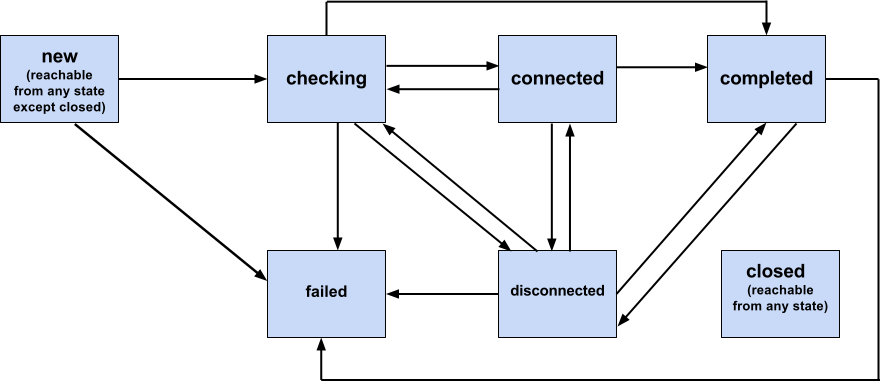
enum RTCIceRole {
  "unknown",
  "controlling",
  "controlled"
};| Enum value | Description |
|---|---|
unknown
|
An agent whose role as defined by [RFC5245], Section 3, has not yet been determined. |
controlling
|
A controlling agent as defined by [RFC5245], Section 3. |
controlled
|
A controlled agent as defined by [RFC5245], Section 3. |
enum RTCIceComponent {
  "rtp",
  "rtcp"
};| Enum value | Description |
|---|---|
rtp
|
The ICE Transport is used for RTP (or RTCP multiplexing),
as defined in [RFC5245], Section 4.1.1.1. Protocols
multiplexed with RTP (e.g. data channel) share its
component ID. This represents the component-id value 1 when encoded
in candidate-attribute.
|
rtcp
|
The ICE Transport is used for RTCP as defined by [RFC5245],
Section 4.1.1.1. This represents the component-id value 2 when encoded
in candidate-attribute.
|
The track event uses the RTCTrackEvent interface.
The Peer-to-peer Data API lets a web application send and receive generic application data peer-to-peer. The API for sending and receiving data models the behavior of Web Sockets.
The Peer-to-peer data API extends the RTCPeerConnection interface
as described below.
          partial interface RTCPeerConnection {
  readonly attribute RTCSctpTransport? sctp;
  RTCDataChannel createDataChannel(USVString label,
                                   optional RTCDataChannelInit dataChannelDict = {});
  attribute EventHandler ondatachannel;
};-
sctpof typeRTCSctpTransport, readonly, nullable -
The SCTP transport over which SCTP data is sent and received. If SCTP has not been negotiated, the value is null. This attribute MUST return the
RTCSctpTransportobject stored in the[[SctpTransport]]internal slot. -
ondatachannelof type EventHandler -
The event type of this event handler is
datachannel.
-
createDataChannel -
Creates a new
RTCDataChannelobject with the given label. TheRTCDataChannelInitdictionary can be used to configure properties of the underlying channel such as data reliability.When the
createDataChannelmethod is invoked, the user agent MUST run the following steps.-
Let connection be the
RTCPeerConnectionobject on which the method is invoked. -
If connection.
[[IsClosed]]istrue, throw anInvalidStateError. -
Create an RTCDataChannel, channel.
-
Initialize channel.
[[DataChannelLabel]]to the value of the first argument. -
If the UTF-8 representation of
[[DataChannelLabel]]is longer than 65535 bytes, throw aTypeError. -
Let options be the second argument.
-
Initialize channel.
[[MaxPacketLifeTime]]to option.maxPacketLifeTime, if present, otherwisenull. -
Initialize channel.
[[MaxRetransmits]]to option.maxRetransmits, if present, otherwisenull. -
Initialize channel.
[[Ordered]]to option.ordered. -
Initialize channel.
[[DataChannelProtocol]]to option.protocol. -
If the UTF-8 representation of
[[DataChannelProtocol]]is longer than 65535 bytes, throw aTypeError. -
Initialize channel.
[[Negotiated]]to option.negotiated. -
Initialize channel.
[[DataChannelId]]to the value of option.id, if it is present and[[Negotiated]]is true, otherwisenull. -
If
[[Negotiated]]istrueand[[DataChannelId]]isnull, throw aTypeError. -
If both
[[MaxPacketLifeTime]]and[[MaxRetransmits]]attributes are set (not null), throw aTypeError. -
If a setting, either
[[MaxPacketLifeTime]]or[[MaxRetransmits]], has been set to indicate unreliable mode, and that value exceeds the maximum value supported by the user agent, the value MUST be set to the user agents maximum value. -
If
[[DataChannelId]]is equal to 65535, which is greater than the maximum allowed ID of 65534 but still qualifies as an unsigned short, throw aTypeError. -
If the
[[DataChannelId]]slot isnull(due to no ID being passed intocreateDataChannel, or[[Negotiated]]being false), and the DTLS role of the SCTP transport has already been negotiated, then initialize[[DataChannelId]]to a value generated by the user agent, according to [RFC8832], and skip to the next step. If no available ID could be generated, or if the value of the[[DataChannelId]]slot is being used by an existingRTCDataChannel, throw anOperationErrorexception.Note
If the
[[DataChannelId]]slot isnullafter this step, it will be populated during the RTCSctpTransport connected procedure. -
Let transport be connection.
[[SctpTransport]].If the
[[DataChannelId]]slot is notnull, transport is in the "connected" state and[[DataChannelId]]is greater or equal to transport.[[MaxChannels]], throw anOperationError. -
If channel is the first
RTCDataChannelcreated on connection, update the negotiation-needed flag for connection. -
Append channel to connection.
[[DataChannels]]. -
Return channel and continue the following steps in parallel.
-
Create channel's associated underlying data transport and configure it according to the relevant properties of channel.
-
The RTCSctpTransport interface allows an application access to
information about the SCTP data channels tied to a particular SCTP
association.
To create an RTCSctpTransport with an initial
state, initialState, run the following steps:
-
Let transport be a new
RTCSctpTransportobject. -
Let transport have a [[SctpTransportState]] internal slot initialized to initialState.
-
Let transport have a [[MaxMessageSize]] internal slot and run the steps labeled update the data max message size to initialize it.
-
Let transport have a [[MaxChannels]] internal slot initialized to
null. -
Return transport.
To update the data max message size of an
RTCSctpTransport run the following steps:
-
Let transport be the
RTCSctpTransportobject to be updated. -
Let remoteMaxMessageSize be the value of the
max-message-sizeSDP attribute read from the remote description, as described in [RFC8841] (section 6), or 65536 if the attribute is missing. -
Let canSendSize be the number of bytes that this client can send (i.e. the size of the local send buffer) or 0 if the implementation can handle messages of any size.
-
If both remoteMaxMessageSize and canSendSize are 0, set
[[MaxMessageSize]]to the positive Infinity value. -
Else, if either remoteMaxMessageSize or canSendSize is 0, set
[[MaxMessageSize]]to the larger of the two. -
Else, set
[[MaxMessageSize]]to the smaller of remoteMaxMessageSize or canSendSize.
Once an SCTP transport
is connected, meaning the SCTP association of an RTCSctpTransport has been established, the user agent MUST
queue a task that runs the following steps:
-
Let transport be the
RTCSctpTransportobject. -
Let connection be the
RTCPeerConnectionobject associated with transport. -
Set
[[MaxChannels]]to the minimum of the negotiated amount of incoming and outgoing SCTP streams. -
For each of connection's
RTCDataChannel:-
Let channel be the
RTCDataChannelobject. -
If channel.
[[DataChannelId]]isnull, initialize[[DataChannelId]]to the value generated by the underlying sctp data channel, according to [RFC8832]. -
If channel.
[[DataChannelId]]is greater or equal to transport.[[MaxChannels]], or the previous step failed to assign an id, close the channel due to a failure. Otherwise, announce the channel as open.
-
-
Fire an event named
statechangeat transport.Note
This event is fired before the
openevents fired by announcing the channel as open; theopenevents are fired from a separate queued task.
[Exposed=Window]
interface RTCSctpTransport : EventTarget {
  readonly attribute RTCDtlsTransport transport;
  readonly attribute RTCSctpTransportState state;
  readonly attribute unrestricted double maxMessageSize;
  readonly attribute unsigned short? maxChannels;
  attribute EventHandler onstatechange;
};-
transportof typeRTCDtlsTransport, readonly -
The transport over which all SCTP packets for data channels will be sent and received.
-
stateof typeRTCSctpTransportState, readonly -
The current state of the SCTP transport. On getting, this attribute MUST return the value of the
[[SctpTransportState]]slot. -
maxMessageSizeof type unrestricted double, readonly -
The maximum size of data that can be passed to
RTCDataChannel'ssend()method. The attribute MUST, on getting, return the value of the[[MaxMessageSize]]slot. -
maxChannelsof type unsigned short , readonly, nullable -
The maximum amount of
RTCDataChannel's that can be used simultaneously. The attribute MUST, on getting, return the value of the[[MaxChannels]]slot.Note
This attribute's value will be
nulluntil the SCTP transport goes into the "connected" state. -
onstatechangeof type EventHandler -
The event type of this event handler is
statechange.
RTCSctpTransportState indicates the state of the SCTP
transport.
enum RTCSctpTransportState {
  "connecting",
  "connected",
  "closed"
};| Enum value | Description |
|---|---|
connecting
|
The |
connected
|
When the negotiation of an association is completed, a
task is queued to update the [[SctpTransportState]] slot
to " |
closed
|
A task is queued to update the [[SctpTransportState]]
slot to "
Note that the last transition is logical due to the fact that an SCTP association requires an established DTLS connection - [RFC8261] section 6.1 specifies that SCTP over DTLS is single-homed - and that no way of of switching to an alternate transport is defined in this API. |
The RTCDataChannel interface represents a bi-directional data
channel between two peers. An RTCDataChannel is created via a
factory method on an RTCPeerConnection object. The messages sent
between the browsers are described in [RFC8831] and
[RFC8832].
There are two ways to establish a connection with RTCDataChannel.
The first way is to simply create an RTCDataChannel at one of the
peers with the negotiated
RTCDataChannelInit dictionary member unset or set to its default
value false. This will announce the new channel in-band and trigger
an RTCDataChannelEvent with the corresponding RTCDataChannel
object at the other peer. The second way is to let the application
negotiate the RTCDataChannel. To do this, create an
RTCDataChannel object with the negotiated
RTCDataChannelInit dictionary member set to true, and signal
out-of-band (e.g. via a web server) to the other side that it SHOULD
create a corresponding RTCDataChannel with the
negotiated RTCDataChannelInit dictionary
member set to true and the same id. This will
connect the two separately created RTCDataChannel objects. The
second way makes it possible to create channels with asymmetric
properties and to create channels in a declarative way by specifying
matching ids.
Each RTCDataChannel has an associated underlying data transport that is used to
transport actual data to the other peer. In the case of SCTP data
channels utilizing an RTCSctpTransport (which represents the
state of the SCTP association), the underlying data transport is the
SCTP stream pair. The transport properties of the underlying data transport, such as in order delivery settings and reliability
mode, are configured by the peer as the channel is created. The
properties of a channel cannot change after the channel has been
created. The actual wire protocol between the peers is specified by
the WebRTC DataChannel Protocol specification [RFC8831].
An RTCDataChannel can be configured to operate in different
reliability modes. A reliable channel ensures that the data is
delivered at the other peer through retransmissions. An unreliable
channel is configured to either limit the number of retransmissions (
maxRetransmits ) or set a time during which
transmissions (including retransmissions) are allowed (
maxPacketLifeTime ). These properties can not
be used simultaneously and an attempt to do so will result in an
error. Not setting any of these properties results in a reliable
channel.
An RTCDataChannel, created with
createDataChannel or dispatched via an
RTCDataChannelEvent, MUST initially be in the
"connecting" state. When the
RTCDataChannel object's underlying data transport is ready,
the user agent MUST announce the RTCDataChannel as open.
To create an RTCDataChannel, run the following
steps:
-
Let channel be a newly created
RTCDataChannelobject. -
Let channel have a [[ReadyState]] internal slot initialized to "
connecting". -
Let channel have a [[BufferedAmount]] internal slot initialized to
0. -
Let channel have internal slots named [[DataChannelLabel]], [[Ordered]], [[MaxPacketLifeTime]], [[MaxRetransmits]], [[DataChannelProtocol]], [[Negotiated]], and [[DataChannelId]].
- Let channel have a [[IsTransferable]] internal slot initialized to
true. - Queue a task to run the following step:
- Set channel.
[[IsTransferable]]tofalse.
This task needs to run before any task enqueued by the receiving messages on a data channel algorithm for channel. This ensures that no message is lost during the transfer of a
RTCDataChannel. - Set channel.
-
Return channel.
When the user agent is to announce an RTCDataChannel as
open, the user agent MUST queue a task to run the following
steps:
-
If the associated
RTCPeerConnectionobject's[[IsClosed]]slot istrue, abort these steps. -
Let channel be the
RTCDataChannelobject to be announced. -
If channel.
[[ReadyState]]is "closing" or "closed", abort these steps. -
Set channel.
[[ReadyState]]to "open". -
Fire an event named
openat channel.
When an underlying data transport is to be announced (the
other peer created a channel with negotiated
unset or set to false), the user agent of the peer that did not
initiate the creation process MUST queue a task to run the
following steps:
-
Let connection be the
RTCPeerConnectionobject associated with the underlying data transport. -
If connection.
[[IsClosed]]istrue, abort these steps. -
Create an RTCDataChannel, channel.
-
Let configuration be an information bundle received from the other peer as a part of the process to establish the underlying data transport described by the WebRTC DataChannel Protocol specification [RFC8832].
-
Initialize channel.
[[DataChannelLabel]],[[Ordered]],[[MaxPacketLifeTime]],[[MaxRetransmits]],[[DataChannelProtocol]], and[[DataChannelId]]internal slots to the corresponding values in configuration. -
Initialize channel.
[[Negotiated]]tofalse. -
Append channel to connection.
[[DataChannels]]. -
Set channel.
[[ReadyState]]to "open" (but do not fire theopenevent, yet).Note
This allows to start sending messages inside of the
datachannelevent handler prior to theopenevent being fired. -
Fire an event named
datachannelusing theRTCDataChannelEventinterface with thechannelattribute set to channel at connection.
Candidate Correction 38:Prevent GC of non-closed RTCDataChannels (PR #2902)
6.2.4 Closing procedure
An RTCDataChannel object's underlying data transport may
be torn down in a non-abrupt manner by running the closing procedure. When
that happens the user agent MUST queue a task to run the following
steps:
Let channel be the
RTCDataChannelobject whose underlying data transport was closed.Let connection be the
RTCPeerConnectionobject associated with channel.Remove channel from connection.
[[DataChannels]].Unless the procedure was initiated by channel.
close, set channel.[[ReadyState]]to "closing" and fire an event namedclosingat channel.Run the following steps
in parallelin parallel:Finish sending all currently pending messages of the channel.
Follow the closing procedure defined for the channel's underlying data transport :
RenderClose the channel's data transportclosed
When an RTCDataChannel object's underlying data transport
has been closed, the user agent MUST queue a task to run the
following steps:
-
Let channel be the
RTCDataChannelobject whose underlying data transport was closed. - If channel.
[[ReadyState]]is "closed", abort these steps. -
Set channel.
[[ReadyState]]to "closed". -
Remove channel from connection.
[[DataChannels]]if it is still there. -
If the transport was closed with an error, fire an event named
errorusing theRTCErrorEventinterface with itserrorDetailattribute set to "sctp-failure" at channel. -
Fire an event named close at channel.
The RTCDataChannel transfer steps, given value and dataHolder, are:
If value.
[[IsTransferable]]isfalse, throw aDataCloneErrorDOMException.Set dataHolder.
[[ReadyState]]to value.[[ReadyState]].Set dataHolder.
[[DataChannelLabel]]to value.[[DataChannelLabel]].Set dataHolder.
[[Ordered]]to value.[[Ordered]].Set dataHolder.
[[MaxPacketLifeTime]]to value..[[MaxPacketLifeTime]]Set dataHolder.
[[MaxRetransmits]]to value.[[MaxRetransmits]].Set dataHolder.
[[DataChannelProtocol]]to value.[[DataChannelProtocol]].Set dataHolder.
[[Negotiated]]to value.[[Negotiated]].Set dataHolder.
[[DataChannelId]]to value.[[DataChannelId]].Set dataHolder’s underlying data transport to value underlying data transport.
Set value.
[[IsTransferable]]tofalse.Set value.
[[ReadyState]]to "closed".
The RTCDataChannel transfer-receiving steps, given dataHolder and channel, are:
Initialize channel.
[[ReadyState]]to dataHolder.[[ReadyState]].Initialize channel.
[[DataChannelLabel]]to dataHolder.[[DataChannelLabel]].Initialize channel.
[[Ordered]]to dataHolder.[[Ordered]].Initialize channel.
[[MaxPacketLifeTime]]to dataHolder.[[MaxPacketLifeTime]].Initialize channel.
[[MaxRetransmits]]to dataHolder.[[MaxRetransmits]].Initialize channel.
[[DataChannelProtocol]]to dataHolder.[[DataChannelProtocol]].Initialize channel.
[[Negotiated]]to dataHolder.[[Negotiated]].Initialize channel.
[[DataChannelId]]to dataHolder.[[DataChannelId]].Initialize channel’s underlying data transport to dataHolder’s underlying data transport.
The above steps do not need to transfer [[BufferedAmount]] as its value will always be equal to 0.
The reason is an RTCDataChannel can be transferred only if its send() algorithm was not called prior the transfer.
If the underlying data transport is closed at the time of the transfer-receiving steps,
the RTCDataChannel object will be closed by running the announcing a data channel as closed algorithm immediately after the transfer-receiving steps.
In some cases, the user agent may be unable to create an
RTCDataChannel 's underlying data transport. For
example, the data channel's id may be outside
the range negotiated by the [RFC8831] implementations in the
SCTP handshake. When the user agent determines that an
RTCDataChannel's underlying data transport cannot be
created, the user agent MUST queue a task to run the following
steps:
-
Let channel be the
RTCDataChannelobject for which the user agent could not create an underlying data transport. -
Set channel.
[[ReadyState]]to "closed". -
Fire an event named
errorusing theRTCErrorEventinterface with theerrorDetailattribute set to "data-channel-failure" at channel. -
Fire an event named close at channel.
When an RTCDataChannel message has
been received via the underlying data transport with
type type and data rawData, the user agent
MUST queue a task to run the following steps:
-
Let channel be the
RTCDataChannelobject for which the user agent has received a message. -
Let connection be the
RTCPeerConnectionobject associated with channel. -
If channel.
[[ReadyState]]is not "open", abort these steps and discard rawData. -
Execute the sub step by switching on type and channel.
binaryType:-
If type indicates that rawData is a
string:Let data be a DOMString that represents the result of decoding rawData as UTF-8.
-
If type indicates that rawData is binary and
binaryTypeis"blob":Let data be a new
Blobobject containing rawData as its raw data source. -
If type indicates that rawData is binary and
binaryTypeis"arraybuffer":Let data be a new
ArrayBufferobject containing rawData as its raw data source.
-
-
Fire an event named
messageusing theMessageEventinterface with itsoriginattribute initialized to the serialization of an origin of connection.[[DocumentOrigin]], and thedataattribute initialized to data at channel.
[Exposed=(Window,DedicatedWorker), Transferable]
interface RTCDataChannel : EventTarget {
  readonly attribute USVString label;
  readonly attribute boolean ordered;
  readonly attribute unsigned short? maxPacketLifeTime;
  readonly attribute unsigned short? maxRetransmits;
  readonly attribute USVString protocol;
  readonly attribute boolean negotiated;
  readonly attribute unsigned short? id;
  readonly attribute RTCDataChannelState readyState;
  readonly attribute unsigned long bufferedAmount;
  [EnforceRange] attribute unsigned long bufferedAmountLowThreshold;
  attribute EventHandler onopen;
  attribute EventHandler onbufferedamountlow;
  attribute EventHandler onerror;
  attribute EventHandler onclosing;
  attribute EventHandler onclose;
  undefined close();
  attribute EventHandler onmessage;
  attribute BinaryType binaryType;
  undefined send(USVString data);
  undefined send(Blob data);
  undefined send(ArrayBuffer data);
  undefined send(ArrayBufferView data);
};-
labelof type USVString, readonly -
The
labelattribute represents a label that can be used to distinguish thisRTCDataChannelobject from otherRTCDataChannelobjects. Scripts are allowed to create multipleRTCDataChannelobjects with the same label. On getting, the attribute MUST return the value of the[[DataChannelLabel]]slot. -
orderedof type boolean, readonly -
The
orderedattribute returns true if theRTCDataChannelis ordered, and false if out of order delivery is allowed. On getting, the attribute MUST return the value of the[[Ordered]]slot. -
maxPacketLifeTimeof type unsigned short, readonly, nullable -
The
maxPacketLifeTimeattribute returns the length of the time window (in milliseconds) during which transmissions and retransmissions may occur in unreliable mode. On getting, the attribute MUST return the value of the[[MaxPacketLifeTime]]slot. -
maxRetransmitsof type unsigned short, readonly, nullable -
The
maxRetransmitsattribute returns the maximum number of retransmissions that are attempted in unreliable mode. On getting, the attribute MUST return the value of the[[MaxRetransmits]]slot. -
protocolof type USVString, readonly -
The
protocolattribute returns the name of the sub-protocol used with thisRTCDataChannel. On getting, the attribute MUST return the value of the[[DataChannelProtocol]]slot. -
negotiatedof type boolean, readonly -
The
negotiatedattribute returns true if thisRTCDataChannelwas negotiated by the application, or false otherwise. On getting, the attribute MUST return the value of the[[Negotiated]]slot. -
idof type unsigned short, readonly, nullable -
The
idattribute returns the ID for thisRTCDataChannel. The value is initially null, which is what will be returned if the ID was not provided at channel creation time, and the DTLS role of the SCTP transport has not yet been negotiated. Otherwise, it will return the ID that was either selected by the script or generated by the user agent according to [RFC8832]. After the ID is set to a non-null value, it will not change. On getting, the attribute MUST return the value of the[[DataChannelId]]slot. -
readyStateof typeRTCDataChannelState, readonly -
The
readyStateattribute represents the state of theRTCDataChannelobject. On getting, the attribute MUST return the value of the[[ReadyState]]slot. -
bufferedAmountof type unsigned long, readonly -
The
bufferedAmountattribute MUST, on getting, return the value of the[[BufferedAmount]]slot. The attribute exposes the number of bytes of application data (UTF-8 text and binary data) that have been queued usingsend(). Even though the data transmission can occur in parallel, the returned value MUST NOT be decreased before the current task yielded back to the event loop to prevent race conditions. The value does not include framing overhead incurred by the protocol, or buffering done by the operating system or network hardware. The value of the[[BufferedAmount]]slot will only increase with each call to thesend()method as long as the[[ReadyState]]slot is "open"; however, the slot does not reset to zero once the channel closes. When the underlying data transport sends data from its queue, the user agent MUST queue a task that reduces[[BufferedAmount]]with the number of bytes that was sent. -
bufferedAmountLowThresholdof type unsigned long -
The
bufferedAmountLowThresholdattribute sets the threshold at which thebufferedAmountis considered to be low. When thebufferedAmountdecreases from above this threshold to equal or below it, thebufferedamountlowevent fires. ThebufferedAmountLowThresholdis initially zero on each newRTCDataChannel, but the application may change its value at any time. -
onopenof type EventHandler -
The event type of this event handler is
open. -
onbufferedamountlowof type EventHandler -
The event type of this event handler is
bufferedamountlow. -
onerrorof type EventHandler -
The event type of this event handler is
RTCErrorEvent.errorDetailcontains "sctp-failure",sctpCauseCodecontains the SCTP Cause Code value, andmessagecontains the SCTP Cause-Specific-Information, possibly with additional text. -
onclosingof type EventHandler -
The event type of this event handler is
closing. -
oncloseof type EventHandler -
The event type of this event handler is close.
-
onmessageof type EventHandler -
The event type of this event handler is
message. -
binaryTypeof type BinaryType -
The
binaryTypeattribute returns the value to which it was last set. When anRTCDataChannelobject is created, thebinaryTypeattribute MUST be initialized to the string "arraybuffer".This attribute controls how binary data is exposed to scripts. See Web Socket's
binaryType.
-
close() -
Closes the
RTCDataChannel. It may be called regardless of whether theRTCDataChannelobject was created by this peer or the remote peer.When the
closemethod is called, the user agent MUST run the following steps:-
Let channel be the
RTCDataChannelobject which is about to be closed. -
If channel.
[[ReadyState]]is "closing" or "closed", then abort these steps. -
Set channel.
[[ReadyState]]to "closing". -
If the closing procedure has not started yet, start it.
-
-
send -
Run the steps described by the send() algorithm with argument type
stringobject. -
send -
Run the steps described by the send() algorithm with argument type
Blobobject. -
send -
Run the steps described by the send() algorithm with argument type
ArrayBufferobject. -
send -
Run the steps described by the send() algorithm with argument type
ArrayBufferViewobject.
The send() method is overloaded to
handle different data argument types. When any version of the
method is called, the user agent MUST run the following
steps:
-
Let channel be the
RTCDataChannelobject on which data is to be sent. Set channel.
[[IsTransferable]]tofalse.-
If channel.
[[ReadyState]]is not "open", throw anInvalidStateError. -
Execute the sub step that corresponds to the type of the methods argument:
-
stringobject:Let data be a byte buffer that represents the result of encoding the method's argument as UTF-8.
-
Blobobject:Let data be the raw data represented by the
Blobobject.Note
Although the actual retrieval of data from a
Blobobject can happen asynchronously, the user agent will make sure to queue the data on the channel's underlying data transport in the same order as the send method is called. The byte size of data needs to be known synchronously. -
ArrayBufferobject:Let data be the data stored in the buffer described by the
ArrayBufferobject. -
ArrayBufferViewobject:Let data be the data stored in the section of the buffer described by the
ArrayBufferobject that theArrayBufferViewobject references.
Note
Any data argument type this method has not been overloaded with will result in a
TypeError. This includesnullandundefined. -
-
If the byte size of data exceeds the value of
maxMessageSizeon channel's associatedRTCSctpTransport, throw aTypeError. -
Queue data for transmission on channel's underlying data transport. If queuing data is not possible because not enough buffer space is available, throw an
OperationError.Note
The actual transmission of data occurs in parallel. If sending data leads to an SCTP-level error, the application will be notified asynchronously through
onerror. -
Increase the value of the
[[BufferedAmount]]slot by the byte size of data.
dictionary RTCDataChannelInit {
  boolean ordered = true;
  [EnforceRange] unsigned short maxPacketLifeTime;
  [EnforceRange] unsigned short maxRetransmits;
  USVString protocol = "";
  boolean negotiated = false;
  [EnforceRange] unsigned short id;
};-
orderedof type boolean, defaulting totrue -
If set to false, data is allowed to be delivered out of order. The default value of true, guarantees that data will be delivered in order.
-
maxPacketLifeTimeof type unsigned short -
Limits the time (in milliseconds) during which the channel will transmit or retransmit data if not acknowledged. This value may be clamped if it exceeds the maximum value supported by the user agent.
-
maxRetransmitsof type unsigned short -
Limits the number of times a channel will retransmit data if not successfully delivered. This value may be clamped if it exceeds the maximum value supported by the user agent.
-
protocolof type USVString, defaulting to"" -
Subprotocol name used for this channel.
-
negotiatedof type boolean, defaulting tofalse -
The default value of false tells the user agent to announce the channel in-band and instruct the other peer to dispatch a corresponding
RTCDataChannelobject. If set to true, it is up to the application to negotiate the channel and create anRTCDataChannelobject with the sameidat the other peer.Note
If set to true, the application must also take care to not send a message until the other peer has created a data channel to receive it. Receiving a message on an SCTP stream with no associated data channel is undefined behavior, and it may be silently dropped. This will not be possible as long as both endpoints create their data channel before the first offer/answer exchange is complete.
-
idof type unsigned short -
Sets the channel ID when
negotiatedis true. Ignored whennegotiatedis false.
enum RTCDataChannelState {
  "connecting",
  "open",
  "closing",
  "closed"
};| Enum value | Description |
|---|---|
connecting
|
The user agent is attempting to establish the underlying data transport. This is the initial state of an
|
open
|
The underlying data transport is established and communication is possible. |
closing
|
The procedure to close down the underlying data transport has started. |
closed
|
The underlying data transport has been |
The datachannel event uses the RTCDataChannelEvent interface.
[Exposed=Window]
interface RTCDataChannelEvent : Event {
  constructor(DOMString type, RTCDataChannelEventInit eventInitDict);
  readonly attribute RTCDataChannel channel;
};-
RTCDataChannelEvent.constructor()
-
channelof typeRTCDataChannel, readonly -
The
channelattribute represents theRTCDataChannelobject associated with the event.
dictionary RTCDataChannelEventInit : EventInit {
  required RTCDataChannel channel;
};-
channelof typeRTCDataChannel, required -
The
RTCDataChannelobject to be announced by the event.
An RTCDataChannel object MUST not be garbage collected if its
-
[[ReadyState]]slot is "connecting" and at least one event listener is registered foropenevents,messageevents,errorevents,closingevents, or close events. -
[[ReadyState]]slot is "open" and at least one event listener is registered formessageevents,errorevents,closingevents, or close events. -
[[ReadyState]]slot is "closing" and at least one event listener is registered forerrorevents, or close events. -
underlying data transport is established and data is queued to be transmitted.
This section describes an interface on RTCRtpSender to send DTMF
(phone keypad) values across an RTCPeerConnection. Details of how
DTMF is sent to the other peer are described in [RFC7874].
The Peer-to-peer DTMF API extends the RTCRtpSender interface as
described below.
          partial interface RTCRtpSender {
  readonly attribute RTCDTMFSender? dtmf;
};-
dtmfof typeRTCDTMFSender, readonly, nullable -
On getting, the
dtmfattribute returns the value of the[[Dtmf]]internal slot, which represents aRTCDTMFSenderwhich can be used to send DTMF, ornullif unset. The[[Dtmf]]internal slot is set when the kind of anRTCRtpSender's[[SenderTrack]]is"audio".
To create an RTCDTMFSender, the user agent MUST run the following steps:
-
Let dtmf be a newly created
RTCDTMFSenderobject. -
Let dtmf have a [[Duration]] internal slot.
-
Let dtmf have a [[InterToneGap]] internal slot.
-
Let dtmf have a [[ToneBuffer]] internal slot.
[Exposed=Window]
interface RTCDTMFSender : EventTarget {
  undefined insertDTMF(DOMString tones, optional unsigned long duration = 100, optional unsigned long interToneGap = 70);
  attribute EventHandler ontonechange;
  readonly attribute boolean canInsertDTMF;
  readonly attribute DOMString toneBuffer;
};-
ontonechangeof type EventHandler -
The event type of this event handler is
tonechange. -
canInsertDTMFof type boolean, readonly -
Whether the
RTCDTMFSenderdtmfSender is capable of sending DTMF. On getting, the user agent MUST return the result of running determine if DTMF can be sent for dtmfSender. -
toneBufferof type DOMString, readonly -
The
toneBufferattribute MUST return a list of the tones remaining to be played out. For the syntax, content, and interpretation of this list, seeinsertDTMF.
-
insertDTMF -
An
RTCDTMFSenderobject'sinsertDTMFmethod is used to send DTMF tones.The tones parameter is treated as a series of characters. The characters 0 through 9, A through D, #, and * generate the associated DTMF tones. The characters a to d MUST be normalized to uppercase on entry and are equivalent to A to D. As noted in [RTCWEB-AUDIO] Section 3, support for the characters 0 through 9, A through D, #, and * are required. The character ',' MUST be supported, and indicates a delay of 2 seconds before processing the next character in the tones parameter. All other characters (and only those other characters) MUST be considered unrecognized.
The duration parameter indicates the duration in ms to use for each character passed in the tones parameters. The duration cannot be more than 6000 ms or less than 40 ms. The default duration is 100 ms for each tone.
The interToneGap parameter indicates the gap between tones in ms. The user agent clamps it to at least 30 ms and at most 6000 ms. The default value is 70 ms.
The browser MAY increase the duration and interToneGap times to cause the times that DTMF start and stop to align with the boundaries of RTP packets but it MUST not increase either of them by more than the duration of a single RTP audio packet.
When the
insertDTMF()method is invoked, the user agent MUST run the following steps:- Let sender be the
RTCRtpSenderused to send DTMF. -
Let transceiver be the
RTCRtpTransceiverobject associated with sender. - Let dtmf be the
RTCDTMFSenderassociated with sender. - If determine if DTMF can be sent for
dtmf returns
false, throw anInvalidStateError. - Let tones be the method's first argument.
- Let duration be the method's second argument.
- Let interToneGap be the method's third argument.
- If
tones contains any
unrecognizedcharacters, throw anInvalidCharacterError. - Set the object's
[[ToneBuffer]]slot to tones. - Set dtmf.
[[Duration]]to the value of duration. - Set dtmf.
[[InterToneGap]]to the value of interToneGap. -
If the value of duration is less than 40 ms, set
dtmf.
[[Duration]]to 40 ms. -
If the value of duration parameter is greater than
6000 ms, set dtmf.
[[Duration]]to 6000 ms. - If the
value of interToneGap is less than 30 ms, set
dtmf.
[[InterToneGap]]to 30 ms. -
If the value of interToneGap is greater than 6000
ms, set dtmf.
[[InterToneGap]]to 6000 ms. - If [[ToneBuffer]] slot is an empty string, abort these steps.
- If a
task to run the DTMF playout task steps is scheduled to be run,
abort these steps; otherwise queue a task that runs the following
DTMF playout task steps:
Candidate Correction 33:Determine if DTMF can be sent inside queued playout task (PR #2861)
If transceiver.[[CurrentDirection]]If determine if DTMF can be sentis neither "for dtmf returnssendrecvsendonlyfalse, abort these steps.- If the
[[ToneBuffer]]slot contains the empty string, fire an event namedtonechangeusing theRTCDTMFToneChangeEventinterface with thetoneattribute set to an empty string at theRTCDTMFSenderobject and abort these steps. - Remove the first character from the
[[ToneBuffer]]slot and let that character be tone. - If tone is
","delay sending tones for2000ms on the associated RTP media stream, and queue a task to be executed in2000ms from now that runs the DTMF playout task steps. - If tone is not
","start playout of tone for[[Duration]]ms on the associated RTP media stream, using the appropriate codec, then queue a task to be executed in[[Duration]]+[[InterToneGap]]ms from now that runs the DTMF playout task steps. - Fire an event named
tonechangeusing theRTCDTMFToneChangeEventinterface with thetoneattribute set to tone at theRTCDTMFSenderobject.
Since
insertDTMFreplaces the tone buffer, in order to add to the DTMF tones being played, it is necessary to callinsertDTMFwith a string containing both the remaining tones (stored in the[[ToneBuffer]]slot) and the new tones appended together. CallinginsertDTMFwith an empty tones parameter can be used to cancel all tones queued to play after the currently playing tone. - Let sender be the
To determine if DTMF can be sent for an RTCDTMFSender
instance dtmfSender, the user agent MUST run the following
steps:
- Let sender be the
RTCRtpSenderassociated with dtmfSender. - Let transceiver be the
RTCRtpTransceiverassociated with sender. - Let connection be the
RTCPeerConnectionassociated with transceiver. - If connection's
RTCPeerConnectionStateis not "connected" returnfalse. - If transceiver.
[[Stopping]]istruereturnfalse. - If sender.
[[SenderTrack]]isnullreturnfalse. - If transceiver.
[[CurrentDirection]]is neither "sendrecv" nor "sendonly" returnfalse. - If
sender.
[[SendEncodings]][0].activeisfalsereturnfalse. - If no codec with mimetype
"audio/telephone-event"has been negotiated for sending with this sender, returnfalse. - Otherwise, return
true.
The tonechange event uses the RTCDTMFToneChangeEvent
interface.
[Exposed=Window]
interface RTCDTMFToneChangeEvent : Event {
  constructor(DOMString type, optional RTCDTMFToneChangeEventInit eventInitDict = {});
  readonly attribute DOMString tone;
};-
RTCDTMFToneChangeEvent.constructor()
-
toneof type DOMString, readonly -
The
toneattribute contains the character for the tone (including",") that has just begun playout (seeinsertDTMF). If the value is the empty string, it indicates that the[[ToneBuffer]]slot is an empty string and that the previous tones have completed playback.
          dictionary RTCDTMFToneChangeEventInit : EventInit {
  DOMString tone = "";
};-
toneof type DOMString, defaulting to"" -
The
toneattribute contains the character for the tone (including",") that has just begun playout (seeinsertDTMF). If the value is the empty string, it indicates that the[[ToneBuffer]]slot is an empty string and that the previous tones have completed playback.
The basic statistics model is that the browser maintains a set of statistics for monitored objects, in the form of stats objects.
A group of related objects may be referenced by a selector. The selector may, for example, be a
MediaStreamTrack. For a track to be a valid selector, it MUST be
a MediaStreamTrack that is sent or received by the
RTCPeerConnection object on which the stats request was issued.
The calling Web application provides the selector to the
getStats() method and the browser emits (in the
JavaScript) a set of statistics that are relevant to the selector,
according to the stats selection algorithm. Note that that
algorithm takes the sender or receiver of a selector.
The statistics returned in stats objects are designed in such a
way that repeated queries can be linked by the RTCStats
id dictionary member. Thus, a Web application can make
measurements over a given time period by requesting measurements at
the beginning and end of that period.
With a few exceptions, monitored objects, once created, exist
for the duration of their associated RTCPeerConnection. This
ensures statistics from them are available in the result from
getStats() even past the associated peer
connection being closed.
Only a few monitored objects have shorter lifetimes. Statistics from these objects are no longer available in subsequent getStats() results. The object descriptions in [WEBRTC-STATS] describe when these monitored objects are deleted.
The Statistics API extends the RTCPeerConnection interface as
described below.
          partial interface RTCPeerConnection {
  Promise<RTCStatsReport> getStats(optional MediaStreamTrack? selector = null);
};-
getStats -
Gathers stats for the given selector and reports the result asynchronously.
When the
getStats()method is invoked, the user agent MUST run the following steps:-
Let selectorArg be the method's first argument.
-
Let connection be the
RTCPeerConnectionobject on which the method was invoked. -
If selectorArg is
null, let selector benull. -
If selectorArg is a
MediaStreamTracklet selector be anRTCRtpSenderorRTCRtpReceiveron connection whichtrackattribute matches selectorArg. If no such sender or receiver exists, or if more than one sender or receiver fit this criteria, return a promise rejected with a newly createdInvalidAccessError. -
Let p be a new promise.
-
Run the following steps in parallel:
-
Gather the stats indicated by selector according to the stats selection algorithm.
-
Queue a global task on the networking task source given the current realm's global object as global to resolve p with the resulting
RTCStatsReportobject, containing the gathered stats.
-
-
Return p.
-
The getStats() method delivers a successful
result in the form of an RTCStatsReport object. An
RTCStatsReport object is a map between strings that identify the
inspected objects (id attribute in RTCStats
instances), and their corresponding RTCStats-derived
dictionaries.
An RTCStatsReport may be composed of several RTCStats-derived
dictionaries, each reporting stats for one underlying object that the
implementation thinks is relevant for the selector. One
achieves the total for the selector by summing over all the
stats of a certain type; for instance, if an RTCRtpSender uses
multiple SSRCs to carry its track over the network, the
RTCStatsReport may contain one RTCStats-derived dictionary
per SSRC (which can be distinguished by the value of the
ssrc stats attribute).
[Exposed=Window]
interface RTCStatsReport {
  readonly maplike<DOMString, object>;
};
Use these to retrieve the various dictionaries descended from
RTCStats that this stats report is composed of. The set of
supported property names [WEBIDL] is defined as the ids of all
the RTCStats-derived dictionaries that have been generated for
this stats report.
An RTCStats dictionary represents the stats object
constructed by inspecting a specific monitored object. The
RTCStats dictionary is a base type that specifies as set of
default attributes, such as timestamp and
type. Specific stats are added by extending the
RTCStats dictionary.
Note that while stats names are standardized, any given implementation may be using experimental values or values not yet known to the Web application. Thus, applications MUST be prepared to deal with unknown stats.
Statistics need to be synchronized with each other in order to yield
reasonable values in computation; for instance, if
bytesSent and
packetsSent are both reported, they both
need to be reported over the same interval, so that "average packet
size" can be computed as "bytes / packets" - if the intervals are
different, this will yield errors. Thus implementations MUST return
synchronized values for all stats in an RTCStats-derived
dictionary.
dictionary RTCStats {
  required DOMHighResTimeStamp timestamp;
  required RTCStatsType type;
  required DOMString id;
};-
timestampof type DOMHighResTimeStamp Candidate Correction 50:Use Performance.timeOrigin + Performance.now() for stats timestamps (PR #3005)
TheTimestamps are expressed withtimestampDOMHighResTimeStamp,associated with this object. The time is relative to the UNIX epoch (Jan 1[HIGHRES-TIME],1970,and are defined asPerformance.timeOriginUTC)+Performance.now()at the time the information is collected. For statistics that came from a remote source (e.g., from received RTCP packets),timestampRTCStats-derived dictionary, if applicable.-
typeof typeRTCStatsType -
The type of this object.
The
typeattribute MUST be initialized to the name of the most specific type thisRTCStatsdictionary represents. -
idof type DOMString -
A unique
idthat is associated with the object that was inspected to produce thisRTCStatsobject. TwoRTCStatsobjects, extracted from two differentRTCStatsReportobjects, MUST have the same id if they were produced by inspecting the same underlying object.Stats ids MUST NOT be predictable by an application. This prevents applications from depending on a particular user agent's way of generating ids, since this prevents an application from getting stats objects by their id unless they have already read the id of that specific stats object.
User agents are free to pick any format for the id as long as it meets the requirements above.
Note
A user agent can turn a predictably generated string into an unpredictable string using a hash function, as long as it uses a salt that is unique to the peer connection. This allows an implementation to have predictable ids internally, which may make it easier to guarantee that stats objects have stable ids across getStats() calls.
The set of valid values for RTCStatsType, and the dictionaries
derived from RTCStats that they indicate, are documented in
[WEBRTC-STATS].
The stats selection algorithm is as follows:
- Let result be an empty
RTCStatsReport. - If
selector is
null, gather stats for the whole connection, add them to result, return result, and abort these steps. -
If selector is an
RTCRtpSender, gather stats for and add the following objects to result:- All
RTCOutboundRtpStreamStatsobjects representing RTP streams being sent by selector. - All stats objects referenced directly or indirectly by the
RTCOutboundRtpStreamStatsobjects added.
- All
-
If selector is an
RTCRtpReceiver, gather stats for and add the following objects to result:- All
RTCInboundRtpStreamStatsobjects representing RTP streams being received by selector. - All stats objects referenced directly or indirectly by the
RTCInboundRtpStreamStatsadded.
- All
- Return result.
The stats listed in [WEBRTC-STATS] are intended to cover a wide range of use cases. Not all of them have to be implemented by every WebRTC implementation.
An implementation MUST support generating statistics of the following
types when the corresponding objects exist on a
RTCPeerConnection, with the fields that are listed when they are
valid for that object in addition to the generic fields defined in
the RTCStats dictionary:
An implementation MAY support generating any other statistic defined in [WEBRTC-STATS], and MAY generate statistics that are not documented.
Consider the case where the user is experiencing bad sound and the application wants to determine if the cause of it is packet loss. The following example code might be used:
async function gatherStats(pc) {
  try {
    const [sender] = pc.getSenders();
    const baselineReport = await sender.getStats();
    await new Promise(resolve => setTimeout(resolve, aBit)); // wait a bit
    const currentReport = await sender.getStats();

    // compare the elements from the current report with the baseline
    for (const now of currentReport.values()) {
      if (now.type != 'outbound-rtp') continue;

      // get the corresponding stats from the baseline report
      const base = baselineReport.get(now.id);
      if (!base) continue;

      const remoteNow = currentReport.get(now.remoteId);
      const remoteBase = baselineReport.get(base.remoteId);

      const packetsSent = now.packetsSent - base.packetsSent;
      const packetsReceived = remoteNow.packetsReceived -
                              remoteBase.packetsReceived;

      const fractionLost = (packetsSent - packetsReceived) / packetsSent;
      if (fractionLost > 0.3) {
        // if fractionLost is > 0.3, we have probably found the culprit
      }
    }
  } catch (err) {
    console.error(err);
  }
}
The MediaStreamTrack interface, as defined in the
[GETUSERMEDIA] specification, typically represents a stream of
data of audio or video. One or more MediaStreamTracks can be
collected in a MediaStream (strictly speaking, a MediaStream
as defined in [GETUSERMEDIA] may contain zero or more
MediaStreamTrack objects).
A MediaStreamTrack may be extended to represent a media flow that
either comes from or is sent to a remote peer (and not just the local
camera, for instance). The extensions required to enable this
capability on the MediaStreamTrack object will be described in
this section. How the media is transmitted to the peer is described
in [RFC8834], [RFC7874], and [RFC8835].
A MediaStreamTrack sent to another peer will appear as one and
only one MediaStreamTrack to the recipient. A peer is defined as
a user agent that supports this specification. In addition, the
sending side application can indicate what MediaStream object(s)
the MediaStreamTrack is a member of. The corresponding
MediaStream object(s) on the receiver side will be created (if
not already present) and populated accordingly.
As also described earlier in this document, the objects
RTCRtpSender and RTCRtpReceiver can be used by the
application to get more fine grained control over the transmission
and reception of MediaStreamTracks.
Channels are the smallest unit considered in the Media Capture and
Streams specification. Channels are intended to be encoded together
for transmission as, for instance, an RTP payload type. All of the
channels that a codec needs to encode jointly MUST be in the same
MediaStreamTrack and the codecs SHOULD be able to encode, or
discard, all the channels in the track.
The concepts of an input and output to a given MediaStreamTrack
apply in the case of MediaStreamTrack objects transmitted over
the network as well. A MediaStreamTrack created by an
RTCPeerConnection object (as described previously in this
document) will take as input the data received from a remote peer.
Similarly, a MediaStreamTrack from a local source, for instance a
camera via [GETUSERMEDIA], will have an output that represents
what is transmitted to a remote peer if the object is used with an
RTCPeerConnection object.
The concept of duplicating MediaStream and MediaStreamTrack
objects as described in [GETUSERMEDIA] is also applicable here.
This feature can be used, for instance, in a video-conferencing
scenario to display the local video from the user's camera and
microphone in a local monitor, while only transmitting the audio to
the remote peer (e.g. in response to the user using a "video mute"
feature). Combining different MediaStreamTrack objects into new
MediaStream objects is useful in certain situations.
Note
In this document, we only specify aspects of the following objects
that are relevant when used along with an RTCPeerConnection.
Please refer to the original definitions of the objects in the
[GETUSERMEDIA] document for general information on using
MediaStream and MediaStreamTrack.
The id attribute specified in MediaStream
returns an id that is unique to this stream, so that streams can be
recognized at the remote end of the RTCPeerConnection API.
When a MediaStream is created to represent a stream obtained
from a remote peer, the id attribute is initialized
from information provided by the remote source.
Note
The id of a MediaStream object is unique to the
source of the stream, but that does not mean it is not possible to
end up with duplicates. For example, the tracks of a locally
generated stream could be sent from one user agent to a remote peer
using RTCPeerConnection and then sent back to the original user
agent in the same manner, in which case the original user agent
will have multiple streams with the same id (the locally-generated
one and the one received from the remote peer).
A MediaStreamTrack object's reference to its MediaStream in
the non-local media source case (an RTP source, as is the case for
each MediaStreamTrack associated with an RTCRtpReceiver) is
always strong.
Whenever an RTCRtpReceiver receives data on an RTP source whose
corresponding MediaStreamTrack is muted, but not ended, and the
[[Receptive]] slot of the RTCRtpTransceiver object the
RTCRtpReceiver is a member of is true, it MUST queue
a task to set the muted state of the corresponding
MediaStreamTrack to false.
When one of the SSRCs for RTP source media streams received by an
RTCRtpReceiver is removed either due to reception of a BYE or via
timeout, it MUST queue a task to set the muted state of the
corresponding MediaStreamTrack to true. Note that
setRemoteDescription can also lead to the setting of the muted state of the
track to the value true.
The procedures add a track, remove a track and set a track's muted state are specified in [GETUSERMEDIA].
When a MediaStreamTrack track produced by an RTCRtpReceiver
receiver has ended
[GETUSERMEDIA] (such as via a call to
receiver.track.stop), the user agent MAY choose to free resources
allocated for the incoming stream, by for instance turning off the
decoder of receiver.
The concept of constraints and constrainable properties, including
MediaTrackConstraints (MediaStreamTrack.getConstraints(), MediaStreamTrack.applyConstraints()), and MediaTrackSettings
(MediaStreamTrack.getSettings()) are
outlined in [GETUSERMEDIA]. However, the constrainable
properties of tracks sourced from a peer connection are different
than those sourced by getUserMedia(); the
constraints and settings applicable to MediaStreamTracks
sourced from a remote source are defined here. The settings
of a remote track represent the latest frame received.
MediaStreamTrack.getCapabilities()
MUST always return the empty set and
MediaStreamTrack.applyConstraints()
MUST always reject with OverconstrainedError on remote tracks for constraints
defined here.
The following constrainable properties are defined to apply to
video MediaStreamTracks sourced from a remote source:
| Property Name | Values | Notes |
|---|---|---|
| width |
ConstrainULong
|
As a setting, this is the width, in pixels, of the latest frame received. |
| height |
ConstrainULong
|
As a setting, this is the height, in pixels, of the latest frame received. |
| frameRate |
ConstrainDouble
|
As a setting, this is an estimate of the frame rate based on recently received frames. |
| aspectRatio |
ConstrainDouble
|
As a setting, this is the aspect ratio of the latest frame; this is the width in pixels divided by height in pixels as a double rounded to the tenth decimal place. |
This document does not define any constrainable properties to apply
to audio MediaStreamTracks sourced from a remote source.
This section is non-normative.
When two peers decide they are going to set up a connection to each other, they both go through these steps. The STUN/TURN server configuration describes a server they can use to get things like their public IP address or to set up NAT traversal. They also have to send data for the signaling channel to each other using the same out-of-band mechanism they used to establish that they were going to communicate in the first place.
const signaling = new SignalingChannel(); // handles JSON.stringify/parse
const constraints = {audio: true, video: true};
const configuration = {iceServers: [{urls: 'stun:stun.example.org'}]};
const pc = new RTCPeerConnection(configuration);

// send any ice candidates to the other peer
pc.onicecandidate = ({candidate}) => signaling.send({candidate});

// let the "negotiationneeded" event trigger offer generation
pc.onnegotiationneeded = async () => {
  try {
    await pc.setLocalDescription();
    // send the offer to the other peer
    signaling.send({description: pc.localDescription});
  } catch (err) {
    console.error(err);
  }
};

pc.ontrack = ({track, streams}) => {
  // once media for a remote track arrives, show it in the remote video element
  track.onunmute = () => {
    // don't set srcObject again if it is already set.
    if (remoteView.srcObject) return;
    remoteView.srcObject = streams[0];
  };
};

// call start() to initiate
function start() {
  addCameraMic();
}

// add camera and microphone to connection
async function addCameraMic() {
  try {
    // get a local stream, show it in a self-view and add it to be sent
    const stream = await navigator.mediaDevices.getUserMedia(constraints);
    for (const track of stream.getTracks()) {
      pc.addTrack(track, stream);
    }
    selfView.srcObject = stream;
  } catch (err) {
    console.error(err);
  }
}

signaling.onmessage = async ({data: {description, candidate}}) => {
  try {
    if (description) {
      await pc.setRemoteDescription(description);
      // if we got an offer, we need to reply with an answer
      if (description.type == 'offer') {
        if (!selfView.srcObject) {
          // blocks negotiation on permission (not recommended in production code)
          await addCameraMic();
        }
        await pc.setLocalDescription();
        signaling.send({description: pc.localDescription});
      }
    } else if (candidate) {
      await pc.addIceCandidate(candidate);
    }
  } catch (err) {
    console.error(err);
  }
};
When two peers decide they are going to set up a connection to each other and want to have the ICE, DTLS, and media connections "warmed up" such that they are ready to send and receive media immediately, they both go through these steps.
const signaling = new SignalingChannel(); // handles JSON.stringify/parse
const constraints = {audio: true, video: true};
const configuration = {iceServers: [{urls: 'stun:stun.example.org'}]};
let pc;
let audio;
let video;
let started = false;

// Call warmup() before media is ready, to warm-up ICE, DTLS, and media.
async function warmup(isAnswerer) {
  pc = new RTCPeerConnection(configuration);
  if (!isAnswerer) {
    audio = pc.addTransceiver('audio');
    video = pc.addTransceiver('video');
  }

  // send any ice candidates to the other peer
  pc.onicecandidate = ({candidate}) => signaling.send({candidate});

  // let the "negotiationneeded" event trigger offer generation
  pc.onnegotiationneeded = async () => {
    try {
      await pc.setLocalDescription();
      // send the offer to the other peer
      signaling.send({description: pc.localDescription});
    } catch (err) {
      console.error(err);
    }
  };

  pc.ontrack = async ({track, transceiver}) => {
    try {
      // once media for the remote track arrives, show it in the video element
      event.track.onunmute = () => {
        // don't set srcObject again if it is already set.
        if (!remoteView.srcObject) {
          remoteView.srcObject = new MediaStream();
        }
        remoteView.srcObject.addTrack(track);
      }

      if (isAnswerer) {
        if (track.kind == 'audio') {
          audio = transceiver;
        } else if (track.kind == 'video') {
          video = transceiver;
        }
        if (started) await addCameraMicWarmedUp();
      }
    } catch (err) {
      console.error(err);
    }
  };

  try {
    // get a local stream, show it in a self-view and add it to be sent
    selfView.srcObject = await navigator.mediaDevices.getUserMedia(constraints);
    if (started) await addCameraMicWarmedUp();
  } catch (err) {
    console.error(err);
  }
}

// call start() after warmup() to begin transmitting media from both ends
function start() {
  signaling.send({start: true});
  signaling.onmessage({data: {start: true}});
}

// add camera and microphone to already warmed-up connection
async function addCameraMicWarmedUp() {
  const stream = selfView.srcObject;
  if (audio && video && stream) {
    await Promise.all([
      audio.sender.replaceTrack(stream.getAudioTracks()[0]),
      video.sender.replaceTrack(stream.getVideoTracks()[0]),
    ]);
  }
}

signaling.onmessage = async ({data: {start, description, candidate}}) => {
  if (!pc) warmup(true);

  try {
    if (start) {
      started = true;
      await addCameraMicWarmedUp();
    } else if (description) {
      await pc.setRemoteDescription(description);
      // if we got an offer, we need to reply with an answer
      if (description.type == 'offer') {
        await pc.setLocalDescription();
        signaling.send({description: pc.localDescription});
      }
    } else {
      await pc.addIceCandidate(candidate);
    }
  } catch (err) {
    console.error(err);
  }
};
A client wants to send multiple RTP encodings (simulcast) to a server.
const signaling = new SignalingChannel(); // handles JSON.stringify/parse
const constraints = {audio: true, video: true};
const configuration = {'iceServers': [{'urls': 'stun:stun.example.org'}]};
let pc;

// call start() to initiate
async function start() {
  pc = new RTCPeerConnection(configuration);

  // let the "negotiationneeded" event trigger offer generation
  pc.onnegotiationneeded = async () => {
    try {
      await pc.setLocalDescription();
      // send the offer to the other peer
      signaling.send({description: pc.localDescription});
    } catch (err) {
      console.error(err);
    }
  };

  try {
    // get a local stream, show it in a self-view and add it to be sent
    const stream = await navigator.mediaDevices.getUserMedia(constraints);
    selfView.srcObject = stream;
    pc.addTransceiver(stream.getAudioTracks()[0], {direction: 'sendonly'});
    pc.addTransceiver(stream.getVideoTracks()[0], {
      direction: 'sendonly',
      sendEncodings: [
        {rid: 'q', scaleResolutionDownBy: 4.0}
        {rid: 'h', scaleResolutionDownBy: 2.0},
        {rid: 'f'},
      ]
    });
  } catch (err) {
    console.error(err);
  }
}

signaling.onmessage = async ({data: {description, candidate}}) => {
  try {
    if (description) {
      await pc.setRemoteDescription(description);
      // if we got an offer, we need to reply with an answer
      if (description.type == 'offer') {
        await pc.setLocalDescription();
        signaling.send({description: pc.localDescription});
      }
    } else if (candidate) {
      await pc.addIceCandidate(candidate);
    }
  } catch (err) {
    console.error(err);
  }
};
This example shows how to create an RTCDataChannel object and
perform the offer/answer exchange required to connect the channel
to the other peer. The RTCDataChannel is used in the context of
a simple chat application using an input field for
user input.
const signaling = new SignalingChannel(); // handles JSON.stringify/parse
const configuration = {iceServers: [{urls: 'stun:stun.example.org'}]};
let pc, channel;

// call start() to initiate
function start() {
  pc = new RTCPeerConnection(configuration);

  // send any ice candidates to the other peer
  pc.onicecandidate = ({candidate}) => signaling.send({candidate});

  // let the "negotiationneeded" event trigger offer generation
  pc.onnegotiationneeded = async () => {
    try {
      await pc.setLocalDescription();
      // send the offer to the other peer
      signaling.send({description: pc.localDescription});
    } catch (err) {
      console.error(err);
    }
  };

  // create data channel and setup chat using "negotiated" pattern
  channel = pc.createDataChannel('chat', {negotiated: true, id: 0});
  channel.onopen = () => input.disabled = false;
  channel.onmessage = ({data}) => showChatMessage(data);

  input.onkeydown = ({key}) => {
    if (key != 'Enter') return;
    channel.send(input.value);
  }
}

signaling.onmessage = async ({data: {description, candidate}}) => {
  if (!pc) start();

  try {
    if (description) {
      await pc.setRemoteDescription(description);
      // if we got an offer, we need to reply with an answer
      if (description.type == 'offer') {
        await pc.setLocalDescription();
        signaling.send({description: pc.localDescription});
      }
    } else if (candidate) {
      await pc.addIceCandidate(candidate);
    }
  } catch (err) {
    console.error(err);
  }
};
This shows an example of one possible call flow between two browsers. This does not show the procedure to get access to local media or every callback that gets fired but instead tries to reduce it down to only show the key events and messages.
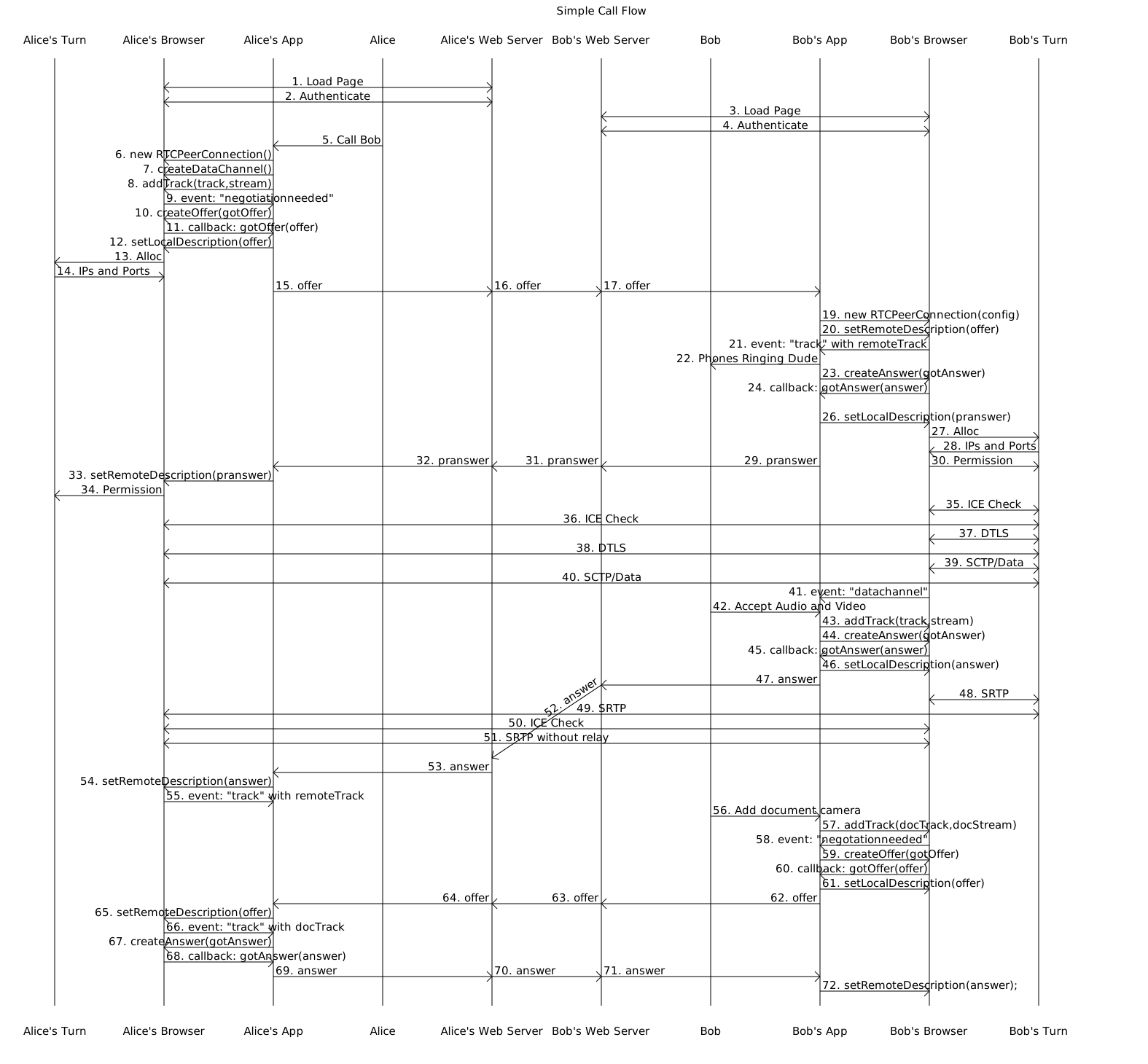
Examples assume that sender is an RTCRtpSender.
Sending the DTMF signal "1234" with 500 ms duration per tone:
if (sender.dtmf.canInsertDTMF) {
  const duration = 500;
  sender.dtmf.insertDTMF('1234', duration);
} else {
  console.log('DTMF function not available');
}
Send the DTMF signal "123" and abort after sending "2".
async function sendDTMF() {
  if (sender.dtmf.canInsertDTMF) {
    sender.dtmf.insertDTMF('123');
    await new Promise(r => sender.dtmf.ontonechange = e => e.tone == '2' && r());
    // empty the buffer to not play any tone after "2"
    sender.dtmf.insertDTMF('');
  } else {
    console.log('DTMF function not available');
  }
}
Send the DTMF signal "1234", and light up the active key using
lightKey(key) while the tone is playing
(assuming that lightKey("") will darken
all the keys):
const wait = ms => new Promise(resolve => setTimeout(resolve, ms));

if (sender.dtmf.canInsertDTMF) {
  const duration = 500; // ms
  sender.dtmf.insertDTMF(sender.dtmf.toneBuffer + '1234', duration);
  sender.dtmf.ontonechange = async ({tone}) => {
    if (!tone) return;
    lightKey(tone); // light up the key when playout starts
    await wait(duration);
    lightKey(''); // turn off the light after tone duration
  };
} else {
  console.log('DTMF function not available');
}
It is always safe to append to the tone buffer. This example appends before any tone playout has started as well as during playout.
if (sender.dtmf.canInsertDTMF) {
  sender.dtmf.insertDTMF('123');
  // append more tones to the tone buffer before playout has begun
  sender.dtmf.insertDTMF(sender.dtmf.toneBuffer + '456');

  sender.dtmf.ontonechange = ({tone}) => {
    // append more tones when playout has begun
    if (tone != '1') return;
    sender.dtmf.insertDTMF(sender.dtmf.toneBuffer + '789');
  };
} else {
  console.log('DTMF function not available');
}
Send a 1-second "1" tone followed by a 2-second "2" tone:
if (sender.dtmf.canInsertDTMF) {
  sender.dtmf.ontonechange = ({tone}) => {
    if (tone == '1') {
      sender.dtmf.insertDTMF(sender.dtmf.toneBuffer + '2', 2000);
    }
  };
  sender.dtmf.insertDTMF(sender.dtmf.toneBuffer + '1', 1000);
} else {
  console.log('DTMF function not available');
}
Perfect negotiation is a recommended pattern to manage negotiation
transparently, abstracting this asymmetric task away from the rest of
an application. This pattern has advantages over one side always
being the offerer, as it lets applications operate on both peer
connection objects simultaneously without risk of glare (an offer
coming in outside of "stable" state). The rest
of the application may use any and all modification methods and
attributes, without worrying about signaling state races.
It designates different roles to the two peers, with behavior to resolve signaling collisions between them:
-
The polite peer uses rollback to avoid collision with an incoming offer.
-
The impolite peer ignores an incoming offer when this would collide with its own.
Together, they manage signaling for the rest of the application in a manner that doesn't deadlock. The example assumes a polite boolean variable indicating the designated role:
const signaling = new SignalingChannel(); // handles JSON.stringify/parse
const constraints = {audio: true, video: true};
const configuration = {iceServers: [{urls: 'stun:stun.example.org'}]};
const pc = new RTCPeerConnection(configuration);

// call start() anytime on either end to add camera and microphone to connection
async function start() {
  try {
    const stream = await navigator.mediaDevices.getUserMedia(constraints);
    for (const track of stream.getTracks()) {
      pc.addTrack(track, stream);
    }
    selfView.srcObject = stream;
  } catch (err) {
    console.error(err);
  }
}

pc.ontrack = ({track, streams}) => {
  // once media for a remote track arrives, show it in the remote video element
  track.onunmute = () => {
    // don't set srcObject again if it is already set.
    if (remoteView.srcObject) return;
    remoteView.srcObject = streams[0];
  };
};

// - The perfect negotiation logic, separated from the rest of the application ---

// keep track of some negotiation state to prevent races and errors
let makingOffer = false;
let ignoreOffer = false;
let isSettingRemoteAnswerPending = false;

// send any ice candidates to the other peer
pc.onicecandidate = ({candidate}) => signaling.send({candidate});

// let the "negotiationneeded" event trigger offer generation
pc.onnegotiationneeded = async () => {
  try {
    makingOffer = true;
    await pc.setLocalDescription();
    signaling.send({description: pc.localDescription});
  } catch (err) {
     console.error(err);
  } finally {
    makingOffer = false;
  }
};

signaling.onmessage = async ({data: {description, candidate}}) => {
  try {
    if (description) {
      // An offer may come in while we are busy processing SRD(answer).
      // In this case, we will be in "stable" by the time the offer is processed
      // so it is safe to chain it on our Operations Chain now.
      const readyForOffer =
          !makingOffer &&
          (pc.signalingState == "stable" || isSettingRemoteAnswerPending);
      const offerCollision = description.type == "offer" && !readyForOffer;

      ignoreOffer = !polite && offerCollision;
      if (ignoreOffer) {
        return;
      }
      isSettingRemoteAnswerPending = description.type == "answer";
      await pc.setRemoteDescription(description); // SRD rolls back as needed
      isSettingRemoteAnswerPending = false;
      if (description.type == "offer") {
        await pc.setLocalDescription();
        signaling.send({description: pc.localDescription});
      }
    } else if (candidate) {
      try {
        await pc.addIceCandidate(candidate);
      } catch (err) {
        if (!ignoreOffer) throw err; // Suppress ignored offer's candidates
      }
    }
  } catch (err) {
    console.error(err);
  }
}
Note that this is timing sensitive, and deliberately uses versions of
setLocalDescription (without arguments) and
setRemoteDescription (with implicit rollback)
to avoid races with other signaling messages being serviced.
The ignoreOffer variable is needed, because the
RTCPeerConnection object on the impolite side is never told about
ignored offers. We must therefore suppress errors from incoming
candidates belonging to such offers.
Some operations throw or fire RTCError. This is an extension of
DOMException that carries additional WebRTC-specific information.
-
constructor() -
Run the following steps:
-
Let init be the constructor's first argument.
-
Let message be the constructor's second argument.
-
Let e be a new
RTCErrorobject. -
Invoke the
DOMExceptionconstructor of e with themessageargument set to message and thenameargument set to"OperationError".Note
This name does not have a mapping to a legacy code so e.
codewill return 0. -
Set all
RTCErrorattributes of e to the value of the corresponding attribute in init if it is present, otherwise set it tonull. -
Return e.
-
-
errorDetailof type RTCErrorDetailType, readonly -
The WebRTC-specific error code for the type of error that occurred.
-
sdpLineNumberof type long, readonly, nullable -
If
errorDetailis "sdp-syntax-error" this is the line number where the error was detected (the first line has line number 1). -
sctpCauseCodeof type long, readonly, nullable -
If
errorDetailis "sctp-failure" this is the SCTP cause code of the failed SCTP negotiation. -
receivedAlertof type unsigned long, readonly, nullable -
If
errorDetailis "dtls-failure" and a fatal DTLS alert was received, this is the value of the DTLS alert received. -
sentAlertof type unsigned long, readonly, nullable -
If
errorDetailis "dtls-failure" and a fatal DTLS alert was sent, this is the value of the DTLS alert sent. -
(Feature at Risk) Issue 1
All attributes defined in
RTCErrorare marked at risk due to lack of implementation (errorDetail,sdpLineNumber,sctpCauseCode,receivedAlertandsentAlert). This does not include attributes inherited fromDOMException.
dictionary RTCErrorInit {
  required RTCErrorDetailType errorDetail;
  long sdpLineNumber;
  long sctpCauseCode;
  unsigned long receivedAlert;
  unsigned long sentAlert;
};
The errorDetail, sdpLineNumber, sctpCauseCode,
receivedAlert and sentAlert members of RTCErrorInit have the same
definitions as the attributes of the same name of RTCError.
| Enum value | Description |
|---|---|
data-channel-failure
|
The data channel has failed. |
dtls-failure
|
The DTLS negotiation has failed or the connection has been
terminated with a fatal error. The message
contains information relating to the nature of error. If a
fatal DTLS alert was received, the receivedAlert
attribute is set to the value of the DTLS alert received. If a
fatal DTLS alert was sent, the sentAlert attribute
is set to the value of the DTLS alert sent.
|
fingerprint-failure
|
The RTCDtlsTransport's remote certificate did not match any
of the fingerprints provided in the SDP. If the remote peer
cannot match the local certificate against the provided
fingerprints, this error is not generated. Instead a
"bad_certificate" (42) DTLS alert might be received from the
remote peer, resulting in a
"dtls-failure".
|
sctp-failure
|
The SCTP negotiation has failed or the connection has been
terminated with a fatal error. The sctpCauseCode
attribute is set to the SCTP cause code.
|
sdp-syntax-error
|
The SDP syntax is not valid. The sdpLineNumber
attribute is set to the line number in the SDP where the syntax
error was detected.
|
hardware-encoder-not-available
|
The hardware encoder resources required for the requested operation are not available. |
hardware-encoder-error
|
The hardware encoder does not support the provided parameters. |
The RTCErrorEvent interface is defined for cases when an
RTCError is raised as an event:
-
constructor() -
Constructs a new
RTCErrorEvent.
This section is non-normative.
The following events fire on RTCDataChannel objects:
| Event name | Interface | Fired when... |
|---|---|---|
| open |
Event
|
The RTCDataChannel object's underlying data transport
has been established (or re-established).
|
| message |
MessageEvent
[html]
|
A message was successfully received. |
| bufferedamountlow |
Event
|
The RTCDataChannel object's bufferedAmount
decreases from above its
bufferedAmountLowThreshold to less than or
equal to its bufferedAmountLowThreshold.
|
| error |
RTCErrorEvent
|
An error occurred on the data channel. |
| closing |
Event
|
The RTCDataChannel object transitions to the
"closing" state
|
| close |
Event
|
The RTCDataChannel object's underlying data transport
has been closed.
|
The following events fire on RTCPeerConnection objects:
| Event name | Interface | Fired when... |
|---|---|---|
| track |
RTCTrackEvent
|
New incoming media has been negotiated for a specific
RTCRtpReceiver, and that receiver's track
has been added to any associated remote MediaStreams.
|
| negotiationneeded |
Event
|
The browser wishes to inform the application that session negotiation needs to be done (i.e. a createOffer call followed by setLocalDescription). |
| signalingstatechange |
Event
|
The connection's [[SignalingState]] has changed.
This state change is the
result of either setLocalDescription or
setRemoteDescription being invoked.
|
| iceconnectionstatechange |
Event
|
The RTCPeerConnection's [[IceConnectionState]] has
changed.
|
| icegatheringstatechange |
Event
|
The RTCPeerConnection's [[IceGatheringState]] has
changed.
|
| icecandidate |
RTCPeerConnectionIceEvent
|
A new RTCIceCandidate is made available to the script.
|
| connectionstatechange |
Event
|
The RTCPeerConnection.connectionState
has changed.
|
| icecandidateerror |
RTCPeerConnectionIceErrorEvent
|
A failure occured when gathering ICE candidates. |
| datachannel |
RTCDataChannelEvent
|
A new RTCDataChannel is dispatched to the script in response
to the other peer creating a channel.
|
The following events fire on RTCDTMFSender objects:
| Event name | Interface | Fired when... |
|---|---|---|
| tonechange |
RTCDTMFToneChangeEvent
|
The RTCDTMFSender object has either just begun playout of a
tone (returned as the tone attribute)
or just ended the playout of tones in the
toneBuffer (returned as an empty value in the
tone attribute).
|
The following events fire on RTCIceTransport objects:
| Event name | Interface | Fired when... |
|---|---|---|
| statechange |
Event
|
The RTCIceTransport state changes.
|
| gatheringstatechange |
Event
|
The RTCIceTransport gathering state changes.
|
| selectedcandidatepairchange |
Event
|
The RTCIceTransport's selected candidate pair changes.
|
The following events fire on RTCDtlsTransport objects:
| Event name | Interface | Fired when... |
|---|---|---|
| statechange |
Event
|
The RTCDtlsTransport state changes.
|
| error |
RTCErrorEvent
|
An error occurred on the RTCDtlsTransport (either
"dtls-failure" or
"fingerprint-failure").
|
The following events fire on RTCSctpTransport objects:
| Event name | Interface | Fired when... |
|---|---|---|
| statechange |
Event
|
The RTCSctpTransport state changes.
|
This section is non-normative.
This section is non-normative; it specifies no new behaviour, but instead summarizes information already present in other parts of the specification. The overall security considerations of the general set of APIs and protocols used in WebRTC are described in [RFC8827].
This document extends the Web platform with the ability to set up real-time, direct communication between browsers and other devices, including other browsers.
This means that data and media can be shared between applications running in different browsers, or between an application running in the same browser and something that is not a browser, something that is an extension to the usual barriers in the Web model against sending data between entities with different origins.
The WebRTC specification provides no user prompts or chrome indicators for communication; it assumes that once the Web page has been allowed to access media, it is free to share that media with other entities as it chooses. Peer-to-peer exchanges of data view WebRTC datachannels can thus occur without any user explicit consent or involvement, similarly as a server-mediated exchange (e.g. via Web Sockets) could occur without user involvement.
Even without WebRTC, the Web server providing a Web application will know the public IP address to which the application is delivered. Setting up communications exposes additional information about the browser’s network context to the web application, and may include the set of (possibly private) IP addresses available to the browser for WebRTC use. Some of this information has to be passed to the corresponding party to enable the establishment of a communication session.
Revealing IP addresses can leak location and means of connection; this can be sensitive. Depending on the network environment, it can also increase the fingerprinting surface and create persistent cross-origin state that cannot easily be cleared by the user.
A connection will always reveal the IP addresses proposed for
communication to the corresponding party. The application can limit
this exposure by choosing not to use certain addresses using the
settings exposed by the RTCIceTransportPolicy dictionary, and by
using relays (for instance TURN servers) rather than direct
connections between participants. One will normally assume that the
IP address of TURN servers is not sensitive information. These
choices can for instance be made by the application based on whether
the user has indicated consent to start a media connection with the
other party.
Mitigating the exposure of IP addresses to the application itself requires limiting the IP addresses that can be used, which will impact the ability to communicate on the most direct path between endpoints. Browsers are encouraged to provide appropriate controls for deciding which IP addresses are made available to applications, based on the security posture desired by the user. The choice of which addresses to expose is controlled by local policy (see [RFC8828] for details).
Since the browser is an active platform executing in a trusted network environment (inside the firewall), it is important to limit the damage that the browser can do to other elements on the local network, and it is important to protect data from interception, manipulation and modification by untrusted participants.
Mitigations include:
- A user agent will always request permission from the correspondent user agent to communicate using ICE. This ensures that the user agent can only send to partners who you have shared credentials with.
- A user agent will always request ongoing permission to continue sending using ICE continued consent. This enables a receiver to withdraw consent to receive.
- A user agent will always encrypt data, with strong per-session keying (DTLS-SRTP).
- A user agent will always use congestion control. This ensures that WebRTC cannot be used to flood the network.
These measures are specified in the relevant IETF documents.
The fact that communication is taking place cannot be hidden from adversaries that can observe the network, so this has to be regarded as public information.
Communication certificates may be opaquely shared using
postMessage(message, options) in anticipation of future needs. User
agents are strongly encouraged to isolate the private keying material
these objects hold a handle to, from the processes that have access
to the RTCCertificate objects, to reduce memory attack surface.
As described above, the list of IP addresses exposed by the WebRTC API can be used as a persistent cross-origin state.
Beyond IP addresses, the WebRTC API exposes information about the
underlying media system via the
RTCRtpSender.getCapabilities and
RTCRtpReceiver.getCapabilities methods,
including detailed and ordered information about the codecs that the
system is able to produce and consume. A subset of that information
is likely to be represented in the SDP session descriptions
generated, exposed and transmitted during session negotiation. That
information is in most cases persistent across time and origins, and
increases the fingerprint surface of a given device.
When establishing DTLS connections, the WebRTC API can generate certificates that can be persisted by the application (e.g. in IndexedDB). These certificates are not shared across origins, and get cleared when persistent storage is cleared for the origin.
setRemoteDescription guards against malformed
and invalid SDP by throwing exceptions, but makes no attempt to guard
against SDP that might be unexpected by the application. Setting the
remote description can cause significant resources to be allocated
(including image buffers and network ports), media to start flowing
(which may have privacy and bandwidth implications) among other
things. An application that does not guard against malicious SDP
could be at risk of resource deprivation, unintentionally allowing
incoming media or at risk of not having certain events fire like
ontrack if the other endpoint does not
negotiate sending. Applications need to be on guard against
malevolent SDP.
This section is non-normative.
The WebRTC 1.0 specification exposes an API to control protocols (defined within the IETF) necessary to establish real-time audio, video and data exchange.
The Telecommunications Device for the Deaf (TDD/TTY) enables individuals who are hearing or speech impaired (among others) to communicate over telephone lines. Real-Time Text, defined in [RFC4103], utilizes T.140 encapsulated in RTP to enable the transition from TDD/TTY devices to IP-based communications, including emergency communication with Public Safety Access Points (PSAP).
Since Real-Time Text requires the ability to send and receive data in near real time, it can be best supported via the WebRTC 1.0 data channel API. As defined by the IETF, the data channel protocol utilizes the SCTP/DTLS/UDP protocol stack, which supports both reliable and unreliable data channels. The IETF chose to standardize SCTP/DTLS/UDP over proposals for an RTP data channel which relied on SRTP key management and were focused on unreliable communications.
Since the IETF chose a different approach than the RTP data channel as part of the WebRTC suite of protocols, as of the time of this publication there is no standardized way for the WebRTC APIs to directly support Real-Time Text as defined at IETF and implemented in U.S. (FCC) regulations. The WebRTC working Group will evaluate whether the developing IETF protocols in this space warrant direct exposure in the browser APIs and is looking for input from the relevant user communities on this potential gap.
Within the IETF MMUSIC Working Group, work is ongoing to enable Real-time text to be sent over the WebRTC data channel, allowing gateways to be deployed to translate between the SCTP data channel protocol and RFC 4103 Real-Time Text. This work, once completed, is expected to enable a unified and interoperable approach for integrating real-time text in WebRTC user-agents (including browsers) - through a gateway or otherwise.
At the time of this publication, gateways that enable effective RTT support in WebRTC clients can be developed e.g. through a custom WebRTC data channel. This is deemed sufficient until such time as future standardized gateways are enabled via IETF protocols such as the SCTP data channel protocol and RFC 4103 Real-Time Text. This will need to be defined at IETF in conjunction with related work at W3C groups to effectively and consistently standardise RTT support internationally.
Since its publication as a W3C Recommendation in January 2021, the following candidate amendments have been integrated in this document.
- Candidate Correction 5:
- Forbid ICE gathering and connectivity checks on administrative prohibited candidates - section Set the session description (PR #2708) - Changes to Web Platform Tests: #21025 #45339
- Forbid ICE gathering and connectivity checks on administrative prohibited candidates - section Set the session description (PR #2708) - Changes to Web Platform Tests: #21025 #45339
- Candidate Correction 12:
- Mark RTP Pause/Resume as not supported - section 5.4.1 Simulcast functionality (PR #2755) - Changes to Web Platform Tests: #34912
- Remove interaction between encoding.active and simulcast ~rid - section 4.4.1.5 Set the session description (PR #2754) - Changes to Web Platform Tests: #34912
- Candidate Correction 13:
- Rollback restores ridless encoding trounced by sRD(simulcastOffer). - section RTCRtpSender Interface (PR #2797) - Changes to Web Platform Tests: #37477
- Rollback restores ridless encoding trounced by sRD(simulcastOffer). - section Set the session description (PR #2797) - Changes to Web Platform Tests: #37477
- Rollback restores ridless encoding trounced by sRD(simulcastOffer). - section Set the session description (PR #2797) - Changes to Web Platform Tests: #37477
- Candidate Correction 14:
- Make RTCTransceiver.direction reflects local preference in offers and answers - section 4.4.1.5 Set the session description (PR #2759)
- Candidate Addition 16:
- Add RTCIceCandidate.relayProtocol - section 4.8.1 RTCIceCandidate Interface (PR #2763) - Changes to Web Platform Tests: #36157
- Add RTCIceCandidate.relayProtocol - section RTCIceServerTransportProtocol Enum (PR #2763) - Changes to Web Platform Tests: #36157
- Add RTCIceCandidate.relayProtocol - section Attributes (PR #2763) - Changes to Web Platform Tests: #36157
- Candidate Correction 18:
- TypeError unless all or none of encodings have rids and on duplicate rids - section Methods (PR #2774, PR #2775) - Changes to Web Platform Tests: #37477
- Candidate Correction 22:
- Allow remote offer rid pruning of encodings through the client answer. - section 4.4.1.5 Set the session description (PR #2758)
- Candidate Addition 23:
- Add RTCIceCandidate.url - section 4.8.1 RTCIceCandidate Interface (PR #2773) - Changes to Web Platform Tests: #36572
- Mark RTCPeerConnectionIceEvent.url as deprecated - section Attributes (PR #2773) (not testable)
- Add RTCIceCandidate.url - section Attributes (PR #2773) - Changes to Web Platform Tests: #36572
- Candidate Correction 24:
- Queue two tasks upon finishing ICE gathering, and fire gatheringstatechange & icegatheringstatechange in same task - section 5.6 RTCIceTransport Interface (PR #2894) - Changes to Web Platform Tests: #44687
- Candidate Correction 25:
- Remove duplicate rids in proposedSendEncodings. - section 4.4.1.5 Set the session description (PR #2800) - Changes to Web Platform Tests: #37477
- Candidate Correction 26:
- Prune createAnswer()'s encodings and SendEncodings in sLD(answer). - section 4.4.1.5 Set the session description (PR #2801)
- Prune createAnswer()'s encodings and SendEncodings in sLD(answer). - section Methods (PR #2801)
- Candidate Correction 27:
- Ignore comma-separated rid alternatives. - section 4.4.1.5 Set the session description (PR #2813) - Changes to Web Platform Tests: #36155 #37477
- Ignore comma-separated rid alternatives. - section Methods (PR #2813) - Changes to Web Platform Tests: #36155 #37477
- Candidate Correction 33:
- Use the url spec to parse ice server urls - section 4.4.1.6 Set the configuration (PR #2853, PR #2996, PR #2998) - Changes to Web Platform Tests: #47959
- Determine if DTMF can be sent inside queued playout task - section Methods (PR #2861)
- Candidate Correction 37:
- Don't fail sRD(offer) over rid mismatch, just answer with unicast. - section 4.4.1.5 Set the session description (PR #2794)
- Don't fail sRD(offer) over rid mismatch, just answer with unicast. - section 4.4.1.5 Set the session description (PR #2794)
- Candidate Correction 38:
- Prevent GC of non-closed RTCDataChannels - section 6.2.4 Closing procedure (PR #2902) - Changes to Web Platform Tests: #43369
- Candidate Addition 45:
- Convert RTCIceCandidatePair dictionary to an interface - section 5.6.2 RTCIceCandidatePair Dictionary (PR #2961) - Changes to Web Platform Tests: #46647 #46655
- Candidate Correction 46:
- Replace RFC8829 reference with RFC9429 - section B.1 Normative references (PR #2966) (no change needed in tests)
- Candidate Addition 49:
- Add codec to RTCRtpEncodingParameters - section Methods (PR #2985) - Changes to Web Platform Tests: #47663
- Add codec to RTCRtpEncodingParameters - section Methods (PR #2985) - Changes to Web Platform Tests: #47663
- Add codec to RTCRtpEncodingParameters - section Methods (PR #2985) - Changes to Web Platform Tests: #47663
- Add codec to RTCRtpEncodingParameters - section Methods (PR #2985) - Changes to Web Platform Tests: #47663
- Add codec to RTCRtpEncodingParameters - section Methods (PR #2985) - Changes to Web Platform Tests: #47663
- Add codec to RTCRtpEncodingParameters - section Methods (PR #2985) - Changes to Web Platform Tests: #47663
- Add codec to RTCRtpEncodingParameters - section Methods (PR #2985) - Changes to Web Platform Tests: #47663
- Add codec to RTCRtpEncodingParameters - section
Dictionary
RTCRtpEncodingParametersMembers (PR #2985) - Changes to Web Platform Tests: #47663 - Add codec to RTCRtpEncodingParameters - section Set the session description (PR #2985) - Changes to Web Platform Tests: #47663
- Candidate Correction 50:
- Use Performance.timeOrigin + Performance.now() for stats timestamps - section Dictionary RTCStats Members (PR #3005) - Changes to Web Platform Tests: #48361
- Candidate Addition 51:
- setCodecPreferences supports both send and receive codecs (filtered by direction) - section Methods (PR #3018) - Changes to Web Platform Tests: #49421
- Candidate Correction 52:
- Two codecs are considered the same even if level-id is not - section Methods (PR #3023) - Changes to Web Platform Tests: #49990
The editors wish to thank the Working Group chairs and Team Contact, Harald Alvestrand, Stefan Håkansson, Erik Lagerway and Dominique Hazaël-Massieux, for their support. Substantial text in this specification was provided by many people including Martin Thomson, Harald Alvestrand, Justin Uberti, Eric Rescorla, Peter Thatcher, Jan-Ivar Bruaroey and Peter Saint-Andre. Dan Burnett would like to acknowledge the significant support received from Voxeo and Aspect during the development of this specification.
The RTCRtpSender and RTCRtpReceiver objects were initially
described in the W3C ORTC
CG, and have been adapted for use in this specification.
Candidate Correction 46:Replace RFC8829 reference with RFC9429 (PR #2966)
B.1 Normative references
- [DOM]
- DOM Standard. Anne van Kesteren. WHATWG. Living Standard. URL: https://dom.spec.whatwg.org/
- [ECMASCRIPT-6.0]
- ECMA-262 6th Edition, The ECMAScript 2015 Language Specification. Allen Wirfs-Brock. Ecma International. June 2015. Standard. URL: http://www.ecma-international.org/ecma-262/6.0/index.html
- [Fetch]
- Fetch Standard. Anne van Kesteren. WHATWG. Living Standard. URL: https://fetch.spec.whatwg.org/
- [FILEAPI]
-
File API. Marijn Kruisselbrink
; Arun Ranganathan. W3C.11 September 20194 December 2024. W3C Working Draft. URL: https://www.w3.org/TR/FileAPI/ - [FIPS-180-4]
-
FIPS PUB
180-4180-4: Secure HashStandardStandard (SHS). U.S. Department of Commerce/National Institute of Standards and Technology. August 2015. National Standard. URL: https://nvlpubs.nist.gov/nistpubs/FIPS/NIST.FIPS.180-4.pdf - [GETUSERMEDIA]
-
Media Capture and Streams. Cullen Jennings; Bernard Aboba; Jan-Ivar Bruaroey; Henrik Boström; youenn fablet
; Daniel Burnett; Adam Bergkvist; Anant Narayanan. W3C.21 January 202119 December 2024.W3C Candidate RecommendationCRD. URL: https://www.w3.org/TR/mediacapture-streams/ - [hr-time]
-
High Resolution
Time Level 2Time.Ilya GrigorikYoav Weiss. W3C.217 November20192024. W3CRecommendationWorking Draft. URL:org/TR/hr-time-2/org/TR/hr-time-3/ - [HTML]
- HTML Standard. Anne van Kesteren; Domenic Denicola; Dominic Farolino; Ian Hickson; Philip Jägenstedt; Simon Pieters. WHATWG. Living Standard. URL: https://html.spec.whatwg.org/multipage/
- [IANA-HASH-FUNCTION]
- Hash Function Textual Names. IANA. URL: https://www.iana.org/assignments/hash-function-text-names/hash-function-text-names.xml
- [IANA-RTP-2]
- RTP Payload Format media types. IANA. URL: https://www.iana.org/assignments/rtp-parameters/rtp-parameters.xhtml#rtp-parameters-2
- [INFRA]
- Infra Standard. Anne van Kesteren; Domenic Denicola. WHATWG. Living Standard. URL: https://infra.spec.whatwg.org/
- [RFC2119]
-
Key words for use in RFCs to Indicate Requirement Levels. S. Bradner. IETF. March 1997. Best Current Practice. URL:
https://tools.ietf.org/html/rfc2119https://www.rfc-editor.org/rfc/rfc2119 - [RFC3550]
-
RTP: A Transport Protocol for Real-Time Applications. H. Schulzrinne; S. Casner; R. Frederick; V. Jacobson. IETF. July 2003. Internet Standard. URL:
https://tools.ietf.org/html/rfc3550https://www.rfc-editor.org/rfc/rfc3550 - [RFC3890]
-
A Transport Independent Bandwidth Modifier for the Session Description Protocol (SDP). M. Westerlund. IETF. September 2004. Proposed Standard. URL:
https://tools.ietf.org/html/rfc3890https://www.rfc-editor.org/rfc/rfc3890 [RFC3986]Uniform Resource Identifier (URI): Generic Syntax. T. Berners-Lee; R. Fielding; L. Masinter. IETF. January 2005. Internet Standard. URL: https://tools.ietf.org/html/rfc3986- [RFC4566]
-
SDP: Session Description Protocol. M. Handley; V. Jacobson; C. Perkins. IETF. July 2006. Proposed Standard. URL:
https://tools.ietf.org/html/rfc4566https://www.rfc-editor.org/rfc/rfc4566 - [RFC4572]
-
Connection-Oriented Media Transport over the Transport Layer Security (TLS) Protocol in the Session Description Protocol (SDP). J. Lennox. IETF. July 2006. Proposed Standard. URL:
https://tools.ietf.org/html/rfc4572https://www.rfc-editor.org/rfc/rfc4572 - [RFC5245]
-
Interactive Connectivity Establishment (ICE): A Protocol for Network Address Translator (NAT) Traversal for Offer/Answer Protocols. J. Rosenberg. IETF. April 2010. Proposed Standard. URL:
https://tools.ietf.org/html/rfc5245https://www.rfc-editor.org/rfc/rfc5245 - [RFC5246]
-
The Transport Layer Security (TLS) Protocol Version 1.2. T. Dierks; E. Rescorla. IETF. August 2008. Proposed Standard. URL:
https://tools.ietf.org/html/rfc5246https://www.rfc-editor.org/rfc/rfc5246 - [RFC5285]
-
A General Mechanism for RTP Header Extensions. D. Singer; H. Desineni. IETF. July 2008. Proposed Standard. URL:
https://tools.ietf.org/html/rfc5285https://www.rfc-editor.org/rfc/rfc5285 - [RFC5389]
-
Session Traversal Utilities for NAT (STUN). J. Rosenberg; R. Mahy; P. Matthews; D. Wing. IETF. October 2008. Proposed Standard. URL:
https://tools.ietf.org/html/rfc5389https://www.rfc-editor.org/rfc/rfc5389 - [RFC5506]
-
Support for Reduced-Size Real-Time Transport Control Protocol (RTCP): Opportunities and Consequences. I. Johansson; M. Westerlund. IETF. April 2009. Proposed Standard. URL:
https://tools.ietf.org/html/rfc5506https://www.rfc-editor.org/rfc/rfc5506 - [RFC5888]
-
The Session Description Protocol (SDP) Grouping Framework. G. Camarillo; H. Schulzrinne. IETF. June 2010. Proposed Standard. URL:
https://tools.ietf.org/html/rfc5888https://www.rfc-editor.org/rfc/rfc5888 - [RFC6464]
-
A Real-time Transport Protocol (RTP) Header Extension for Client-to-Mixer Audio Level Indication. J. Lennox, Ed.; E. Ivov; E. Marocco. IETF. December 2011. Proposed Standard. URL:
https://tools.ietf.org/html/rfc6464https://www.rfc-editor.org/rfc/rfc6464 - [RFC6465]
-
A Real-time Transport Protocol (RTP) Header Extension for Mixer-to-Client Audio Level Indication. E. Ivov, Ed.; E. Marocco, Ed.; J. Lennox. IETF. December 2011. Proposed Standard. URL:
https://tools.ietf.org/html/rfc6465https://www.rfc-editor.org/rfc/rfc6465 - [RFC6544]
-
TCP Candidates with Interactive Connectivity Establishment (ICE). J. Rosenberg; A. Keranen; B. B. Lowekamp; A. B. Roach. IETF. March 2012. Proposed Standard. URL:
https://tools.ietf.org/html/rfc6544https://www.rfc-editor.org/rfc/rfc6544 - [RFC7064]
-
URI Scheme for the Session Traversal Utilities for NAT (STUN) Protocol. S. Nandakumar; G. Salgueiro; P. Jones; M. Petit-Huguenin. IETF. November 2013. Proposed Standard. URL:
https://tools.ietf.org/html/rfc7064https://www.rfc-editor.org/rfc/rfc7064 - [RFC7065]
-
Traversal Using Relays around NAT (TURN) Uniform Resource Identifiers. M. Petit-Huguenin; S. Nandakumar; G. Salgueiro; P. Jones. IETF. November 2013. Proposed Standard. URL:
https://tools.ietf.org/html/rfc7065https://www.rfc-editor.org/rfc/rfc7065 - [RFC7656]
-
A Taxonomy of Semantics and Mechanisms for Real-Time Transport Protocol (RTP) Sources. J. Lennox; K. Gross; S. Nandakumar; G. Salgueiro; B. Burman, Ed.
.IETF. November 2015. Informational. URL:https://tools.ietf.org/html/rfc7656https://www.rfc-editor.org/rfc/rfc7656 - [RFC7675]
-
Session Traversal Utilities for NAT (STUN) Usage for Consent Freshness. M. Perumal; D. Wing; R. Ravindranath; T. Reddy; M. Thomson. IETF. October 2015. Proposed Standard. URL:
https://tools.ietf.org/html/rfc7675https://www.rfc-editor.org/rfc/rfc7675 - [RFC7874]
-
WebRTC Audio Codec and Processing Requirements. JM. Valin; C. Bran. IETF. May 2016. Proposed Standard. URL:
https://tools.ietf.org/html/rfc7874https://www.rfc-editor.org/rfc/rfc7874 - [RFC8174]
-
Ambiguity of Uppercase vs Lowercase in RFC 2119 Key Words. B. Leiba. IETF. May 2017. Best Current Practice. URL:
https://tools.ietf.org/html/rfc8174https://www.rfc-editor.org/rfc/rfc8174 - [RFC8261]
-
Datagram Transport Layer Security (DTLS) Encapsulation of SCTP Packets. M. Tuexen; R. Stewart; R. Jesup; S. Loreto. IETF. November 2017. Proposed Standard. URL:
https://tools.ietf.org/html/rfc8261https://www.rfc-editor.org/rfc/rfc8261 - [RFC8445]
-
Interactive Connectivity Establishment (ICE): A Protocol for Network Address Translator (NAT) Traversal. A. Keranen; C. Holmberg; J. Rosenberg. IETF. July 2018. Proposed Standard. URL:
https://tools.ietf.org/html/rfc8445https://www.rfc-editor.org/rfc/rfc8445 - [RFC8656]
- Traversal Using Relays around NAT (TURN): Relay Extensions to Session Traversal Utilities for NAT (STUN). T. Reddy, Ed.; A. Johnston, Ed.; P. Matthews; J. Rosenberg. IETF. February 2020. Proposed Standard. URL: https://www.rfc-editor.org/rfc/rfc8656
- [RFC8826]
-
Security Considerations for WebRTC
for WebRTC. E. Rescorla. IETF. January 2021. Proposed Standard. URL:https://tools.ietf.org/html/rfc8826https://www.rfc-editor.org/rfc/rfc8826 [RFC8829]JavaScript Session Establishment Protocol (JSEP). J. Uberti; C. Jennings; E. Rescorla, Ed.. IETF. January 2021. Proposed Standard. URL: https://tools.ietf.org/html/rfc8829- [RFC8831]
-
WebRTC Data Channels. R. Jesup; S. Loreto; M. Tüxen. IETF. January 2021. Proposed Standard. URL:
https://tools.ietf.org/html/rfc8831https://www.rfc-editor.org/rfc/rfc8831 - [RFC8832]
-
WebRTC Data Channel Establishment Protocol. R. Jesup; S. Loreto; M. Tüxen. IETF. January 2021. Proposed Standard. URL:
https://tools.ietf.org/html/rfc8832https://www.rfc-editor.org/rfc/rfc8832 - [RFC8834]
-
Media Transport and Use of RTP in WebRTC. C. Perkins; M. Westerlund; J. Ott. IETF. January 2021. Proposed Standard. URL:
https://tools.ietf.org/html/rfc8834https://www.rfc-editor.org/rfc/rfc8834 - [RFC8835]
-
Transports for WebRTC. H. Alvestrand. IETF. January 2021. Proposed Standard. URL:
https://tools.ietf.org/html/rfc8835https://www.rfc-editor.org/rfc/rfc8835 - [RFC8838]
-
Trickle ICE: Incremental Provisioning of Candidates for the Interactive Connectivity Establishment (ICE) Protocol. E. Ivov; J. Uberti; P. Saint-Andre. IETF. January 2021. Proposed Standard. URL:
https://tools.ietf.org/html/rfc8838https://www.rfc-editor.org/rfc/rfc8838 - [RFC8841]
-
Session Description Protocol (SDP) Offer/Answer Procedures for Stream Control Transmission Protocol (SCTP) over Datagram Transport Layer Security (DTLS) Transport. C. Holmberg; R. Shpount; S. Loreto; G. Camarillo. IETF. January 2021. Proposed Standard. URL:
https://tools.ietf.org/html/rfc8841https://www.rfc-editor.org/rfc/rfc8841 - [RFC8843]
-
Negotiating Media Multiplexing Using the Session Description Protocol (SDP). C. Holmberg; H. Alvestrand; C. Jennings. IETF. January 2021. Proposed Standard. URL:
https://tools.ietf.org/html/rfc8843https://www.rfc-editor.org/rfc/rfc8843 - [RFC8851]
-
RTP Payload Format Restrictions. A.B. Roach, Ed.
.IETF. January 2021. Proposed Standard. URL:https://tools.ietf.org/html/rfc8851https://www.rfc-editor.org/rfc/rfc8851 - [RFC8853]
-
Using Simulcast in Session Description Protocol (SDP) and RTP Sessions. B. Burman; M. Westerlund; S. Nandakumar; M. Zanaty. IETF. January 2021. Proposed Standard. URL:
https://tools.ietf.org/html/rfc8853https://www.rfc-editor.org/rfc/rfc8853 - [RFC8863]
- Interactive Connectivity Establishment Patiently Awaiting Connectivity (ICE PAC). C. Holmberg; J. Uberti. IETF. January 2021. Proposed Standard. URL: https://www.rfc-editor.org/rfc/rfc8863
- [RFC9429]
- JavaScript Session Establishment Protocol (JSEP). J. Uberti; C. Jennings; E. Rescorla, Ed. IETF. April 2024. Proposed Standard. URL: https://www.rfc-editor.org/rfc/rfc9429
- [SDP]
-
An Offer/Answer Model with Session Description Protocol (SDP). J. Rosenberg; H. Schulzrinne. IETF. June 2002. Proposed Standard. URL:
https://tools.ietf.org/html/rfc3264https://www.rfc-editor.org/rfc/rfc3264 - [STUN-PARAMETERS]
- STUN Error Codes. IETF. IANA. April 2011. IANA Parameter Assignment. URL: https://www.iana.org/assignments/stun-parameters/stun-parameters.xhtml#stun-parameters-6
- [WebCryptoAPI]
- Web Cryptography API. Mark Watson. W3C. 26 January 2017. W3C Recommendation. URL: https://www.w3.org/TR/WebCryptoAPI/
- [WEBIDL]
Web IDL. Boris Zbarsky. W3C. 15 December 2016. W3C Editor's Draft. URL: https://heycam.github.io/webidl/- Web IDL Standard. Edgar Chen; Timothy Gu. WHATWG. Living Standard. URL: https://webidl.spec.whatwg.org/
- [WEBRTC-STATS]
-
Identifiers for WebRTC's Statistics API. Harald Alvestrand; Varun Singh; Henrik Boström. W3C.
20 January 20216 March 2025.W3C Candidate RecommendationCRD. URL: https://www.w3.org/TR/webrtc-stats/ - [X509V3]
-
ITU-T Recommendation X.509 version 3 (1997). "Information Technology - Open Systems Interconnection - The Directory Authentication Framework" ISO/IEC 9594-8:1997.. ITU.
- [X690]
- Recommendation X.690 — Information Technology — ASN.1 Encoding Rules — Specification of Basic Encoding Rules (BER), Canonical Encoding Rules (CER), and Distinguished Encoding Rules (DER). ITU. URL: https://www.itu.int/ITU-T/studygroups/com17/languages/X.690-0207.pdf
- [API-DESIGN-PRINCIPLES]
- Web Platform Design Principles. Martin Thomson; Jeffrey Yasskin. W3C. 6 March 2025. W3C Working Group Note. URL: https://www.w3.org/TR/design-principles/
- [INDEXEDDB]
- Indexed Database API. Nikunj Mehta; Jonas Sicking; Eliot Graff; Andrei Popescu; Jeremy Orlow; Joshua Bell. W3C. 8 January 2015. W3C Recommendation. URL: https://www.w3.org/TR/IndexedDB/
- [RFC4103]
- RTP Payload for Text Conversation. G. Hellstrom; P. Jones. IETF. June 2005. Proposed Standard. URL: https://www.rfc-editor.org/rfc/rfc4103
- [RFC6236]
- Negotiation of Generic Image Attributes in the Session Description Protocol (SDP). I. Johansson; K. Jung. IETF. May 2011. Proposed Standard. URL: https://www.rfc-editor.org/rfc/rfc6236
- [RFC7728]
- RTP Stream Pause and Resume. B. Burman; A. Akram; R. Even; M. Westerlund. IETF. February 2016. Proposed Standard. URL: https://www.rfc-editor.org/rfc/rfc7728
- [RFC8825]
- Overview: Real-Time Protocols for Browser-Based Applications. H. Alvestrand. IETF. January 2021. Proposed Standard. URL: https://www.rfc-editor.org/rfc/rfc8825
- [RFC8827]
- WebRTC Security Architecture. E. Rescorla. IETF. January 2021. Proposed Standard. URL: https://www.rfc-editor.org/rfc/rfc8827
- [RFC8828]
- WebRTC IP Address Handling Requirements. J. Uberti; G. Shieh. IETF. January 2021. Proposed Standard. URL: https://www.rfc-editor.org/rfc/rfc8828