C++ program to check whether a given number is even or odd
In this article, you will learn how to check whether a given number is even or odd in C++ and get the code to do it. The program is created in the following two ways:
- Check for an even or odd number using an if-else statement
- Check an even or odd number using the ternary operator
Using if-else, determine whether the value is Even or Odd
To check whether the given number (by the user at run-time) is an even or an odd number in C++ programming, you have to ask the user to enter a number first. Now if it is divisible by 2 (without leaving any remainder), then it is an even number. Otherwise, it is an odd number.
#include<iostream>
using namespace std;
int main()
{
    int num;
    cout<<"Enter a Number: ";
    cin>>num;
    if(num%2==0)
        cout<<"\nIt is an Even Number.";
    else
        cout<<"\nIt is an Odd Number.";
    cout<<endl;
    return 0;
}
This program was built and runs under the Code::Blocks IDE. Here is its sample run:
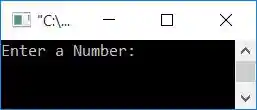
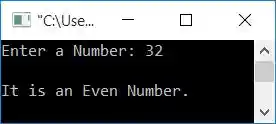
Now enter any number to check whether it is an even or an odd number, as shown in the following output with user input as 32:
Here is another sample run with user input as 33:
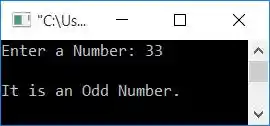
With the user's input of 32, 32%2 gives 0. So the condition num%2==0 or 32%2==0 or 0==0 evaluates to true, therefore program flow goes inside the if's body and executes a statement that prints a message, "It is an Even Number.". In contrast, with a user input of 33, 33%2 yields 2. So the condition num%2==0 or 33%2==0 or 1==0 evaluates to false; therefore, in this case, program flow goes to else's body and executes a statement available in the body of else that prints a message, "It is an Odd Number."
Using the Ternary Operator, check Even/Odd
Now let's create the same-purpose program using the ternary operator.
#include<iostream>
using namespace std;
int main()
{
    int num;
    cout<<"Enter a Number: ";
    cin>>num;
    (num%2==0)?(cout<<"\nEven Number"):(cout<<"\nOdd Number");
    cout<<endl;
    return 0;
}
Here's an example run with user input of 5:
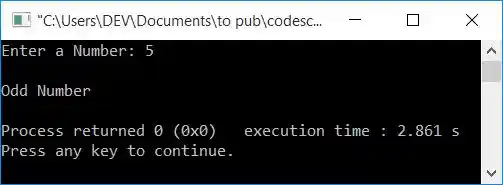
The condition num%2==0 is evaluated as true. Therefore, the first statement (cout<<"\nEven Number")
gets executed, otherwise the second statement (cout<<"\nOdd Number") gets executed.
In the ternary operator statement,
<condition> ? <true_case> : <false_case>;
shows that if condition is true, true_case is evaluated or executed; otherwise, false_case is evaluated.
Previous program can also be replaced with:
#include<iostream>
using namespace std;
int main()
{
    int num;
    char ch;
    cout<<"Enter a Number: ";
    cin>>num;
    ch = num%2==0?'e':'o';
    if(ch=='e')
        cout<<"\nEven Number";
    else
        cout<<"\nOdd Number";
    cout<<endl;
    return 0;
}
Again, you can see that, if the condition num%2==0 evaluates to being true, then "e" gets initialized to ch. Otherwise, "o" gets initialized to "ch." Now check for the value of ch, that is, whether it equals e or o. If it holds the value e, then print it as an even number; otherwise, print it as an odd number. You can also replace the previous program with this one:
#include<iostream>
using namespace std;
int main()
{
    int num, val;
    cout<<"Enter a Number: ";
    cin>>num;
    val = (num%2==0)?1:0;
    if(val==1)
        cout<<"\nEven Number";
    else
        cout<<"\nOdd Number";
    cout<<endl;
    return 0;
}
The same program in different languages
« Previous Program Next Program »
Liked this post? Share it!