C++ program to check if a given number is a prime number or not
In this article, you will learn and get code on checking whether a given number, given by the user at run-time, is a prime number or not in C++. The program is created in the following ways:
- Check if a number is prime or not without using a function or a class
- Check if a number is prime or not using a user-defined function
- Using class and object, determine whether a number is a prime number
What is a prime number?
A prime number is a number that can only be divisible by 1 and the number itself. That is, if a number has no factors except 1 and the number itself, then it is called a prime number. For example, 13, 7, 17, 19, 23, etc.
Examine the prime number in C++
To check whether the number is a prime number or not in C++ programming, you have to ask the user to enter a number first, and then check and print as shown in the program given below:
If a number, n, is divisible by any number from 2 to one less than the number (n-1), then it is not prime; otherwise, it is a prime number.
#include<iostream>
using namespace std;
int main()
{
    int num, i, chk=0;
    cout<<"Enter a Number: ";
    cin>>num;
    for(i=2; i<num; i++)
    {
        if(num%i==0)
        {
            chk++;
            break;
        }
    }
    if(chk==0)
        cout<<"\nIt is a Prime Number";
    else
        cout<<"\nIt is not a Prime Number";
    cout<<endl;
    return 0;
}
This program was built and runs under the Code::Blocks IDE. Here is its sample run:
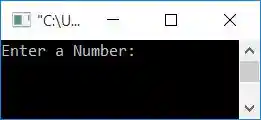
Now supply any number as input, say 13, and press the ENTER key to check whether it is a prime or not, as shown here:
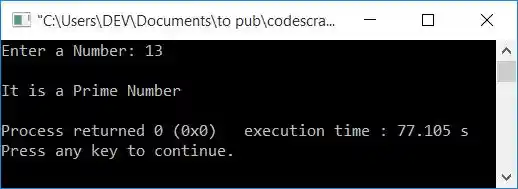
The dry run of the above program (with user input 13) goes like this:
- Initially chk=0 and num=13 (the user entered 13).
- Inside the for loop, the initialization part executes first and only once. Therefore i=2
- Checks whether the value of i is less than the value of num or not.
- The condition evaluates to be true because 2 (the value of i) is less than 13 (the value of num), therefore program flow goes inside the loop.
- Inside the loop, there is an if statement that checks whether the value of num is divisible by the current value of i or not.
- Note: If the value of i ever divides num, just increment the value of count and exit the loop using the break keyword.
- Because 13 is not divisible by 2, the condition evaluates to be false, therefore program flow doesn't go inside the if's body.
- Now the program flow goes to the update part of the for loop and increments the value of i. Now i=3. Checks for the condition again to see if i<num or 3<13 evaluates to true or false.
- Condition again evaluates to be true, therefore program flow again goes inside the loop.
- In this manner, each time you enter the loop, check whether the num's value is divisible by the i's value.
- Continue the process until the condition of the for loop evaluates to be false.
- After exiting from the loop, check for the value of chk and print the message.
- That is, if chk holds its initial value (0), then the given number is a prime number, otherwise it is not a prime number.
In C++, use a function to check the prime number
Now let's create the same-purpose program using a user-defined function called checkPrimeNumber(). It takes the number entered by the user as an argument and returns a value. Initialize its return value to a variable, say chk, so check its value and print the message accordingly.
#include<iostream>
using namespace std;
int checkPrimeNumber(int);
int main()
{
    int num, chk;
    cout<<"Enter a Number: ";
    cin>>num;
    chk = checkPrimeNumber(num);
    if(chk==0)
        cout<<"\nIt is a Prime Number";
    else
        cout<<"\nIt is not a Prime Number";
    cout<<endl;
    return 0;
}
int checkPrimeNumber(int num)
{
    int i, chk=0;
    for(i=2; i<num; i++)
    {
        if(num%i==0)
        {
            chk++;
            return chk;
        }
    }
    return chk;
}
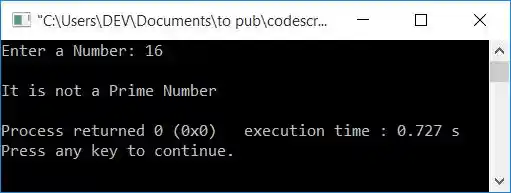
It will produce the same output as the previous program. Here is its sample run with user input as 16:
You can also prefer the program given below for the same purpose as the previous one. In this program, rather than returning a value to the main() function, this program checks and prints directly from inside the function:
#include<iostream>
using namespace std;
void checkPrimeNumber(int);
int main()
{
    int num;
    cout<<"Enter a Number: ";
    cin>>num;
    checkPrimeNumber(num);
    cout<<endl;
    return 0;
}
void checkPrimeNumber(int num)
{
    int i, chk=0;
    for(i=2; i<num; i++)
    {
        if(num%i==0)
        {
            chk++;
            break;
        }
    }
    if(chk==0)
        cout<<"\nIt is a Prime Number";
    else
        cout<<"\nIt is not a Prime Number";
}
In C++, check the prime number using the class
This is the last program that uses classes and objects to check for the prime number. The question is: write a program in C++ to check whether an input number is a prime number or not using classes. Here is its answer:
#include<iostream>
using namespace std;
class CodesCracker
{
    private:
        int num, i, chk;
    public:
        int getData();
        int checkPrimeNumber(int);
};
int CodesCracker::getData()
{
    cout<<"Enter a Number: ";
    cin>>num;
    return num;
}
int CodesCracker::checkPrimeNumber(int num)
{
    int i, chk=0;
    for(i=2; i<num; i++)
    {
        if(num%i==0)
        {
            chk++;
            return chk;
        }
    }
    return chk;
}
int main()
{
    CodesCracker c;
    int num, chk=0;
    num = c.getData();
    chk = c.checkPrimeNumber(num);
    if(chk==0)
        cout<<"\nIt is a Prime Number";
    else
        cout<<"\nIt is not a Prime Number";
    cout<<endl;
    return 0;
}
The brief explanation of the above code is:
- A CodesCracker (class) object c is created.
- Using this object, we have called the function getData() of the class CodesCracker.
- and its return value gets initialized to num inside the main() function.
- Because the getdata() function receives a value from the user and returns it, the number entered by the user is basically initialized to num.
- Now we've passed num to checkPrimeNumber() function. This function checks whether it is a prime or not. It returns 0 (if num is a prime number) or 1 (if num is a composite number), and its return value gets initialized to chk inside the main() function.
- Finally, we have checked the value of chk and printed the message.
The same program in different languages
« Previous Program Next Program »
Liked this post? Share it!