An alternating permutation is an arrangement of the elements  , ...,
  such that no element
  has a magnitude between
  and
and  is called an alternating (or zigzag) permutation. The
determination of the number of alternating permutations for the set of the first
is called an alternating (or zigzag) permutation. The
determination of the number of alternating permutations for the set of the first
 integers
  is known as André's
problem.
is known as André's
problem.
The numbers  of alternating permutations on the integers from 1 to
  for
for  , 2, ... are 1, 2, 4, 10, 32, 122, 544, ... (OEIS A001250).
For example, the alternating permutations on
, 2, ... are 1, 2, 4, 10, 32, 122, 544, ... (OEIS A001250).
For example, the alternating permutations on  integers for small
  are summarized in the following table.
 |  | alternating permutations |
| 1 | 1 |  |
| 2 | 2 |  , ,
 |
| 3 | 4 |  , ,  , ,  , ,  |
| 4 | 10 |  , ,
 , ,
 , ,
 , ,
 , , |
 , ,  , ,  , ,  , ,  |
For  ,
every alternating permutation
,
every alternating permutation  can be written either forward or reversed, and so must be
an even number
can be written either forward or reversed, and so must be
an even number  .
The quantity
.
The quantity  can be simply computed from the recurrence equation
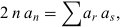 |
(1) |
where  and
and  pass through all integral numbers such that
 |
(2) |
 ,
and
,
and
 |
(3) |
The numbers  are sometimes called the Euler zigzag numbers,
and the first few are given by 1, 1, 1, 2, 5, 16, 61, 272, ... (OEIS A000111).
are sometimes called the Euler zigzag numbers,
and the first few are given by 1, 1, 1, 2, 5, 16, 61, 272, ... (OEIS A000111).
The even-numbered  s are called Euler numbers
  ,
secant numbers
,
secant numbers  , or zig numbers (1, 1, 5,
61, 1385, ...; OEIS A000364), and the odd-numbered
ones are sometimes called tangent numbers
, or zig numbers (1, 1, 5,
61, 1385, ...; OEIS A000364), and the odd-numbered
ones are sometimes called tangent numbers  or zag numbers (1, 2, 16, 272, 7936, ...; OEIS A000182).
Curiously, the secant and tangent Maclaurin series can be written in terms of the
 s
as
s
as
or combining them,
 |
(6) |
See also
Entringer Number, Euler Number, Euler Zigzag Number, Secant Number, Seidel-Entringer-Arnold Triangle, Tangent Number
Explore with Wolfram|Alpha
References
André, D. "Developments de  et
et  ." Comptes Rendus Acad. Sci. Paris 88,
965-967, 1879.André, D. "Memoire sur les permutations alternées."
J. Math. 7, 167-184, 1881.Arnold, V. I. "Bernoulli-Euler
Updown Numbers Associated with Function Singularities, Their Combinatorics and Arithmetics."
Duke Math. J. 63, 537-555, 1991.Arnold, V. I. "Snake
Calculus and Combinatorics of Bernoulli, Euler, and Springer Numbers for Coxeter
Groups." Russian Math. Surveys 47, 3-45, 1992.Bauslaugh,
B. and Ruskey, F. "Generating Alternating Permutations Lexicographically."
BIT 30, 17-26, 1990.Conway, J. H. and Guy, R. K.
In The
Book of Numbers. New York: Springer-Verlag, pp. 110-111, 1996.Dörrie,
H. "André's Derivation of the Secant and Tangent Series." §16
in 100
Great Problems of Elementary Mathematics: Their History and Solutions. New
York: Dover, pp. 64-69, 1965.Honsberger, R. Mathematical
Gems III. Washington, DC: Math. Assoc. Amer., pp. 69-75, 1985.Knuth,
D. E. and Buckholtz, T. J. "Computation of Tangent, Euler, and Bernoulli
Numbers." Math. Comput. 21, 663-688, 1967.Millar,
J.; Sloane, N. J. A.; and Young, N. E. "A New Operation on Sequences:
The Boustrophedon Transform." J. Combin. Th. Ser. A 76, 44-54,
1996.Ruskey, F. "Information of Alternating Permutations."
http://www.theory.csc.uvic.ca/~cos/inf/perm/Alternating.html.Sloane,
N. J. A. Sequences A000111/M1492,
A000182/M2096, A000364/M4019,
and A001250/M1235 in "The On-Line Encyclopedia
of Integer Sequences."
." Comptes Rendus Acad. Sci. Paris 88,
965-967, 1879.André, D. "Memoire sur les permutations alternées."
J. Math. 7, 167-184, 1881.Arnold, V. I. "Bernoulli-Euler
Updown Numbers Associated with Function Singularities, Their Combinatorics and Arithmetics."
Duke Math. J. 63, 537-555, 1991.Arnold, V. I. "Snake
Calculus and Combinatorics of Bernoulli, Euler, and Springer Numbers for Coxeter
Groups." Russian Math. Surveys 47, 3-45, 1992.Bauslaugh,
B. and Ruskey, F. "Generating Alternating Permutations Lexicographically."
BIT 30, 17-26, 1990.Conway, J. H. and Guy, R. K.
In The
Book of Numbers. New York: Springer-Verlag, pp. 110-111, 1996.Dörrie,
H. "André's Derivation of the Secant and Tangent Series." §16
in 100
Great Problems of Elementary Mathematics: Their History and Solutions. New
York: Dover, pp. 64-69, 1965.Honsberger, R. Mathematical
Gems III. Washington, DC: Math. Assoc. Amer., pp. 69-75, 1985.Knuth,
D. E. and Buckholtz, T. J. "Computation of Tangent, Euler, and Bernoulli
Numbers." Math. Comput. 21, 663-688, 1967.Millar,
J.; Sloane, N. J. A.; and Young, N. E. "A New Operation on Sequences:
The Boustrophedon Transform." J. Combin. Th. Ser. A 76, 44-54,
1996.Ruskey, F. "Information of Alternating Permutations."
http://www.theory.csc.uvic.ca/~cos/inf/perm/Alternating.html.Sloane,
N. J. A. Sequences A000111/M1492,
A000182/M2096, A000364/M4019,
and A001250/M1235 in "The On-Line Encyclopedia
of Integer Sequences."
Referenced on Wolfram|Alpha
Cite this as:
Weisstein, Eric W. "Alternating Permutation." From MathWorld--A Wolfram Resource. https://mathworld.wolfram.com/AlternatingPermutation.html