Barycentric coordinates are triples of numbers  corresponding to masses placed at the vertices
of a reference triangle
corresponding to masses placed at the vertices
of a reference triangle  . These masses then determine a point
  , which is the geometric
centroid of the three masses and is identified with coordinates
, which is the geometric
centroid of the three masses and is identified with coordinates  . The vertices of the triangle are given by
  ,
,
 ,
and
,
and  .
Barycentric coordinates were discovered by Möbius in 1827 (Coxeter 1969, p. 217;
Fauvel et al. 1993).
.
Barycentric coordinates were discovered by Möbius in 1827 (Coxeter 1969, p. 217;
Fauvel et al. 1993).
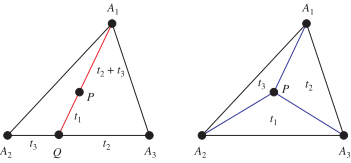
To find the barycentric coordinates for an arbitrary point  , find
  and
and  from the point
  at the intersection of the line
  with the side
  , and then determine
  as the mass at
  that will balance a mass
  at
at  , thus making
  the centroid (left figure). Furthermore, the areas of the
triangles
the centroid (left figure). Furthermore, the areas of the
triangles  ,
,
 ,
and
,
and  are proportional to the barycentric coordinates
  ,
,  , and
, and  of
of  (right figure; Coxeter 1969, p. 217).
Barycentric coordinates are homogeneous, so
 |
(1) |
for  .
.
Barycentric coordinates normalized so that they become the actual areas of the subtriangles are called homogeneous barycentric coordinates. Barycentric coordinates normalized so that
 |
(2) |
so that the coordinates give the areas of the subtriangles normalized by the area of the original triangle are called areal coordinates (Coxeter 1969, p. 218). Barycentric and areal coordinates can provide particularly elegant proofs of geometric theorems such as Routh's theorem, Ceva's theorem, and Menelaus' theorem (Coxeter 1969, pp. 219-221).
(Not necessarily homogeneous) barycentric coordinates for a number of common centers are summarized in the following table. In the table,  ,
,  , and
, and  are the side lengths of the triangle and
  is its semiperimeter.
In barycentric coordinates, a line has a linear homogeneous equation. In particular, the line joining points  and
and  has equation
 |
(3) |
(Loney 1962, pp. 39 and 57; Coxeter 1969, p. 219; Bottema 1982). If the vertices  of a triangle
  have barycentric coordinates
  , then the area of the triangle is
 |
(4) |
(Bottema 1982, Yiu 2000).
See also
Areal Coordinates, Exact Trilinear Coordinates, Homogeneous Barycentric Coordinates, Trilinear Coordinates
Explore with Wolfram|Alpha
References
Bogomolny, A. "Barycentric Coordinates." http://www.cut-the-knot.org/triangle/barycenter.shtml.Bottema, O. "On the Area of a Triangle in Barycentric Coordinates." Crux. Math. 8, 228-231, 1982.Coxeter, H. S. M. "Barycentric Coordinates." §13.7 in Introduction to Geometry, 2nd ed. New York: Wiley, pp. 216-221, 1969.Fauvel, J.; Flood, R.; and Wilson, R. J. (Eds.). Möbius and his Band: Mathematics and Astronomy in Nineteenth-Century Germany. Oxford, England: Oxford University Press, 1993.Joy, K. "Barycentric Coordinates." 1996. http://graphics.idav.ucdavis.edu/education/GraphicsNotes/Barycentric-Coordinates/Barycentric-Coordinates.html.Loney, S. L. The Elements of Coordinate Geometry, 2 vols. in 1. Part II: Trilinear Coordinates. London: Macmillan, 1962.Sommerville, D. M. Y. Analytical Conics, 3rd ed. London: G. Bell and Sons, 1961.Yiu, P. "The Uses of Homogeneous Barycentric Coordinates in Plane Euclidean Geometry." Internat. J. Math. Ed. Sci. Tech. 31, 569-578, 2000. http://www.math.fau.edu/yiu/barycentric.pdf.
Referenced on Wolfram|Alpha
Cite this as:
Weisstein, Eric W. "Barycentric Coordinates." From MathWorld--A Wolfram Resource. https://mathworld.wolfram.com/BarycentricCoordinates.html