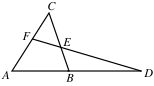
 |
(1) |
For spherical triangles,
 |
(2) |
This can be generalized to  -gons
-gons ![P=[V_1,...,V_n]](https://txtdot.deep-swarm.xyz/proxy/img?url=https%3A%2F%2Fmathworld.wolfram.com%2Fimages%2Fequations%2FMenelausTheorem%2FInline2.svg) , where a transversal cuts the side
, where a transversal cuts the side  in
in  for
for  , ...,
  , by
, by
![product_(i=1)^n[(V_iW_i)/(W_iV_(i+1))]=(-1)^n.](https://txtdot.deep-swarm.xyz/proxy/img?url=https%3A%2F%2Fmathworld.wolfram.com%2Fimages%2Fequations%2FMenelausTheorem%2FNumberedEquation3.svg) |
(3) |
Here,  and
and
![[(AB)/(CD)]](https://txtdot.deep-swarm.xyz/proxy/img?url=https%3A%2F%2Fmathworld.wolfram.com%2Fimages%2Fequations%2FMenelausTheorem%2FNumberedEquation4.svg) |
(4) |
is the ratio of the lengths ![[A,B]](https://txtdot.deep-swarm.xyz/proxy/img?url=https%3A%2F%2Fmathworld.wolfram.com%2Fimages%2Fequations%2FMenelausTheorem%2FInline8.svg) and
and ![[C,D]](https://txtdot.deep-swarm.xyz/proxy/img?url=https%3A%2F%2Fmathworld.wolfram.com%2Fimages%2Fequations%2FMenelausTheorem%2FInline9.svg) with a plus or minus
sign depending if these segments have the same or opposite directions (Grünbaum
and Shepard 1995). The case
with a plus or minus
sign depending if these segments have the same or opposite directions (Grünbaum
and Shepard 1995). The case  is Pasch's axiom.
See also
Ceva's Theorem, Hoehn's Theorem, Pasch's Axiom
Explore with Wolfram|Alpha
References
Beyer, W. H. (Ed.). CRC Standard Mathematical Tables, 28th ed. Boca Raton, FL: CRC Press, p. 122, 1987.Coxeter, H. S. M. and Greitzer, S. L. "Menelaus's Theorem." §3.4 in Geometry Revisited. Washington, DC: Math. Assoc. Amer., pp. 66-67, 1967.Durell, C. V. Modern Geometry: The Straight Line and Circle. London: Macmillan, pp. 42-44, 1928.Graustein, W. C. Introduction to Higher Geometry. New York: Macmillan, p. 81, 1930.Grünbaum, B. and Shepard, G. C. "Ceva, Menelaus, and the Area Principle." Math. Mag. 68, 254-268, 1995.Honsberger, R. "The Theorem of Menelaus." Ch. 13 in Episodes in Nineteenth and Twentieth Century Euclidean Geometry. Washington, DC: Math. Assoc. Amer., pp. 147-154, 1995.Pedoe, D. Circles: A Mathematical View, rev. ed. Washington, DC: Math. Assoc. Amer., p. xxi, 1995.Wells, D. The Penguin Dictionary of Curious and Interesting Geometry. London: Penguin, p. 150, 1991.
Referenced on Wolfram|Alpha
Cite this as:
Weisstein, Eric W. "Menelaus' Theorem." From MathWorld--A Wolfram Resource. https://mathworld.wolfram.com/MenelausTheorem.html