A contravariant tensor is a tensor having specific transformation properties (cf., a covariant tensor). To examine the transformation properties of a contravariant tensor, first consider a tensor of rank 1 (a vector)
 |
(1) |
for which
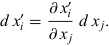 |
(2) |
Now let  ,
then any set of quantities
,
then any set of quantities  which transform according to
 |
(3) |
or, defining
 |
(4) |
according to
 |
(5) |
is a contravariant tensor. Contravariant tensors are indicated with raised indices, i.e.,  .
.
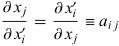
Covariant tensors are a type of tensor with differing transformation properties, denoted  . However, in three-dimensional Euclidean
space,
. However, in three-dimensional Euclidean
space,
 |
(6) |
for  ,
2, 3, meaning that contravariant and covariant tensors are equivalent. Such tensors
are known as Cartesian tensor. The two types
of tensors do differ in higher dimensions, however.
,
2, 3, meaning that contravariant and covariant tensors are equivalent. Such tensors
are known as Cartesian tensor. The two types
of tensors do differ in higher dimensions, however.
Contravariant four-vectors satisfy
 |
(7) |
where  is a Lorentz tensor.
To turn a covariant tensor  into a contravariant tensor
  (index raising), use the
metric tensor
(index raising), use the
metric tensor  to write
 |
(8) |
Covariant and contravariant indices can be used simultaneously in a mixed tensor.
See also
Cartesian Tensor, Contravariant Vector, Covariant Tensor, Four-Vector, Index Raising, Lorentz Tensor, Metric Tensor, Mixed Tensor, Tensor
Explore with Wolfram|Alpha
References
Arfken, G. "Noncartesian Tensors, Covariant Differentiation." §3.8 in Mathematical Methods for Physicists, 3rd ed. Orlando, FL: Academic Press, pp. 158-164, 1985.Morse, P. M. and Feshbach, H. Methods of Theoretical Physics, Part I. New York: McGraw-Hill, pp. 44-46, 1953.Weinberg, S. Gravitation and Cosmology: Principles and Applications of the General Theory of Relativity. New York: Wiley, 1972.
Referenced on Wolfram|Alpha
Cite this as:
Weisstein, Eric W. "Contravariant Tensor." From MathWorld--A Wolfram Resource. https://mathworld.wolfram.com/ContravariantTensor.html