
The cubical graph is the Platonic graph corresponding to the connectivity of the cube. It is isomorphic to the
generalized Petersen graph  , bipartite Kneser
graph
, bipartite Kneser
graph  ,
4-crossed prism graph, crown
graph
,
4-crossed prism graph, crown
graph  ,
grid graph
,
grid graph  , hypercube graph
  , and prism
graph
, and prism
graph  .
It is illustrated above in a number of embeddings (e.g., Knuth 2008, p. 14).
.
It is illustrated above in a number of embeddings (e.g., Knuth 2008, p. 14).
It has 12 distinct (directed) Hamiltonian cycles, corresponding to the unique order-4 LCF notation ![[3,-3]^4](https://txtdot.deep-swarm.xyz/proxy/img?url=https%3A%2F%2Fmathworld.wolfram.com%2Fimages%2Fequations%2FCubicalGraph%2FInline7.svg) .
.
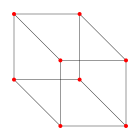
It is a unit-distance graph, as shown above in a unit-distance embedding (Harborth and Möller 1994).
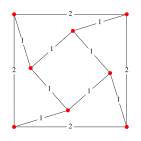
The minimal planar integral embeddings of the cubical graph, illustrated above, has maximum edge length of 2 (Harborth et al. 1987). They are also graceful (Gardner 1983, pp. 158 and 163-164).
 can be constructed as the graph
expansion of
can be constructed as the graph
expansion of  with steps 1 and 1, where
  is a path graph. Excising
an edge of the cubical graph gives the prism graph
is a path graph. Excising
an edge of the cubical graph gives the prism graph  .
.
The cubical graph has 8 nodes, 12 edges, vertex connectivity 3, edge connectivity 3, graph diameter 3, graph radius 3, and girth 4. The cubical graph is implemented in the Wolfram Language as GraphData["CubicalGraph"].
It is a distance-regular graph with intersection array  , and therefore also a Taylor
graph.
, and therefore also a Taylor
graph.
The graph square of the cubical graph is the skeleton of the 16-cell.
Its line graph is the cuboctahedral graph.
The maximum number of nodes in a cubical graph that induce a cycle is six (Danzer and Klee 1967; Skiena 1990, p. 149).
A certain construction involving the cubical graph gives an infinite number of connected vertex-transitive graphs that have no Hamilton decomposition (Bryant and Dean 2014).

The plots above show the adjacency, incidence, and graph distance matrices for the cubical graph.
The following table summarizes some properties of the cubical graph.
See also
Bidiakis Cube, Bislit Cube, Cube, Distance-Regular Graph, Dodecahedral Graph, Folded Cube Graph, Halved Cube Graph, Hypercube Graph, Icosahedral Graph, Integral Graph, Octahedral Graph, Platonic Graph, Tesseract Graph, Tetrahedral Graph
Explore with Wolfram|Alpha
References
Bondy, J. A. and Murty, U. S. R. Graph Theory with Applications. New York: North Holland, p. 234, 1976.Bryant, D. and Dean, M. "Vertex-Transitive Graphs that have no Hamilton Decomposition." 25 Aug 2014. http://arxiv.org/abs/1408.5211.Danzer, L. and Klee, V. "Lengths of Snakes in Boxes." J. Combin. Th. 2, 258-265, 1967.Gardner, M. "Golomb's Graceful Graphs." Ch. 15 in Wheels, Life, and Other Mathematical Amusements. New York: W. H. Freeman, pp. 152-165, 1983.Harborth, H. and Möller, M. "Minimum Integral Drawings of the Platonic Graphs." Math. Mag. 67, 355-358, 1994.Harborth, H.; Kemnitz, A.; Möller, M.; and Süssenbach, A. "Ganzzahlige planare Darstellungen der platonischen Körper." Elem. Math. 42, 118-122, 1987.Knuth, D. E. The Art of Computer Programming, Volume 4, Fascicle 0: Introduction to Combinatorial Functions and Boolean Functions.. Upper Saddle River, NJ: Addison-Wesley, p. 14, 2008.Read, R. C. and Wilson, R. J. An Atlas of Graphs. Oxford, England: Oxford University Press, p. 266, 1998.Royle, G. "F008A." http://www.csse.uwa.edu.au/~gordon/foster/F008A.html.Skiena, S. Implementing Discrete Mathematics: Combinatorics and Graph Theory with Mathematica. Reading, MA: Addison-Wesley, 1990.Wolfram, S. A New Kind of Science. Champaign, IL: Wolfram Media, p. 1032, 2002.
Referenced on Wolfram|Alpha
Cite this as:
Weisstein, Eric W. "Cubical Graph." From MathWorld--A Wolfram Resource. https://mathworld.wolfram.com/CubicalGraph.html