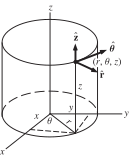
Cylindrical coordinates are a generalization of two-dimensional polar coordinates to three dimensions by superposing a height ( ) axis. Unfortunately, there are a number of different notations
used for the other two coordinates. Either
) axis. Unfortunately, there are a number of different notations
used for the other two coordinates. Either  or
or  is used to refer to the radial coordinate and either
  or
or  to the azimuthal coordinates. Arfken (1985), for instance, uses
  , while Beyer (1987) uses
  . In this work, the notation
  is used.
The following table summarizes notational conventions used by a number of authors.
In terms of the Cartesian coordinates  ,
,
where  ,
,
 ,
,
 ,
and the inverse tangent must be suitably defined
to take the correct quadrant of
,
and the inverse tangent must be suitably defined
to take the correct quadrant of  into account.
In terms of  ,
,
 ,
and
,
and 
Note that Morse and Feshbach (1953) define the cylindrical coordinates by
where  and
and  .
.
The metric elements of the cylindrical coordinates are
so the scale factors are
The line element is
 |
(16) |
and the volume element is
 |
(17) |
The Jacobian is
 |
(18) |
A Cartesian vector is given in cylindrical coordinates by
![r=[rcostheta; rsintheta; z].](https://txtdot.deep-swarm.xyz/proxy/img?url=https%3A%2F%2Fmathworld.wolfram.com%2Fimages%2Fequations%2FCylindricalCoordinates%2FNumberedEquation4.svg) |
(19) |
To find the unit vectors,
Derivatives of unit vectors with respect to the coordinates are
The gradient operator in cylindrical coordinates is given by
 |
(32) |
so the gradient components become
The Christoffel symbols of the second kind in the definition of Misner et al. (1973, p. 209) are given by
The Christoffel symbols of the second kind in the definition of Arfken (1985) are given by
(Walton 1967; Arfken 1985, p. 164, Ex. 3.8.10; Moon and Spencer 1988, p. 12a).
The covariant derivatives are then given by
 |
(48) |
are
Cross products of the coordinate axes are
The commutation coefficients are given by
![c_(alphabeta)^mue^->_mu=[e^->_alpha,e^->_beta]=del _alphae^->_beta-del _betae^->_alpha,](https://txtdot.deep-swarm.xyz/proxy/img?url=https%3A%2F%2Fmathworld.wolfram.com%2Fimages%2Fequations%2FCylindricalCoordinates%2FNumberedEquation7.svg) |
(61) |
But
![[r^^,r^^]=[theta^^,theta^^]=[phi^^,phi^^]=0,](https://txtdot.deep-swarm.xyz/proxy/img?url=https%3A%2F%2Fmathworld.wolfram.com%2Fimages%2Fequations%2FCylindricalCoordinates%2FNumberedEquation8.svg) |
(62) |
so  ,
where
,
where  .
Also
.
Also
![[r^^,theta^^]=-[theta^^,r^^]=del _rtheta^^-del _thetar^^=0-1/rtheta^^=-1/rtheta^^,](https://txtdot.deep-swarm.xyz/proxy/img?url=https%3A%2F%2Fmathworld.wolfram.com%2Fimages%2Fequations%2FCylindricalCoordinates%2FNumberedEquation9.svg) |
(63) |
so 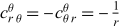 ,
,
 .
Finally,
.
Finally,
![[r^^,phi^^]=[theta^^,phi^^]=0.](https://txtdot.deep-swarm.xyz/proxy/img?url=https%3A%2F%2Fmathworld.wolfram.com%2Fimages%2Fequations%2FCylindricalCoordinates%2FNumberedEquation10.svg) |
(64) |
Summarizing,
Time derivatives of the vector are
Speed is given by
Time derivatives of the unit vectors are
The convective derivative is
To rewrite this, use the identity
 |
(83) |
and set  ,
to obtain
,
to obtain
 |
(84) |
so
 |
(85) |
Then
The curl in the above expression gives
so
We expect the gradient term to vanish since speed does not depend on position. Check this using the identity  ,
,
Examining this term by term,
so, as expected,
 |
(108) |
We have already computed  , so combining all three pieces gives
The divergence is
or, in vector notation
 |
(116) |
The curl is
The scalar Laplacian is
The vector Laplacian is
![del ^2v=[(partial^2v_r)/(partialr^2)+1/(r^2)(partial^2v_r)/(partialtheta^2)+(partial^2v_r)/(partialz^2)+1/r(partialv_r)/(partialr)-2/(r^2)(partialv_theta)/(partialtheta)-(v_r)/(r^2); (partial^2v_theta)/(partialr^2)+1/(r^2)(partial^2v_theta)/(partialtheta^2)+(partial^2v_theta)/(partialz^2)+1/r(partialv_theta)/(partialr)+2/(r^2)(partialv_r)/(partialtheta)-(v_theta)/(r^2); (partial^2v_z)/(partialr^2)+1/(r^2)(partial^2v_z)/(partialtheta^2)+(partial^2v_z)/(partialz^2)+1/r(partialv_z)/(partialr)].](https://txtdot.deep-swarm.xyz/proxy/img?url=https%3A%2F%2Fmathworld.wolfram.com%2Fimages%2Fequations%2FCylindricalCoordinates%2FNumberedEquation16.svg) |
(120) |
The Helmholtz differential equation is separable in cylindrical coordinates and has Stäckel
determinant  (for
(for  ,
,  ,
,  ) or
) or 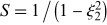 (for Morse and Feshbach's
  ,
,  , and
, and  ).
).
See also
Cartesian Coordinates, Elliptic Cylindrical Coordinates, Helmholtz Differential Equation--Circular Cylindrical Coordinates, Polar Coordinates, Spherical Coordinates
Explore with Wolfram|Alpha
References
Arfken, G. "Circular Cylindrical Coordinates." §2.4 in Mathematical
Methods for Physicists, 3rd ed. Orlando, FL: Academic Press, pp. 95-101,
1985.Beyer, W. H. CRC
Standard Mathematical Tables, 28th ed. Boca Raton, FL: CRC Press, 1987.Korn,
G. A. and Korn, T. M. Mathematical
Handbook for Scientists and Engineers. New York: McGraw-Hill, 1968.Misner,
C. W.; Thorne, K. S.; and Wheeler, J. A. Gravitation.
San Francisco: W. H. Freeman, 1973.Moon, P. and Spencer, D. E.
"Circular-Cylinder Coordinates  ." Table 1.02 in Field
Theory Handbook, Including Coordinate Systems, Differential Equations, and Their
Solutions, 2nd ed. New York: Springer-Verlag, pp. 12-17, 1988.Morse,
P. M. and Feshbach, H. Methods
of Theoretical Physics, Part I. New York: McGraw-Hill, p. 657, 1953.Walton,
J. J. "Tensor Calculations on Computer: Appendix." Comm. ACM 10,
183-186, 1967.
." Table 1.02 in Field
Theory Handbook, Including Coordinate Systems, Differential Equations, and Their
Solutions, 2nd ed. New York: Springer-Verlag, pp. 12-17, 1988.Morse,
P. M. and Feshbach, H. Methods
of Theoretical Physics, Part I. New York: McGraw-Hill, p. 657, 1953.Walton,
J. J. "Tensor Calculations on Computer: Appendix." Comm. ACM 10,
183-186, 1967.
Referenced on Wolfram|Alpha
Cite this as:
Weisstein, Eric W. "Cylindrical Coordinates." From MathWorld--A Wolfram Resource. https://mathworld.wolfram.com/CylindricalCoordinates.html