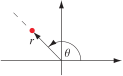
The polar coordinates  (the radial coordinate) and
  (the angular coordinate, often called the polar
angle) are defined in terms of Cartesian
coordinates by
(the angular coordinate, often called the polar
angle) are defined in terms of Cartesian
coordinates by
where  is the radial distance from the origin, and
  is the counterclockwise angle from the x-axis.
In terms of
is the counterclockwise angle from the x-axis.
In terms of  and
and  ,
,
(Here,  should be interpreted as the two-argument inverse
tangent which takes the signs of
should be interpreted as the two-argument inverse
tangent which takes the signs of  and
and  into account to determine in which quadrant
  lies.) It follows immediately that
polar coordinates aren't inherently unique; in particular,
lies.) It follows immediately that
polar coordinates aren't inherently unique; in particular,  will be precisely the same polar point as
  for any integer
  . What's more, one often allows negative values of
  under the assumption that
  is plotted identically to
  .
.

The expression of a point as an ordered pair  is known as polar notation, the equation of a curve
expressed in polar coordinates is known as a polar
equation, and a plot of a curve in polar coordinates is known as a polar
plot.
is known as polar notation, the equation of a curve
expressed in polar coordinates is known as a polar
equation, and a plot of a curve in polar coordinates is known as a polar
plot.
In much the same way that Cartesian curves can be plotted on rectilinear axes, polar plots can be drawn on radial axes such as those shown in the figure above.
The arc length of a polar curve given by  is
is
 |
(5) |
The line element is given by
 |
(6) |
and the area element by
 |
(7) |
The area enclosed by a polar curve  is
is
 |
(8) |
The slope of a polar function  at the point
  is given by
 |
(9) |
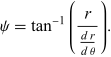
The angle between the tangent and radial line at the point  is
is
 |
(10) |
A polar curve is symmetric about the x-axis if replacing  by
by  in its equation produces an equivalent equation, symmetric about the y-axis
if replacing
in its equation produces an equivalent equation, symmetric about the y-axis
if replacing  by
by  in its equation produces an equivalent equation, and symmetric about the origin if
replacing
in its equation produces an equivalent equation, and symmetric about the origin if
replacing  by
by  in its equation produces an equivalent equation.
In Cartesian coordinates, the radius vector  is
is
 |
(11) |
giving derivative
 |
(12) |
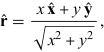
Its unit vector is
 |
(13) |
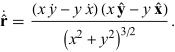
giving derivative
 |
(14) |
In polar coordinates, the radius vector is given by
![r=[rcostheta; rsintheta],](https://txtdot.deep-swarm.xyz/proxy/img?url=https%3A%2F%2Fmathworld.wolfram.com%2Fimages%2Fequations%2FPolarCoordinates%2FNumberedEquation11.svg) |
(15) |
giving derivatives
The unit vectors are
giving derivatives
By way of the Euler formula, the graphical representation of a complex number  in terms of its complex
modulus
in terms of its complex
modulus  and its complex argument
  is closely related to polar coordinates. Indeed, the Argand diagram of such a
  is easily seen to be analogous to the usual polar
plot.
is easily seen to be analogous to the usual polar
plot.
See also
Argand Diagram, Cardioid, Circle, Cissoid, Conchoid, Complex Argument, Complex Modulus, Complex Number, Curvilinear Coordinates, Cylindrical Coordinates, Euler Formula, Lemniscate, Limaçon, Logarithmic Spiral, Polar Angle, Polar Curve, Polar Plot, Polar Vector, Rose Curve Explore this topic in the MathWorld classroom
Portions of this entry contributed by Christopher Stover
Explore with Wolfram|Alpha
Cite this as:
Stover, Christopher and Weisstein, Eric W. "Polar Coordinates." From MathWorld--A Wolfram Resource. https://mathworld.wolfram.com/PolarCoordinates.html