The divergence theorem, more commonly known especially in older literature as Gauss's theorem (e.g., Arfken 1985) and also known as the Gauss-Ostrogradsky theorem, is
a theorem in vector calculus that can be stated as follows. Let  be a region in space with boundary
  . Then the volume integral
of the divergence
. Then the volume integral
of the divergence  of
of  over
over  and the surface integral
of
and the surface integral
of  over the boundary
  of
of  are related by
 |
(1) |
The divergence theorem is a mathematical statement of the physical fact that, in the absence of the creation or destruction of matter, the density within a region of space can change only by having it flow into or away from the region through its boundary.
A special case of the divergence theorem follows by specializing to the plane. Letting  be a region in the plane with boundary
  , equation (1) then collapses to
 |
(2) |
If the vector field  satisfies certain constraints, simplified forms can be used.
For example, if
satisfies certain constraints, simplified forms can be used.
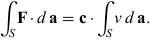
For example, if  where
where  is a constant vector
  , then
 |
(3) |
But
 |
(4) |
so
and
 |
(7) |
But  ,
and
,
and  must vary with
  so that
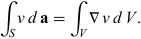
  cannot always equal zero. Therefore,
 |
(8) |
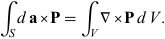
Similarly, if  ,
where
,
where  is a constant vector
  , then
 |
(9) |
See also
Curl Theorem, Divergence, Gradient, Green's Theorem
Explore with Wolfram|Alpha
References
Arfken, G. "Gauss's Theorem." §1.11 in Mathematical Methods for Physicists, 3rd ed. Orlando, FL: Academic Press, pp. 57-61, 1985.Morse, P. M. and Feshbach, H. "Gauss's Theorem." In Methods of Theoretical Physics, Part I. New York: McGraw-Hill, pp. 37-38, 1953.
Referenced on Wolfram|Alpha
Cite this as:
Weisstein, Eric W. "Divergence Theorem." From MathWorld--A Wolfram Resource. https://mathworld.wolfram.com/DivergenceTheorem.html