Green's theorem is a vector identity which is equivalent to the curl theorem in the plane. Over a region  in the plane with boundary
  , Green's theorem states
 |
(1) |
where the left side is a line integral and the right side is a surface integral. This can also be written compactly in vector form as
 |
(2) |
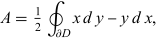
If the region  is on the left when traveling around
  , then area of
  can be computed using the elegant formula
 |
(3) |
giving a surprising connection between the area of a region and the line integral around its boundary. For a plane curve specified parametrically as  for
for ![t in [t_0,t_1]](https://txtdot.deep-swarm.xyz/proxy/img?url=https%3A%2F%2Fmathworld.wolfram.com%2Fimages%2Fequations%2FGreensTheorem%2FInline7.svg) , equation (3) becomes
, equation (3) becomes
 |
(4) |
which gives the signed area enclosed by the curve.
The symmetric form above corresponds to Green's theorem with  and
and  , leading to
However, we are also free to choose other values of  and
and  , including
  and
and  , giving the "simpler" form
 |
(10) |
and  and
and  ,
giving
,
giving
 |
(11) |
A similar procedure can be applied to compute the moment about the  -axis using
  and
and  as
as
 |
(12) |
and about the  -axis
using
-axis
using  and
and  as
as
 |
(13) |
where the geometric centroid  is given by
  and
and  .
.
Finally, the area moments of inertia can be computed using  and
and  as
as
 |
(14) |
using  and
and  as
as
 |
(15) |
and using  and
and  as
as
 |
(16) |
See also
Area, Area Moment of Inertia, Curl Theorem, Divergence Theorem, Geometric Centroid, Multivariable Calculus, Stokes' Theorem
Explore with Wolfram|Alpha
References
Arfken, G. "Gauss's Theorem." §1.11 in Mathematical Methods for Physicists, 3rd ed. Orlando, FL: Academic Press, pp. 57-61, 1985.Kaplan, W. "Green's Theorem." §5.5 in Advanced Calculus, 4th ed. Reading, MA: Addison-Wesley, pp. 286-291, 1991.
Referenced on Wolfram|Alpha
Cite this as:
Weisstein, Eric W. "Green's Theorem." From MathWorld--A Wolfram Resource. https://mathworld.wolfram.com/GreensTheorem.html