Given a formula  with an absolute error
in
with an absolute error
in  of
of  ,
the absolute error is
,
the absolute error is  . The relative error is
 . If
. If  , then
 |
(1) |
where  denotes the mean, so the sample
variance is given by
denotes the mean, so the sample
variance is given by
The definitions of variance and covariance then give
(where  ),
so
),
so
 |
(7) |
If  and
and  are uncorrelated, then
  so
so
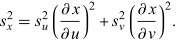 |
(8) |
Now consider addition of quantities with errors. For  ,
,  and
and  , so
, so
 |
(9) |
For division of quantities with  ,
,  and
and  , so
, so
 |
(10) |
Dividing through by  and rearranging then gives
 |
(11) |
For exponentiation of quantities with
 |
(12) |
and
 |
(13) |
so
 |
(14) |
 |
(15) |
If  ,
then
,
then
 |
(16) |
For logarithms of quantities with  ,
,  , so
, so
 |
(17) |
 |
(18) |
For multiplication with  ,
,  and
and  , so
, so
 |
(19) |
For powers, with  ,
,  , so
, so
 |
(22) |
 |
(23) |
See also
Absolute Error, Accuracy, Covariance, Percentage Error, Precision, Relative Error, Significant Digits, Variance
Explore with Wolfram|Alpha
References
Abramowitz, M. and Stegun, I. A. (Eds.). Handbook of Mathematical Functions with Formulas, Graphs, and Mathematical Tables, 9th printing. New York: Dover, p. 14, 1972.Bevington, P. R. Data Reduction and Error Analysis for the Physical Sciences. New York: McGraw-Hill, pp. 58-64, 1969.
Referenced on Wolfram|Alpha
Cite this as:
Weisstein, Eric W. "Error Propagation." From MathWorld--A Wolfram Resource. https://mathworld.wolfram.com/ErrorPropagation.html