An  -algebraic
number is a number
-algebraic
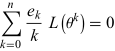
number is a number  which satisfies
 |
(1) |
where  is the Rogers L-function and
  are integers not all equal to 0 (Gordon and Mcintosh 1997).
Loxton (1991, p. 289) gives a slew of similar identities having rational coefficients
are integers not all equal to 0 (Gordon and Mcintosh 1997).
Loxton (1991, p. 289) gives a slew of similar identities having rational coefficients
 |
(2) |
instead of integers.
The only known  -algebraic
numbers of order 1 are
-algebraic
numbers of order 1 are
(Loxton 1991, pp. 287 and 289; Bytsko 1999), where 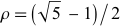 .
.
The only known rational  -algebraic numbers are 1/2 and 1/3:
 |
(8) |
 |
(9) |
(Lewin 1982, pp. 317-318; Gordon and McIntosh 1997).
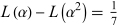
There are a number of known quadratic  -algebraic numbers. Watson (1937) found
 |
(10) |
 |
(11) |
 |
(12) |
where  ,
,
 ,
and
,
and  are the roots of
 |
(13) |
so that
(Loxton 1991, pp. 287-288). These are known as Watson's identities.
Higher-order algebraic identities include
 |
(17) |
 |
(18) |
 |
(19) |
 |
(20) |
 |
(21) |
 |
(22) |
 |
(23) |
 |
(24) |
 |
(25) |
where
(Gordon and McIntosh 1997).
See also
Dilogarithm, Rogers L-Function, Watson's Identities
Explore with Wolfram|Alpha
References
Bytsko, A. G. "Two-Term Dilogarithm Identities Related to Conformal Field Theory." 9 Nov 1999. http://arxiv.org/abs/math-ph/9911012.Gordon, B. and McIntosh, R. J. "Algebraic Dilogarithm Identities." Ramanujan J. 1, 431-448, 1997.Lewin, L. "The Dilogarithm in Algebraic Fields." J. Austral. Math. Soc. Ser. A 33, 302-330, 1982.Lewin, L. (Ed.). Structural Properties of Polylogarithms. Providence, RI: Amer. Math. Soc., 1991.Loxton, J. H. "Special Values of the Dilogarithm Function." Acta Arith. 43, 155-166, 1984.Loxton, J. H. "Partition Identities and the Dilogarithm." Ch. 13 in Structural Properties of Polylogarithms (Ed. L. Lewin). Providence, RI: Amer. Math. Soc., pp. 287-299, 1991.Watson, G. N. "A Note on Spence's Logarithmic Transcendent." Quart. J. Math. Oxford Ser. 8, 39-42, 1937.
Referenced on Wolfram|Alpha
Cite this as:
Weisstein, Eric W. "L-Algebraic Number." From MathWorld--A Wolfram Resource. https://mathworld.wolfram.com/L-AlgebraicNumber.html